



Yohei Kono, Japanese conservative elder who urged apology to Korea, dies
Jun 11, 2026, 01:32 pm


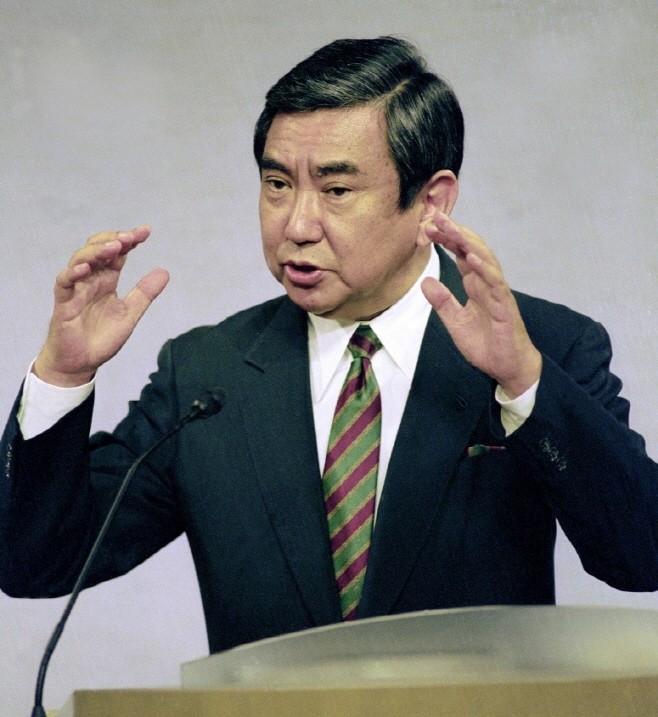 |
| Yohei Kono announcing the 1993 Kono Statement. / Yonhap News Agency. |
Yohei Kono, former Speaker of Japan’s House of Representatives and the politician behind the landmark “Kono Statement” apologizing for the issue of wartime military comfort women, has passed away at the age of 89. Japanese media reported on June 10 that Kono died on June 8. He was a veteran conservative politician who served as Speaker of the House, president of the Liberal Democratic Party (LDP), foreign minister, chief cabinet secretary, and deputy prime minister. For Koreans, he is most remembered as the chief cabinet secretary in Prime Minister Kiichi Miyazawa’s administration who issued the August 4, 1993 statement of apology and remorse.
The Kono Statement acknowledged that the comfort women system was conducted under military involvement and inflicted deep wounds on the honor and dignity of many women. In the statement, Kono declared, “We express our sincere apologies and remorse,” representing the Japanese government’s position. The statement has since become a benchmark for assessing Japan’s historical awareness in Korea–Japan relations.
Kono’s significance for Korea goes beyond issuing a single statement. Within postwar Japanese conservative politics, he was relatively rare in emphasizing the constitution, pacifism, and dialogue with neighboring countries. The Asahi Shimbun described him as a politician who upheld values such as dovishness, constitutionalism, liberalism, and neighborly diplomacy with China and Korea—values increasingly absent in today’s Japanese politics.
His political career traversed both mainstream and non‑mainstream conservative politics. Born the son of former agriculture minister Ichiro Kono, he graduated from Waseda University and was first elected to the House of Representatives in 1967. He went on to win 14 consecutive elections, remaining at the center of Japanese politics for decades.
In 1976, he left the LDP criticizing corruption in the Lockheed scandal
In 1976, Kono left the LDP, criticizing the party’s corruption exposed in the Lockheed scandal, and formed the New Liberal Club. At the time, it was shocking for a conservative politician to openly denounce the long‑ruling LDP’s corruption and leave the party. In 1983, the New Liberal Club entered a coalition with the LDP, and in 1985 Kono joined the Nakasone cabinet as minister of science and technology, his first cabinet post. The New Liberal Club later dissolved, and he returned to the LDP.
In 1993, just before the LDP lost power for the first time, Kono became party president, though he never rose to prime minister, leaving the record as “the first LDP president who did not become prime minister.” In 1994, under the Murayama coalition government of the LDP, Social Democratic Party, and Sakigake, he served as deputy prime minister and foreign minister.
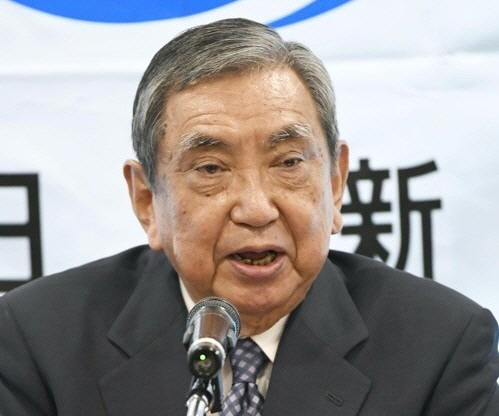 |
| Yohei Kono in 2018. / Yonhap News Agency. |
Yohei Kono, who was often seen as more influential as a parliamentarian than as a government official, served as Speaker of Japan’s House of Representatives from 2003 for 2,029 days, one of the longest tenures in Japanese constitutional history. He was regarded as a politician who valued balance in parliamentary management beyond factional lines.
His historical views often drew criticism from Japan’s conservative circles. Right‑wing groups argued that the Kono Statement spread misunderstandings about the coercive nature of the comfort women system. However, in Korea the statement remains significant as an official document in which the Japanese government acknowledged the involvement of the military, the harm done to victims’ dignity, and expressed apology and remorse.
After retiring from politics, Kono devoted himself to improving Japan–China relations. He served as chairman of the Japan Association for the Promotion of International Trade, continuing economic exchanges with China. According to the Mainichi Shimbun, Kono had planned to lead a delegation to China later this month and was arranging meetings with Chinese officials. During his visit to Beijing in June last year, he met with Chinese Premier Li Qiang.
His planned visit was particularly noted because, following Prime Minister Sanae Takaiichi’s remarks on a Taiwan contingency last November, official visits to China by Japanese business groups had ceased. Kono’s trip was seen as a potential breakthrough in strained bilateral relations. China’s state‑run Xinhua News Agency also reported his death, highlighting the Kono Statement and describing him as a figure who expressed apology and remorse over the comfort women issue.
Kono’s passing also resonates politically in Korea. It marks the end of a generation of conservative Japanese politicians who acknowledged historical issues, emphasized the constitution and pacifism, and placed relations with Korea and China at the center of diplomacy. As Korea–Japan ties move again under the necessity of security and economic cooperation, the legacy of the Kono Statement and his neighborly diplomacy inevitably returns to the spotlight.
Choi Young‑jae
Most Read
-
1
Celltrion’s Omlyclo gains ground in major European..

-
2
Trump demands rates fall below 1% as Fed hikes for..

-
3
Trump makes $1 trillion bet ahead of midterm elect..

-
4
Iran resumes ballistic missile production, assembl..

-
5
Samsung Electronics, Mistral AI to jointly develop..

-
6
Trump warns countries not helping U.S. must pay re..

-
7
Apple launches first foldable, 1 million won prici..

PEOPLE






HEADLINE NEWS
- Trump to roll out ‘unprecedented welcome’ for Xi with B-2 bombers, F-22 fighters
- S. Korea, U.S., and Japan form united front on Taiwan and economic coercion..
- Trump administration moves to impose sweeping sanctions on International Cr..
- Xi to make state visit to U.S. Sept. 23-25, dispelling rumors over his heal..

-
Address : In-Young Bldg., 34, Uisadang-daero 1-gil, Yeongdeungpo-gu, Seoul
Copyright by ASIATODAY CO., LTD. All rights resereved