



Korean researchers uncover how Argonaute proteins form
Jun 11, 2026, 09:52 am


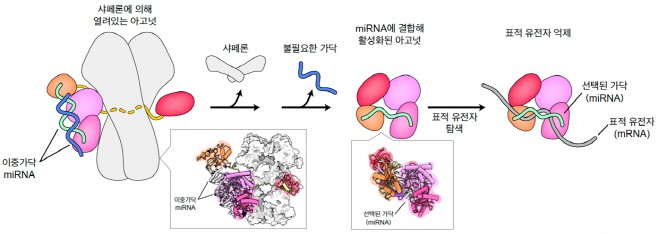 |
| How the “Argonaute” protein acquires the ability to suppress target genes. / Ministry of Science and ICT. |
A domestic research team has achieved results that can reduce trial and error in RNA therapeutic design, with findings published in the international journal Nature.
On June 11, the Ministry of Science and ICT announced that a joint team led by Kim V. Narry, director of the Institute for Basic Science (IBS) RNA Research Center, and Professor Noh Sung‑hoon of Seoul National University’s Department of Biological Sciences, has for the first time in the world identified the activation process of the protein “Argonaute,” which regulates gene expression.
Supported by IBS’s Basic Science Research Program and individual basic research projects, the study revealed the mechanism of “chaperone” proteins that assist Argonaute’s structural formation, and clarified the characteristics of RNA that bind effectively to Argonaute, offering new directions for RNA therapeutic design.
Cells contain microRNAs (miRNAs) that suppress excessive gene expression to maintain balance. For miRNAs to actually inhibit gene expression, they must bind to Argonaute proteins to form a “protein‑RNA complex (RISC).” However, the process by which Argonaute becomes active had remained unknown, limiting RNA drug development.
To directly observe Argonaute’s acquisition of gene‑regulatory activity, the researchers isolated and purified Argonaute‑chaperone complexes for the first time and analyzed their structure at atomic resolution using cryo‑electron microscopy (Cryo‑EM).
They found that chaperones hold Argonaute in a fully open state, creating space for miRNA to bind. Once miRNA enters and binds, the chaperone detaches, and Argonaute completes its closed, functional form capable of regulating genes.
The team reproduced this binding process in vitro, confirming that the completed Argonaute complex precisely cleaved target mRNA.
They also systematically analyzed which RNAs can efficiently load into Argonaute, identifying chemical properties, double‑helix structure, and an optimal length of 20–24 nucleotides as essential. Furthermore, they revealed how chemical modifications in clinically used siRNA therapies affect Argonaute assembly, significantly enhancing design efficiency and applicability.
Kim V. Narry stated, “We have provided molecular and theoretical grounds for RNA therapeutic design, which until now relied on trial and error. This will enable the development of more efficient and safer siRNA drugs in the future.”
Professor Noh added, “The significance lies in directly observing not a completed structure but the process by which a protein acquires function. By elucidating protein assembly principles, we offer a new perspective for understanding biological phenomena.”
Kim Sung‑soo, Director of R&D at the Ministry of Science and ICT, commented, “This achievement is a valuable outcome of basic science research that broadens our understanding of life and treatment. As such foundational knowledge forms the strongest basis for national competitiveness, we will continue to support researchers so they can focus solely on their work.”
Seo Byung‑joo
Most Read
-
1
Alteogen secures European patent for Keytruda SC,..

-
2
Trump shares map on social media labeling Strait o..

-
3
Celltrion seeks rheumatoid arthritis indication ex..

-
4
Kia Sportage outperforms Mazda CX-5 in German auto..

-
5
Chinese e-commerce giants AliExpress, Temu and She..

-
6
China expels No. 2 military official Zhang Youxia..

-
7
Houthi rebels release video claiming downing of Sa..

PEOPLE







-
Address : In-Young Bldg., 34, Uisadang-daero 1-gil, Yeongdeungpo-gu, Seoul
Copyright by ASIATODAY CO., LTD. All rights resereved