



US self‑defense strikes on Iran put 2‑month truce in jeopardy
Jun 11, 2026, 09:16 am


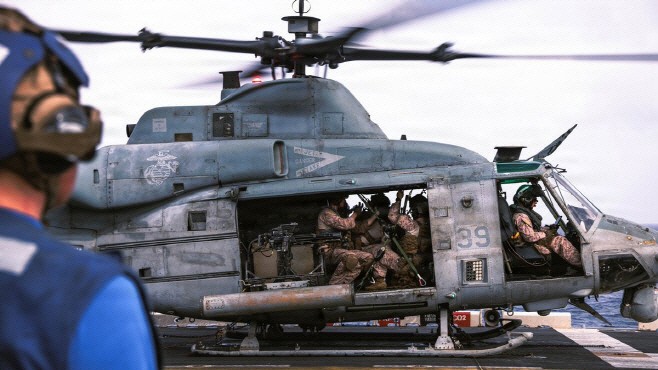 |
| U.S. Marines from the 31st Marine Expeditionary Unit board a UH-1Y Venom helicopter aboard the amphibious assault ship USS Tripoli (LHA-7) during training for aerial target practice and close air support in a regional sea area. / U.S. Central Command (CENTCOM) X account |
On June 10 (local time), the U.S. military resumed attacks against Iran, effectively ending the ceasefire between the United States and Iran that had been in place since April 8, and raising fears of an expanded war.
U.S. Central Command (CENTCOM) announced via X (formerly Twitter) that at 5:15 p.m. Eastern Time (6:15 a.m. KST on June 11), it had begun “self‑defense strikes” against Iran.
Reuters reported that Iranian media outlets carried reports of distant sounds on Kish Island, air defense activity in western Tehran, and explosions in Sirik and Minab.
U.S. President Donald Trump and Secretary of Defense (War Department) Pete Hegseth had publicly signaled additional strikes on Iran’s key facilities earlier that day, while Iran’s Islamic Revolutionary Guard Corps (IRGC) claimed it had retaliated with missiles and drones against U.S.‑related targets in Jordan, Bahrain, and Kuwait.
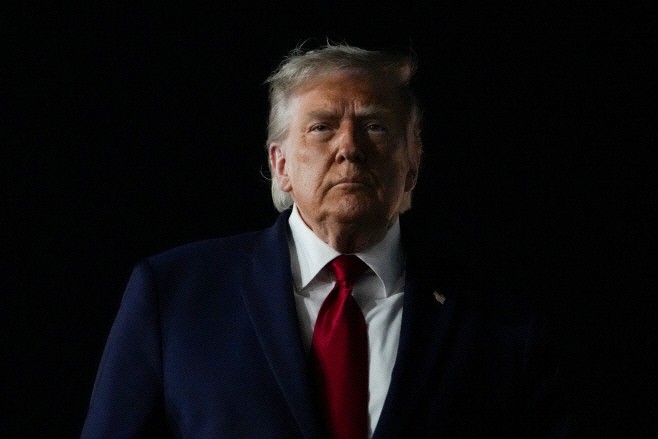 |
| U.S. President Donald Trump prepares to board Air Force One at John F. Kennedy International Airport in New York on the 8th (local time). / Reuters·Yonhap |
US Central Command announces Iran strikes; Iranian media report explosions in Kish, Sirik, Minab
Central Command declared it had begun self‑defense strikes against Iran, while Iran’s Mehr News Agency reported air defense activity detected in western Tehran and explosions heard in Sirik and Minab.
Iran’s semi‑official Tasnim News Agency reported that explosions did not occur directly on Kish Island or Qeshm Island, and that the sounds were related to clashes in the Persian Gulf.
Earlier, Central Command had announced it completed an operation the previous day targeting Iran’s southern air defense network, ground control stations, and surveillance radars.
Trump and Hegseth signal strikes on Iran’s key facilities
President Trump told reporters in the Oval Office: “We are going to attack them, and attack them very strongly. We struck hard yesterday, and today we will strike hard again.”
He also warned on Truth Social: “Iran has dragged out the agreement for too long, and now it will pay the price.”
Meeting reporters at Central Command headquarters at MacDill Air Force Base in Tampa, Secretary of Defense Pete Hegseth said: “Tonight we will strike Iran hard, and we hope Iran makes the right decision. If we have to negotiate with bombs, we will do so, and we are the best in the world.” According to reports by the New York Times and Wall Street Journal, Hegseth added that if further strikes were necessary, they would continue strongly and clearly the following night.
In a Fox News interview, President Trump said he was close to ordering additional strikes on Iranian power plants and bridges. Axios reported that Trump, during a national security team meeting attended by Vice President J.D. Vance, Secretary of State Marco Rubio, CIA Director John Ratcliffe, Joint Chiefs Chairman Dan Kain, and Middle East Envoy Steve Witkoff, discussed additional options including a large‑scale short‑term operation against Iran.
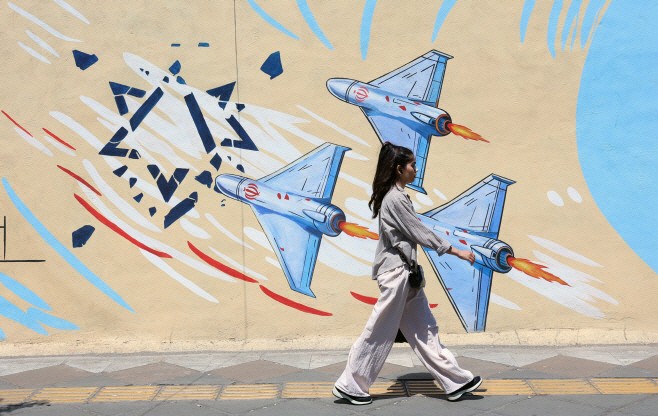 |
| An Iranian girl walks past an anti-Israel mural on a street in Tehran on the 8th (local time). / EPA·Yonhap |
Iran claims retaliation against US targets; Jordan, Bahrain, Kuwait announce interceptions
Iran’s Islamic Revolutionary Guard Corps (IRGC) fired missiles at four sites including an F‑35 fighter jet hangar and U.S. command facilities inside Jordan’s Azraq Air Base, according to Iran’s state broadcaster IRIB. Iran also claimed to have launched drones at Bahrain, home to the largest U.S. naval base in the Middle East, and at Kuwait’s Ali Al Salem Air Base.
Jordan announced it had intercepted five Iranian missiles, while Bahrain and Kuwait each reported intercepting projectiles. Esmail Baghaei, spokesperson for Iran’s Foreign Ministry, said: “Diplomatic processes do not occur in a vacuum; there must be at least minimal space for progress. Our military will respond firmly to the enemy,” Bloomberg reported, citing Iran’s IRNA news agency.
Iranian President Masoud Pezeshkian wrote on X: “Threatening core infrastructure is not a show of strength but a signal of despair in the face of the people’s will,” adding that Iran “will stand firm against any pressure or threat.” Ebrahim Azizi, chairman of Iran’s parliamentary security committee, posted on X: “This time the war will not be confined to this region.”
Ha man‑joo
Most Read
-
1
U.S. Treasury Secretary Bessent publicly warns ove..

-
2
Celltrion’s Omlyclo gains ground in major European..

-
3
Hyundai Motor Group breaks ground on integrated st..

-
4
Russia faces warning signs over prolonged war econ..

-
5
Anti-Western solidarity strengthens amid Trump's e..

-
6
U.S. strikes 3 Iranian oil tankers, Iran vows reta..

-
7
S. Korea seeks redemption from World Cup setback w..

PEOPLE







-
Address : In-Young Bldg., 34, Uisadang-daero 1-gil, Yeongdeungpo-gu, Seoul
Copyright by ASIATODAY CO., LTD. All rights resereved