



Apple's AI offensive begins: Will it shake Samsung-dominated AI phone market?
Jun 10, 2026, 05:48 pm


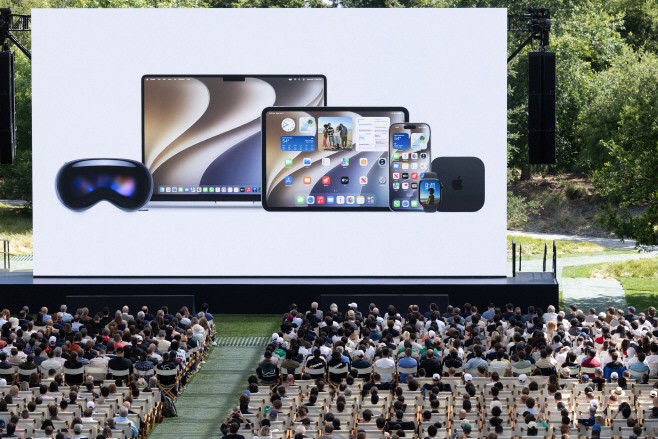 |
| Participants watch Apple’s presentation at the annual Worldwide Developers Conference in California on the 8th (local time). Apple unveiled a new iOS featuring artificial intelligence. / Reuters·Yonhap |
Apple unveiled its revamped Siri and artificial intelligence (AI) features at the Worldwide Developers Conference (WWDC) 2026, but market reactions have been mixed. Some praise the company for delivering on its promised AI functions and strengthening its competitiveness, while others argue the updates are merely extensions of features already introduced by Samsung and Google. Still, Apple has outlined an AI strategy that extends beyond the iPhone to other devices, setting the stage for an intensified ecosystem battle with Samsung in the second half of the year.
According to industry sources on June 10, Apple announced at WWDC in California on June 8 (local time) that it had reorganized its operating systems around AI and introduced a new Siri and “Visual Intelligence.” The focus was on improving user experience by enhancing search capabilities, app integration, and productivity features. Long considered behind Samsung and Google in the AI race, Apple’s latest announcement is seen as a full‑scale counteroffensive.
Apple had previously faced criticism for lagging in generative AI compared to Samsung and Google. Some of the key functions of Apple Intelligence unveiled last year were delayed, raising concerns about its AI strategy. However, this WWDC presentation clarified those promised features, signaling Apple’s push to strengthen its AI competitiveness.
Apple’s strength lies in its massive user base. Market research firm Counterpoint Research estimates that cumulative shipments of iPhones supporting Apple Intelligence surpassed 450 million units in the first quarter of this year. This provides a solid foundation for rapid adoption once AI features expand.
Samsung, meanwhile, has been leading the AI smartphone market with its on‑device AI strategy for two years. The Galaxy S24 series in 2024 introduced generative AI features such as real‑time translation, Circle to Search, and AI photo editing, and Samsung has since continued to expand Galaxy AI’s scope. The Galaxy S26 series released this year further enhanced AI agent functions and personalized services, elevating the AI experience. Samsung has also accelerated ecosystem development by deepening its collaboration with Google Gemini.
Industry observers expect Apple’s full‑scale entry into AI to shift the focus of competition in the premium smartphone market toward AI in the second half of the year. With Apple responding to Samsung’s early Galaxy AI ecosystem, the rivalry is expected to move beyond camera and processor performance to the completeness of AI services and ecosystem‑building capabilities.
In addition, devices beyond smartphones — such as smartwatches, wireless earbuds, and AI glasses — are evolving into AI devices, which is expected to further expand the related market.
Lee Ji-sun
Most Read
-
1
Kia Sportage outperforms Mazda CX-5 in German auto..

-
2
Houthis launch successive attacks on Saudi airport..

-
3
Saudi Arabia, Iran hold first diplomatic talks to..

-
4
U.S. deploys carrier, 10,000 more troops to Middle..

-
5
Saudi airport in Riyadh struck again, leaving at l..

-
6
Putin's ally visits China on the 8th ahead of APEC..

-
7
Chinese military support and training center opens..

PEOPLE






HEADLINE NEWS

-
Address : In-Young Bldg., 34, Uisadang-daero 1-gil, Yeongdeungpo-gu, Seoul
Copyright by ASIATODAY CO., LTD. All rights resereved