



Turkiye to restore Ottoman ‘Hejaz Railway’ as alternative to Hormuz
Jun 10, 2026, 02:03 pm


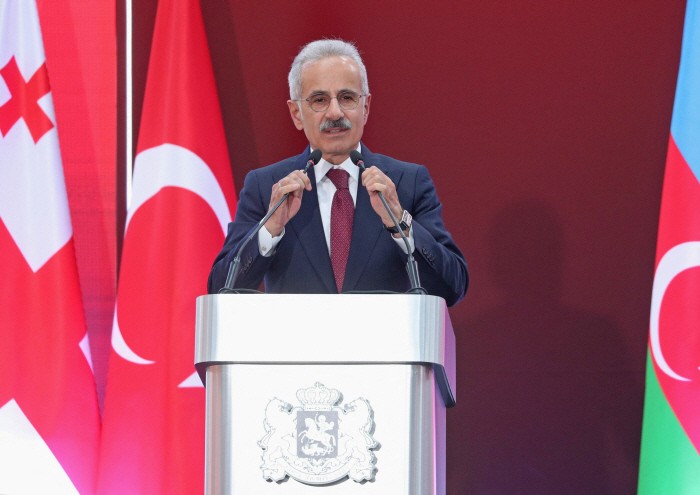 |
| Turkish Minister of Transport and Infrastructure Abdulkadir Uraloğlu speaks at the opening ceremony of the Baku–Tbilisi–Kars (BTK) railway line near Akhalkalaki, Georgia, on the 2nd (local time). / Reuters·Yonhap |
On June 9 (local time), Turkiye and Saudi Arabia signed a memorandum of understanding (MOU) to strengthen cooperation in transportation and railways. The agreement goes beyond sharing logistics infrastructure, laying practical groundwork for restoring and extending the historic “Hejaz Railway” as an alternative trade route bypassing the Strait of Hormuz.
According to Turkiye’s state-run Anadolu Agency (AA), Turkiye’s Minister of Transport and Infrastructure Abdulkadir Uraloğlu signed the MOU in Riyadh with Saudi Minister of Transport and Logistics Services Saleh bin Al-Jasser.
Currently, a significant portion of global oil and cargo shipments relies on the Strait of Hormuz, which connects the Persian Gulf and the Gulf of Oman. However, the region faces chronic geopolitical tensions and risks of maritime blockades.
Turkiye’s proposed alternative is to rebuild the Hejaz Railway, originally constructed by the Ottoman Empire in the early 1900s, into a modern transport network. The plan envisions restoring the line from Turkiye through Aleppo and Damascus in Syria, then Jordan, and onward to Saudi Arabia, eventually extending to Oman for direct access to the Indian Ocean. Once completed, cargo unloaded at Saudi or Omani ports could be transported overland through Turkiye to Europe without passing through Hormuz.
Minister Uraloğlu explained the project would proceed in two phases. The first phase connects Turkiye to Aleppo, then uses the existing Aleppo–Damascus–Jordan route to reach Saudi Arabia. The second phase extends the railway through Saudi Arabia to Oman, completing an independent global trade corridor to the Indian Ocean.
Both countries have explored alternative routes due to disruptions from the Syrian civil war. Recently, two successful trial runs were conducted on a land corridor from Turkiye through Iraq to Saudi Arabia, demonstrating technical feasibility.
The MOU establishes a foundation for practical cooperation, including railway infrastructure development, human resource exchange, and logistics center construction. The two nations aim to restore and surpass the annual transport volume of 20,000 shipments recorded in 2012.
Challenges remain, including instability in Syria and Iraq, the massive financial resources required for thousands of kilometers of railway modernization and construction, and complex negotiations among participating countries. These factors will be critical to the project’s success.
Lee Jung-eun
Most Read
-
1
Celltrion’s Omlyclo gains ground in major European..

-
2
Trump demands rates fall below 1% as Fed hikes for..

-
3
Trump makes $1 trillion bet ahead of midterm elect..

-
4
Iran resumes ballistic missile production, assembl..

-
5
Samsung Electronics, Mistral AI to jointly develop..

-
6
Trump warns countries not helping U.S. must pay re..

-
7
Apple launches first foldable, 1 million won prici..

PEOPLE






HEADLINE NEWS
- Trump to roll out ‘unprecedented welcome’ for Xi with B-2 bombers, F-22 fighters
- S. Korea, U.S., and Japan form united front on Taiwan and economic coercion..
- Trump administration moves to impose sweeping sanctions on International Cr..
- Xi to make state visit to U.S. Sept. 23-25, dispelling rumors over his heal..

-
Address : In-Young Bldg., 34, Uisadang-daero 1-gil, Yeongdeungpo-gu, Seoul
Copyright by ASIATODAY CO., LTD. All rights resereved