



Gov’t to expand housing, finance support for youth marriage
Jun 10, 2026, 10:00 am


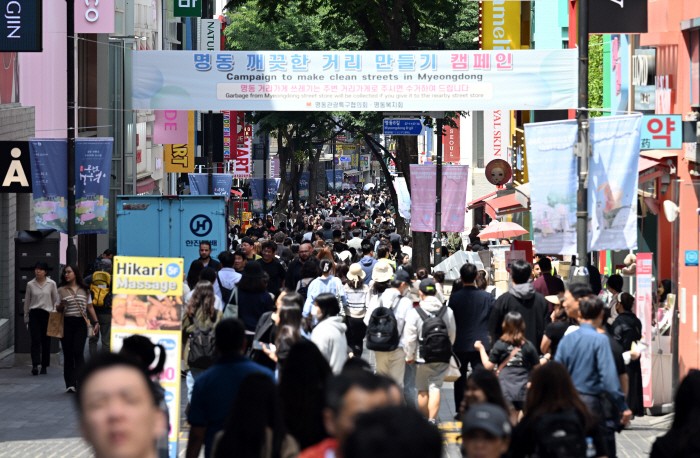 |
| A view of Myeong-dong in central Seoul. / Photo by Song Eui-joo |
The South Korean government plans to revise policies that reduce benefits after marriage in an effort to ease the financial burden on young couples. The goal is to create a system in which marriage brings tangible incentives through expanded housing support, lower loan costs, greater asset-building opportunities, and tax benefits.
The Ministry of Planning and Budget announced the Marriage-Friendly Institutional Reform Plan at the third ministerial meeting on youth policy, chaired by Prime Minister Kim Min-seok, on Aug. 9.
According to the ministry, South Korea's total fertility rate rebounded from a record low of 0.72 in 2023 to 0.75 in 2024, 0.80 in 2025, and 0.95 in the first quarter of this year. However, the share of unmarried people in their 30s has risen significantly over the past decade, while the proportion of couples delaying marriage registration for more than one year nearly doubled from 10.9% in 2014 to 19.0% in 2024.
The government believes that the reduction of certain benefits after marriage has contributed to delayed marriages. It has therefore designated the next decade as a "golden window" for addressing the country's low birth rate and is pursuing reforms aimed at making marriage more attractive.
Housing support for married young adults will be expanded first. Income eligibility thresholds for newly married couples seeking public rental housing will be raised to roughly twice the level applied to single-person households. For example, the monthly income limit for dual-income newlyweds applying for Happy Housing units will increase from 7.63 million won to 9.39 million won, while eligibility criteria for integrated public rental housing will also be broadened.
Single tenants currently living in public rental housing who later marry will be allowed to renew their lease once even if their household income or assets exceed eligibility limits. The government also plans to expand relocation support so that families with children can move into larger homes as their families grow.
For Jeonse loans approved before marriage under the government's "Bogeumjari" support program, the additional interest surcharge imposed when a married couple's combined income exceeds eligibility thresholds will be reduced from 0.3 percentage points to 0.15 percentage points after marriage registration. A special housing allocation program for households with children under the age of two will also be extended to private-sector housing projects.
The government will also strengthen support for asset accumulation. Income thresholds for two-person households eligible for the Youth Future Savings Account will be raised to approximately twice the level for single-person households. The annual income ceiling for the standard program will rise from 94.32 million won to 117.9 million won, while the preferential program threshold will increase from 70.74 million won to 94.32 million won.
Support for young farming couples will also be expanded through higher settlement allowances and larger loan limits for agricultural start-ups.
Tax benefits are set to increase as well. Currently, only one spouse can claim a tax deduction for Jeonse loan principal and interest repayments after marriage. The government is considering allowing both spouses to claim deductions in cases where they must live separately because of work assignments, such as weekend marriages or relocation related to public-sector employment.
In addition, the government plans to revise the fuel tax refund program for compact cars. Under current rules, households lose eligibility if a married couple owns two compact vehicles. The new proposal would allow married households to continue receiving the refund for one vehicle.
Lee Ji-hoon
Most Read
-
1
Celltrion nears additional contract with major U.S..

-
2
Putin proposes trilateral U.S.-China-Russia summit..

-
3
U.S. weighs dropping MOAB, world's most powerful n..

-
4
"Aren't those foreigners on welfare?": M..

-
5
Attention centers on APEC for possible Trump-Xi-Pu..

-
6
Saudi Arabia, Iran hold first diplomatic talks to..

-
7
China tightens grip on boosting domestic demand an..

PEOPLE







-
Address : In-Young Bldg., 34, Uisadang-daero 1-gil, Yeongdeungpo-gu, Seoul
Copyright by ASIATODAY CO., LTD. All rights resereved