



Kishida hails Seoul, Tokyo as Indo-Pacific peace partners
Jun 09, 2026, 02:52 pm


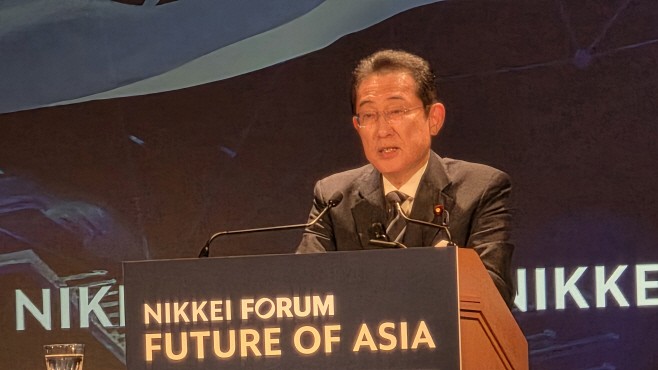 |
| Former Japanese Prime Minister Fumio Kishida delivers a speech at the Imperial Hotel in Tokyo on the afternoon of the 9th. / Choi Young-jae, Tokyo correspondent |
Former Japanese Prime Minister Fumio Kishida said that South Korea and Japan have now become partners working together for peace and stability in the Indo-Pacific region while growing together. His remarks emphasized that the restored bilateral ties since the resumption of “shuttle diplomacy” in 2023 should be institutionalized into practical cooperation in areas such as supply chains, energy, artificial intelligence (AI), and responses to social issues.
In his keynote speech at the 31st Nikkei Forum “Future of Asia” Korea–Japan special session held at the Imperial Hotel in Tokyo at 2 p.m. on the 9th, Kishida said, “South Korea and Japan have now become partners that grow together and work in coordination to fulfill their roles for peace and stability in the Indo-Pacific region.”
The special session was held under the theme “Multi-layered economic cooperation supporting a solid Korea–Japan relationship.” Kishida attended the event alongside former Speaker of the National Assembly Kim Jin-pyo and business leaders from both countries, presenting directions for economic and social cooperation between Korea and Japan.
Kishida recalled that when he took office as prime minister in 2021, Korea–Japan relations were in a “very severe state in which even summit meetings could not be held.” He explained that, amid an increasingly complex international environment, he judged it strategically important to stabilize relations and work together to shape the future, leading him to begin with informal meetings and sustained communication with the Korean side.
He added that “the accumulation of such dialogue gradually melted the accumulated frost between the two countries, leading to the resumption of shuttle diplomacy in 2023.” He also noted that during his tenure, he held 12 face-to-face summit meetings, and that candid exchanges between leaders helped restore a desirable direction in bilateral relations.
Kishida said that even on difficult issues such as the issue of wartime laborers from the Korean Peninsula, the registration of the Sado mine as a World Heritage site, and the discharge of treated water from the Fukushima Daiichi nuclear power plant’s ALPS system, progress toward a future-oriented relationship was possible because of the trust built between the leaders.
He also assessed that Korea–Japan cooperation has expanded into economic and social areas. He cited the “Korea–Japan and Japan–Korea Future Partnership Fund,” led by Japan’s Keidanren (Japan Business Federation) and the Korea Economic Association (formerly the Federation of Korean Industries), as a representative example of bilateral economic cooperation.
He also emphasized trilateral cooperation among South Korea, the United States, and Japan, noting that the Camp David summit significantly advanced trilateral ties and that cooperation in security and economic security continues to strengthen steadily.
Kishida concluded that exchanges between business communities in both countries are playing a major role in building a future-oriented and stable bilateral relationship, adding that corporate cooperation, along with joint projects and youth exchanges under the Future Partnership Fund, should be actively supported by both governments.
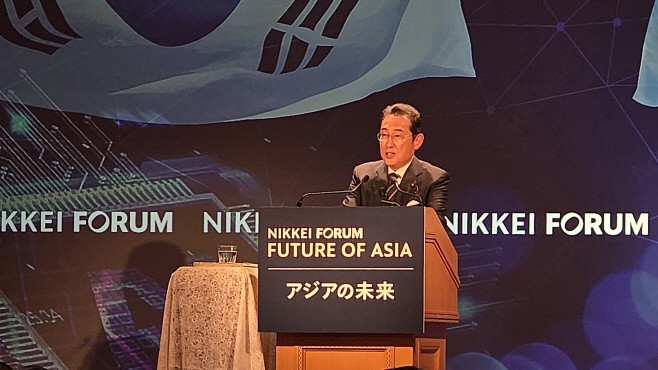 |
| Former Japanese Prime Minister Fumio Kishida delivers a speech at the Imperial Hotel in Tokyo on the afternoon of the 9th. / Choi Young-jae, Tokyo correspondent |
The first priority he presented was strengthening supply chains. Former Prime Minister Kishida said that strengthening and diversifying supply chains, including critical minerals, as well as securing strategic autonomy, are urgent tasks. He noted that South Korea and Japan agreed through a memorandum on supply chain partnership signed in March to cooperate in preparing for supply chain disruptions, working together during recovery processes, and responding to issues such as critical minerals and overcapacity.
Energy cooperation was also presented as a key agenda item. Kishida said that South Korea and Japan share similar energy supply structures and are closely linked within regional supply chains, making joint responses to energy issues indispensable. He referred to the “Asia Zero Emission Community (AZEC),” which he launched during his tenure as prime minister, and introduced the AZEC Plus online summit held in April this year on strengthening energy and critical material supply chains in Asia, attended by South Korean Prime Minister Kim Min-seok.
As recent achievements in Korea–Japan summit diplomacy, he cited the strengthening of energy security cooperation under Japanese Prime Minister Takaichi’s “Power Asia” initiative, including the resilience of energy supply chains in the Indo-Pacific region and measures such as mutual flexibility and swap arrangements for crude oil, petroleum products, and LNG. Kishida said these efforts contribute to securing energy supply chains and are based on an evolved vision of a free and open Indo-Pacific.
He also mentioned cooperation in AI and quantum technologies. Kishida said quantum technology is important from an economic security perspective and that cooperation centered on South Korea–Japan and South Korea–U.S.–Japan frameworks is underway. Regarding AI, he described it as “a field with both new challenges and great potential,” expressing hope that bilateral cooperation will be further developed.
He also raised shared social issues as areas for cooperation. Kishida said that at the Korea–Japan summit in August last year, the two sides agreed to launch a consultation framework to address common challenges such as overconcentration in the capital region, low birth rates and aging populations, and disaster prevention. He stressed that corporate expertise and the flexible ideas of young entrepreneurs are important in solving these issues, calling for public–private cooperation between the two countries.
Kishida concluded, “I am very pleased that the positive momentum in Korea–Japan relations, including the continued shuttle diplomacy between leaders, is being maintained.” He added, “Every time I see many young people traveling and enjoying exchanges between our two countries, I feel great hope for the future of Korea–Japan relations.” He further stated, “Korea and Japan, together with the Indo-Pacific, must fulfill our role in building a more resilient and prosperous Asia,” adding, “I too will continue to work alongside you.”
Choi Young-jae
Most Read
-
1
Celltrion’s Omlyclo gains ground in major European..

-
2
Trump demands rates fall below 1% as Fed hikes for..

-
3
Trump makes $1 trillion bet ahead of midterm elect..

-
4
Iran resumes ballistic missile production, assembl..

-
5
Samsung Electronics, Mistral AI to jointly develop..

-
6
Trump warns countries not helping U.S. must pay re..

-
7
Apple launches first foldable, 1 million won prici..

PEOPLE






HEADLINE NEWS
- Trump to roll out ‘unprecedented welcome’ for Xi with B-2 bombers, F-22 fighters
- S. Korea, U.S., and Japan form united front on Taiwan and economic coercion..
- Trump administration moves to impose sweeping sanctions on International Cr..
- Xi to make state visit to U.S. Sept. 23-25, dispelling rumors over his heal..

-
Address : In-Young Bldg., 34, Uisadang-daero 1-gil, Yeongdeungpo-gu, Seoul
Copyright by ASIATODAY CO., LTD. All rights resereved