



Banks stress ESG while cutting ‘environment, education, culture’ focus
Jun 09, 2026, 01:41 pm


 |
| This image was generated by AI. |
Banking sector social contribution spending surpassed 2 trillion won for the first time, continuing its overall expansion. However, contributions to the environment, education, and culture have weakened noticeably. In particular, environmental contributions last year fell to their lowest level in four years, while spending on academic and educational support as well as arts sponsorship also declined compared with the previous year. This has led to criticism that, despite banks’ emphasis on ESG (Environmental, Social, and Governance) management, the sector needs to rebalance its social contribution portfolio alongside expanding support for livelihoods.
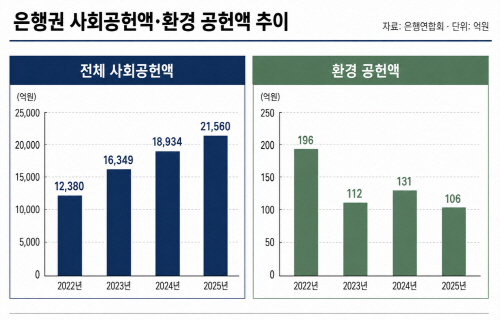
According to the financial industry on the 8th, environmental contributions accounted for just 0.5% of total banking sector social contribution activities last year. This figure has steadily declined from 1.6% in 2022 to 0.7% in both 2023 and 2024, before falling further to 0.5% last year. The total environmental contribution amount also dropped from 19.6 billion won in 2022 to 10.6 billion won last year, marking the lowest level since 2022.
This contrasts with the steady growth in the banking sector’s overall social contribution scale. Total contributions were 1.0617 trillion won in 2021, 1.238 trillion won in 2022, 1.6349 trillion won in 2023, and 1.8934 trillion won in 2024, showing consistent annual growth. In 2025, the figure reached 2.156 trillion won, marking a 103.1% increase over four years and surpassing the 2 trillion won threshold for the first time.
Academic and education-related contributions also showed a declining trend. Spending in this category fell from 76.5 billion won in 2023 to 74.4 billion won in 2024 and 73.9 billion won last year, decreasing for two consecutive years. Its share of total social contributions also dropped from 5.7% in 2022 to 3.4% last year. Cultural, arts, and sports sponsorship (mecenat) also declined by about 9.3%, from 75.4 billion won in 2024 to 68.4 billion won last year.
Field practitioners have also pointed to qualitative changes in social contribution activities. A banking-sector financial education instructor said, “Recently, the number of education requests from banks has been declining somewhat,” adding that “even when programs are conducted, they are increasingly limited to basic and standardized formats such as allowance bookkeeping, rather than advanced financial capability training, raising concerns within the industry about the need for improvement.”
The decline in certain categories is largely attributed to banks’ increased focus on shared growth financing and support for livelihoods. Last year, contributions to local communities and public welfare reached 1.435 trillion won, nearly doubling from 721 billion won in 2022, and their share rose from 58.2% to 66.6%. Including 5.389 trillion won in microfinance and support for vulnerable groups, these two categories totaled 1.9739 trillion won, accounting for 91.6% of total social contributions.
This shift is seen as a response to growing external uncertainty caused by prolonged global tariff disputes and conflicts, which have increased burdens on small businesses and vulnerable groups. Accordingly, banks have prioritized social responsibility efforts by expanding support in areas with more urgent needs.
However, experts argue that short-term assistance for vulnerable groups should be balanced with long-term portfolio diversification. Professor Son Jae-seong of Soongsil University’s Department of Accounting stated, “While urgent support for livelihoods is important, long-term investment areas such as the environment and education are also essential parts of banks’ social responsibility,” adding that “a balanced portfolio approach, along with more flexible regulatory guidance from financial authorities, is necessary.”
Park Seo-a
Most Read
-
1
Celltrion’s Omlyclo gains ground in major European..

-
2
Trump demands rates fall below 1% as Fed hikes for..

-
3
Trump makes $1 trillion bet ahead of midterm elect..

-
4
Iran resumes ballistic missile production, assembl..

-
5
Samsung Electronics, Mistral AI to jointly develop..

-
6
Trump warns countries not helping U.S. must pay re..

-
7
Apple launches first foldable, 1 million won prici..

PEOPLE






HEADLINE NEWS
- Trump to roll out ‘unprecedented welcome’ for Xi with B-2 bombers, F-22 fighters
- S. Korea, U.S., and Japan form united front on Taiwan and economic coercion..
- Trump administration moves to impose sweeping sanctions on International Cr..
- Xi to make state visit to U.S. Sept. 23-25, dispelling rumors over his heal..

-
Address : In-Young Bldg., 34, Uisadang-daero 1-gil, Yeongdeungpo-gu, Seoul
Copyright by ASIATODAY CO., LTD. All rights resereved