



Xi’s NK visit seen as win-win, little downside for S. Korea
Jun 09, 2026, 11:08 am


Xi Jinping’s 1-night, 2-day visit to North Korea and his summit with Kim Jong-un have been assessed as delivering a win-win outcome for both sides, according to analysis. The meeting between the two leaders and the agreements reached are also expected to have a broadly positive impact on South Korea.
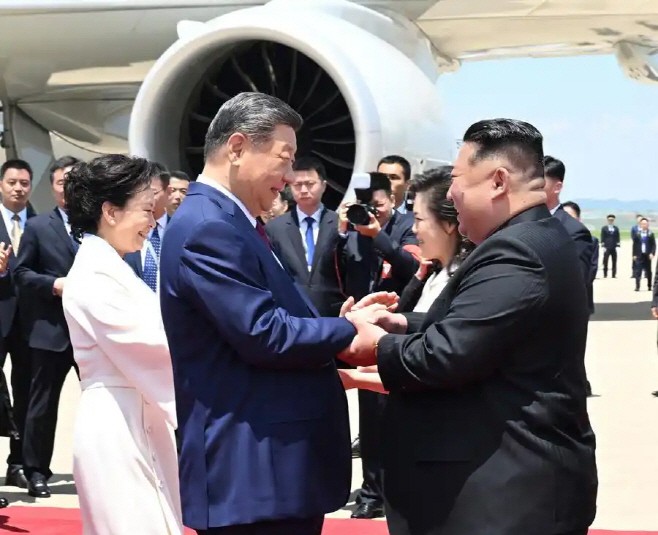 |
| Chinese President Xi Jinping and his wife are welcomed by North Korean leader Kim Jong-un and his wife upon their arrival at Pyongyang’s Sunan International Airport on June 8 for a summit with Kim Jong-un. Xi’s visit and the holding of the summit are also assessed as unlikely to be unfavorable for South Korea. / Xinhua News Agency |
The dialogue between the two leaders reportedly proceeded so smoothly that the conclusion appears far from an exaggeration. According to Beijing-based sources familiar with bilateral relations on the 9th, the talks were said to have unfolded without any obstacles, almost as if they had been pre-scripted in advance. This becomes even clearer when examining in detail the agreements outlining cooperation across various fields.
First, during the meeting with Kim Jong-un—held seven years after Xi Jinping’s last visit to North Korea—Xi reportedly described China–North Korea relations as a “community with a shared destiny,” echoing remarks made at China’s 80th Victory Day commemoration in September last year. He also suggested strengthening exchanges in diplomatic, law enforcement, and military sectors, even signaling the possible revival of a mutual military assistance treaty. In practical terms, this is interpreted as an agreement to expand bilateral military cooperation.
In addition, both sides reportedly aligned on opposing what they describe as Western-led pressures spearheaded by the United States, emphasizing “multipolarity in the world order” and economic globalization. Xi’s unusually direct articulation of his position in Rodong Sinmun, the North Korean Workers’ Party newspaper, just before his visit is seen as deliberate. Beijing-based Korean Peninsula expert Li Guofu noted that Xi had effectively pre-framed the relationship as a “community with a shared destiny,” suggesting that future coordination will proceed along these lines.
China appears to have gained considerably despite the brief nature of Xi’s visit and the single summit meeting. First, it is seen as having succeeded in preventing excessive rapprochement between North Korea and Russia. This also contributes to consolidating what some describe as a de facto North Korea–China–Russia alignment against the U.S.–South Korea–Japan trilateral security framework, strengthening Beijing’s position in its strategic competition with Washington.
Another notable point is China’s perceived progress toward long-standing strategic interests, including improved access toward the East Sea (Sea of Japan) via North Korea’s Tumen River region. This development has reportedly raised concern in Japan and is expected to draw pushback from the United States, which opposes expanded Chinese influence in the Indo-Pacific.
North Korea, for its part, is also assessed to have benefited significantly. Beijing’s behavior is interpreted by some as implicit acknowledgment of North Korea as a nuclear-armed state and of the reality of “two states on the Korean Peninsula.” Combined with expected economic cooperation with China, Pyongyang’s invitation to Xi and the holding of the summit are described as a “masterstroke.”
That said, the situation is not necessarily viewed as negative for South Korea. On the contrary, it may have positive implications. China’s increased influence aimed at easing tensions on the Korean Peninsula and supporting North Korea’s economy is not inherently unfavorable, according to this view. Some Beijing diplomatic sources even go further, describing Xi’s visit and the summit not merely as a “win-win,” but as a “triple win.”
Hong Soon-do
Most Read
-
1
Celltrion’s Omlyclo gains ground in major European..

-
2
Trump demands rates fall below 1% as Fed hikes for..

-
3
Trump makes $1 trillion bet ahead of midterm elect..

-
4
Iran resumes ballistic missile production, assembl..

-
5
Samsung Electronics, Mistral AI to jointly develop..

-
6
Trump warns countries not helping U.S. must pay re..

-
7
Apple launches first foldable, 1 million won prici..

PEOPLE






HEADLINE NEWS
- Trump to roll out ‘unprecedented welcome’ for Xi with B-2 bombers, F-22 fighters
- S. Korea, U.S., and Japan form united front on Taiwan and economic coercion..
- Trump administration moves to impose sweeping sanctions on International Cr..
- Xi to make state visit to U.S. Sept. 23-25, dispelling rumors over his heal..

-
Address : In-Young Bldg., 34, Uisadang-daero 1-gil, Yeongdeungpo-gu, Seoul
Copyright by ASIATODAY CO., LTD. All rights resereved