



Philippines earthquake kills at least 35, injures over 200
Jun 09, 2026, 09:52 am


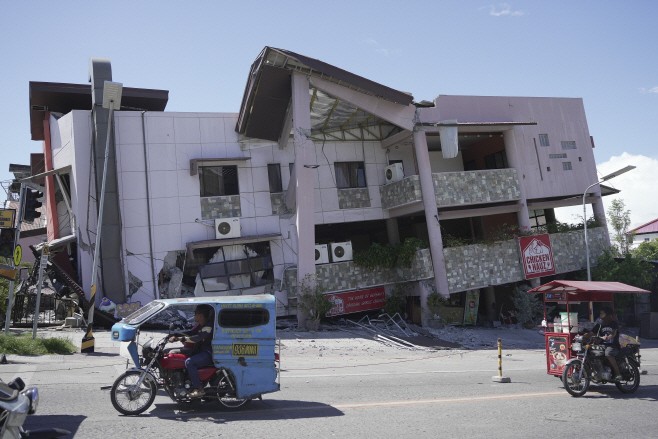 |
A damaged restaurant building is seen in General Santos, southern Philippines, following a magnitude-7.8 earthquake on June 8 (local time). / EPA-Yonhap News
The death toll from a powerful magnitude-7.8 earthquake that struck off the southern Philippine island of Mindanao has risen to at least 35, while more than 200 people have been injured.
According to Associated Press and Reuters, the earthquake occurred at 7:37 a.m. local time on Sunday about 32 kilometers southwest of Maasim in Sarangani Province at a depth of 33 kilometers.
The Philippine Institute of Volcanology and Seismology said it was the strongest earthquake recorded in the Philippines this year.
Buildings collapsed, landslides were triggered and residents rushed into the streets. A journalist staying on the 11th floor of a hotel in Davao City described the shaking as so intense that standing upright was impossible.
Sarangani Province suffered the heaviest loss of life. Disaster official Rene Punzalan told local media that 13 people were killed when a landslide buried homes in the mountainous town of Glan. Four additional deaths were reported elsewhere in the province, bringing the provincial death toll to 17.
The damage extended to the nearby port and commercial hub of General Santos, where several small buildings collapsed or sustained severe damage, leaving at least seven people dead.
A school building also collapsed, and authorities were investigating reports that students may have been trapped inside. Police said at least 12 people remained missing in the city.
Home to more than 700,000 residents and a major center for the tuna export industry, General Santos temporarily shut down its international airport after the quake, resulting in the cancellation of 17 domestic flights.
Students returning to school for the first day of classes also experienced the disaster. More than 100 pupils at an elementary school in Malita, Davao Occidental Province, were attending a flag-raising ceremony when the earthquake struck.
Principal Rosabel Cachuela told AP that the excitement of the first school day had quickly turned into trauma, though major casualties were avoided because most students remained calm and followed instructions.
The earthquake also generated a tsunami of up to one meter along nearby coastlines.
Tsunami warnings were issued for parts of southern Philippines, northern Indonesia and Malaysia's Sabah state on the island of Borneo. The Japan Meteorological Agency also issued a tsunami advisory for parts of Japan's Pacific coast.
All warnings were lifted after 3 p.m. local time. PHIVOLCS said observed tsunami waves ranged from 0.09 meters to 1.48 meters and were not large enough to cause significant damage.
Philippine President Ferdinand Marcos Jr. ordered an immediate disaster response, saying the national government would provide full support to affected communities in Mindanao.
The United States, France, Japan and New Zealand have expressed willingness to provide assistance.
Experts said the disaster highlighted weaknesses in the enforcement of building regulations.
Ben Paolo Valenzuela, a researcher at Singapore Management University, said the extent of the damage in General Santos raised concerns about compliance with construction standards across the country.
He noted that areas near the Cotabato Trench, where the earthquake originated, are classified under the Philippines' highest seismic risk category and should be designed to withstand strong horizontal ground motion.
The same trench generated a magnitude-7.9 earthquake in 1976 that triggered a nine-meter tsunami and killed more than 7,000 people.
Located along the Pacific Ring of Fire, the Philippines is one of the world's most disaster-prone countries, experiencing frequent earthquakes and volcanic eruptions as well as roughly 20 typhoons and tropical storms each year.
Jeong Ri-na |
Most Read
-
1
Celltrion’s Omlyclo gains ground in major European..

-
2
Trump demands rates fall below 1% as Fed hikes for..

-
3
Trump makes $1 trillion bet ahead of midterm elect..

-
4
Iran resumes ballistic missile production, assembl..

-
5
Samsung Electronics, Mistral AI to jointly develop..

-
6
Trump warns countries not helping U.S. must pay re..

-
7
Apple launches first foldable, 1 million won prici..

PEOPLE






HEADLINE NEWS
- Trump to roll out ‘unprecedented welcome’ for Xi with B-2 bombers, F-22 fighters
- S. Korea, U.S., and Japan form united front on Taiwan and economic coercion..
- Trump administration moves to impose sweeping sanctions on International Cr..
- Xi to make state visit to U.S. Sept. 23-25, dispelling rumors over his heal..

-
Address : In-Young Bldg., 34, Uisadang-daero 1-gil, Yeongdeungpo-gu, Seoul
Copyright by ASIATODAY CO., LTD. All rights resereved