



80% of small businesses go digital, but 83% remain basic
Jun 09, 2026, 09:29 am


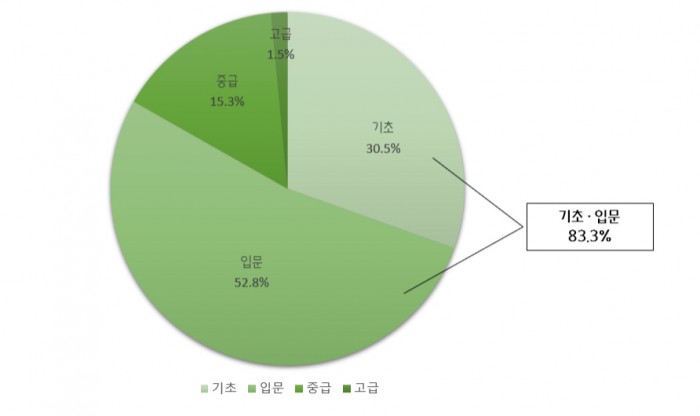 |
| Level of digital technology and AI utilization among small business owners |
Eight in 10 South Korean small business owners are using digital technologies, highlighting how tools such as kiosks, delivery apps and digital document systems have become deeply embedded in daily business operations. However, many experts say policy support is urgently needed to help businesses move beyond basic digital adoption and achieve meaningful digital and artificial intelligence (AI) transformation.
On Monday, the Korea Federation of SMEs released the results of its survey on the status of and policy demand for digital transformation (DX) and AI transformation (AX) among small businesses. The survey covered 500 small business operators.
The findings showed that 83.3% of small business owners currently using digital technologies—30.5% at the basic level and 52.8% at the introductory level—rated their own digital capabilities as no more than beginner-level.
The most common area of digital technology use was business management support (54.5%), followed by customer service (31.8%), sales and distribution (22.3%), and marketing and promotion (21.3%).
Among business management tools, digital point-of-sale (POS) systems were the most widely used technology, accounting for 68.3% of responses. In customer service, AI-powered call assistants and chatbots were the leading technologies, cited by 66.9% of respondents.
The adoption of these technologies has generated tangible business benefits. Among users, 69.8% said digital tools helped save time and improve efficiency, while 25.5% reported increased sales, suggesting that digital transformation is contributing directly to the competitiveness of small businesses.
Despite strong interest in digitalization, only 3.2% of respondents said they had participated in government-supported digital technology or AI assistance programs during the past three years.
The overwhelming reason for non-participation was a lack of awareness, with 76.2% saying they were unaware such programs existed. The survey also found that smaller businesses with lower sales and fewer employees faced particularly severe information gaps.
Business owners said reducing financial burdens should be the government's top priority. The most frequently requested support measures were assistance with operating expenses (59.0%) and initial implementation costs (35.8%).
Respondents also identified support for AI education, product development and service adoption as the government initiative they most anticipated this year, selected by 46.4% of participants.
Kim Hee-joong, head of economic policy at the Korea Federation of SMEs, said that while the rate of digital adoption among small businesses is high, most users remain at a basic level.
"It is important to address the financial burden associated with adopting and operating digital technologies and to closely link customized policy support with the practical needs of small business operators so that these technologies can provide meaningful assistance in managing their stores," Kim said.
Oh Se-eun
Most Read
-
1
Celltrion’s Omlyclo gains ground in major European..

-
2
Trump demands rates fall below 1% as Fed hikes for..

-
3
Trump makes $1 trillion bet ahead of midterm elect..

-
4
Iran resumes ballistic missile production, assembl..

-
5
Samsung Electronics, Mistral AI to jointly develop..

-
6
Trump warns countries not helping U.S. must pay re..

-
7
Apple launches first foldable, 1 million won prici..

PEOPLE






HEADLINE NEWS
- Trump to roll out ‘unprecedented welcome’ for Xi with B-2 bombers, F-22 fighters
- S. Korea, U.S., and Japan form united front on Taiwan and economic coercion..
- Trump administration moves to impose sweeping sanctions on International Cr..
- Xi to make state visit to U.S. Sept. 23-25, dispelling rumors over his heal..

-
Address : In-Young Bldg., 34, Uisadang-daero 1-gil, Yeongdeungpo-gu, Seoul
Copyright by ASIATODAY CO., LTD. All rights resereved