



Higher National Pension contribution ceiling increases burden on high-income workers
Jun 09, 2026, 09:22 am


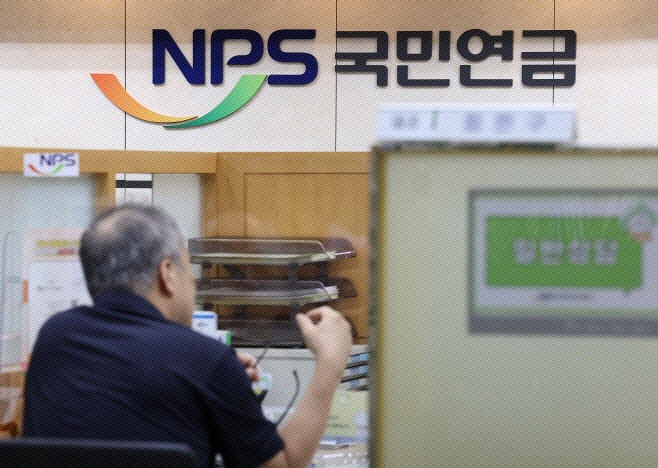 |
| A citizen receives consultation services at the Seoul Northern Regional Headquarters of the National Pension Service in Seodaemun-gu, Seoul. / Yonhap News |
South Korea will raise the upper and lower limits used to calculate National Pension contributions starting next month, increasing premiums for some subscribers. The government says the change will also lead to higher future pension benefits, strengthening retirement income security.
According to the Ministry of Health and Welfare on Monday, revised upper and lower limits for the National Pension's standard monthly income—the basis for calculating contributions—have been finalized and will apply for one year, from next month through July of next year.
The annual adjustment is designed to reflect changes in participants' actual income levels and preserve the real value of pension benefits.
Reflecting a 3.4% increase in the average income of all subscribers over the past three years, the upper income ceiling used for contribution calculations will rise from 6.37 million won to 6.59 million won per month. The lower limit will increase from 400,000 won to 410,000 won.
Under the National Pension system, contributions are calculated only up to the ceiling regardless of how high a person's income may be, while those with very low earnings are assessed based on at least the minimum income floor.
As a result, subscribers earning more than 6.37 million won per month will see their monthly pension contributions increase from 605,150 won to 626,050 won, an increase of 20,900 won.
For salaried employees, however, the contribution is shared equally between the employee and the employer. Consequently, the additional amount paid by an individual employee will be approximately 10,450 won per month.
Subscribers whose monthly income falls between the current ceiling of 6.37 million won and the new ceiling of 6.59 million won will also face partial increases in contributions depending on their income level.
For example, a subscriber earning 6.5 million won per month previously paid contributions based on the capped income level of 6.37 million won. Beginning next month, the contribution rate will apply to the full 6.5 million won, raising the monthly contribution to 617,500 won.
This represents an increase of 12,350 won in total contributions. For salaried workers, the personal share of the increase will amount to 6,175 won per month.
Subscribers in the lowest income bracket—those earning less than 410,000 won per month—will also be affected by the adjustment. Their monthly contribution will rise from 38,000 won, based on the previous floor of 400,000 won, to 38,950 won under the new minimum income threshold.
However, the vast majority of National Pension subscribers will not experience any direct change in contributions as a result of the revised ceiling and floor.
Approximately 86% of subscribers, whose monthly income falls between 410,000 won and 6.37 million won, will see no contribution change from this adjustment if their income remains unchanged. They will only pay additional amounts resulting from the pension reform measure that raised the contribution rate from 9% to 9.5%.
Analysts note that the increased contribution burden is expected to be offset by higher pension benefits in retirement.
Earlier this year, the income replacement rate under the National Pension system—the percentage of pre-retirement income replaced by pension benefits—was raised to 43% from 41.5%.
A Ministry of Health and Welfare official said the adjustment was intended to more accurately reflect changes in subscribers' income levels and improve fairness within the system.
"The purpose of the adjustment is to strengthen retirement income security by linking it with the increase in the income replacement rate," the official said. "As pension contributions increase, future pension benefits will also rise, helping support a more stable retirement."
Seo Byung-joo
Most Read
-
1
Celltrion’s Omlyclo gains ground in major European..

-
2
Trump demands rates fall below 1% as Fed hikes for..

-
3
Hyundai Motor Group breaks ground on integrated st..

-
4
U.S. strikes 3 Iranian oil tankers, Iran vows reta..

-
5
Trump makes $1 trillion bet ahead of midterm elect..

-
6
Iran resumes ballistic missile production, assembl..

-
7
Samsung Electronics, Mistral AI to jointly develop..

PEOPLE







-
Address : In-Young Bldg., 34, Uisadang-daero 1-gil, Yeongdeungpo-gu, Seoul
Copyright by ASIATODAY CO., LTD. All rights resereved