



Trump halts Israel-Iran clashes, but other issues upend ceasefire talks
Jun 09, 2026, 09:15 am


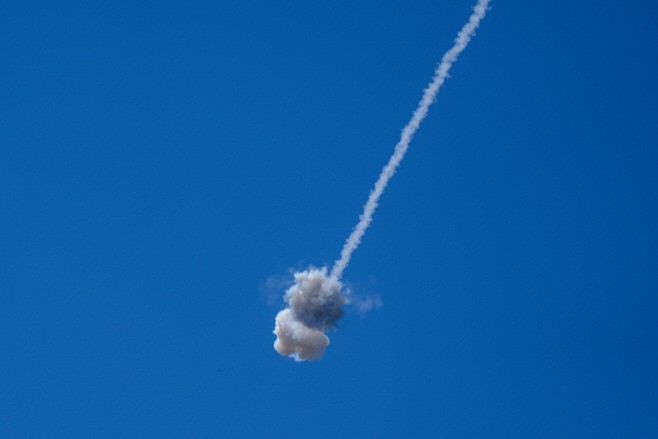 |
| Israel's Iron Dome missile defense system intercepts missiles on the Israeli side of the Israel-Lebanon border on June 8 (local time). / Reuters-Yonhap News |
Israel and Iran halted renewed fighting on June 8 (local time), just one day after it resumed for the first time in two months since the April 8 ceasefire, following U.S. President Donald Trump's call for an immediate cessation of hostilities.
The confrontation had escalated toward the brink of a full-scale war after Iran retaliated with ballistic missile strikes in response to an Israeli airstrike on Beirut, the Lebanese capital. However, pressure from President Trump helped de-escalate tensions.
Nevertheless, uncertainties surrounding ceasefire negotiations have resurfaced as Israel remains committed to targeting Hezbollah in Lebanon, Iran has warned of renewed military action, and Yemen's Houthi rebels have threatened to block the passage of Israel-linked vessels through the Red Sea.
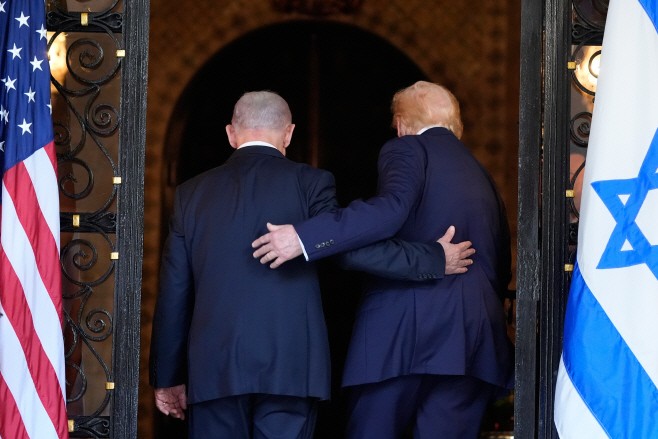 | ||
U.S. President Donald Trump (right) and Israeli Prime Minister Benjamin Netanyahu walk into President Trump's Mar-a-Lago Club in Palm Beach, Florida, on Dec. 29, 2025 (local time), after exchanging greetings upon Netanyahu's arrival. / AP-Yonhap News
Trump calls for halt to hostilities as Iran and Israel announce conditional suspension of attacks
U.S. President Donald Trump on Sunday called for an immediate halt to hostilities between Israel and Iran, urging both sides to stop firing and move toward a negotiated settlement.
In a post on his social media platform Truth Social, Trump said, "Israel and Iran must stop firing immediately," adding that "only ignorance or foolishness can stand in the way of a peace agreement." He also stated that the U.S. naval blockade on Iran would remain in place until a final agreement is reached and stressed that "events must move quickly."
About an hour after Trump's remarks, Iran's Khatam al-Anbiya Central Headquarters, the country's unified military command, announced a suspension of military operations through state media, according to reports by the semi-official Fars News Agency and Islamic Republic of Iran Broadcasting.
In a statement, the military command said it had delivered a "painful response" to the "Zionist regime" and was declaring an end to its current operations. It warned, however, that if what it described as aggression continued—including in southern Lebanon—Iran would take measures "far stronger and more overwhelming" than before.
Israeli Prime Minister Benjamin Netanyahu likewise announced a pause in air operations. In a video statement, Netanyahu said that airstrikes on the current front had been suspended for the time being because "the terror regime in Tehran has ceased its attacks against us after sustaining significant blows."
He cautioned that if Iran "makes the mistake of attacking again," Israel would respond with overwhelming force.
Subsequent developments appeared to reinforce the credibility of the de-escalation effort. The Israeli military announced that most schools that had been temporarily closed would reopen the following day, while Iran lifted restrictions on civilian airspace, according to the Associated Press.
|
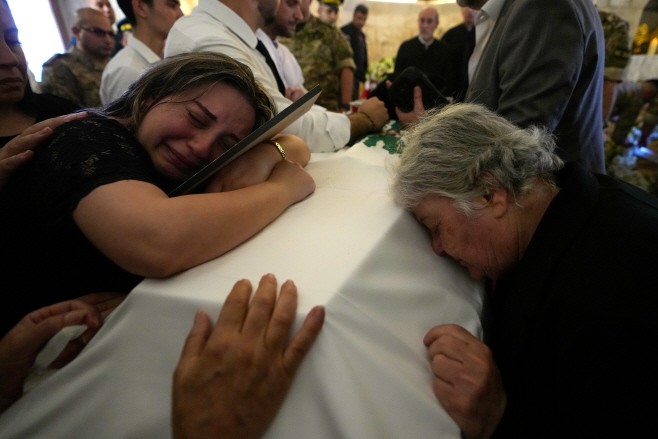 | ||
Rosette (left), the wife of Lebanese Army Captain Eli Khoury, who was killed in an Israeli airstrike on June 6 (local time), mourns during his funeral in Kfar Jarra, southern Lebanon, on June 8. / AP-Yonhap News
Reuters: Israel pushes back against exclusion from talks; NYT: Iran seeks to demonstrate commitment to Hezbollah
According to Reuters, Israel's decision to strike Iran despite President Trump's efforts to restrain further escalation was intended as a message to the Trump administration that Israeli interests must be reflected in any U.S.-Iran ceasefire negotiations.
Danny Orbach, a professor at Hebrew University of Jerusalem, told Reuters that Israel was demonstrating its ability to derail negotiations if its core interests were ignored.
Ofer Guterman, a senior researcher at the Institute for National Security Studies, told the The Wall Street Journal that Iran has become increasingly assertive in defending Hezbollah because it believes the United States and Israel do not share the same position on Lebanon-related issues.
The The New York Times reported that Iran's new leadership appears to believe that its more aggressive response strategy has helped the country withstand pressure from the United States and Israel while preserving the strategic leverage provided by its influence over the Strait of Hormuz.
Farzan Sabet, an Iran analyst at the Geneva Graduate Institute, told the New York Times that Iranian leaders believe Trump is unlikely to restart a major conflict while preparing to host the FIFA World Cup 2026 and facing growing economic pressures ahead of U.S. midterm elections.
"They believe he does not want to reopen the war under such circumstances," Sabet said. "And even if the conflict resumes, they appear fairly confident they can manage it."
The New York Times also reported that Sadegh Larijani, head of Iran's Expediency Discernment Council, described the latest developments as a formal declaration of a strategic doctrine under which an attack on any member of the so-called "Axis of Resistance" would trigger a response extending beyond geographical boundaries and potentially alter the regional balance of power.
Iranian President Masoud Pezeshkian also emphasized on X that diplomacy and defense are "the two wings supporting national power," adding that Iran "has never left either the battlefield or the negotiating table."
Lebanon, Hormuz and the Red Sea remain key variables in ceasefire negotiations President Trump underscored his authority over any potential U.S.-Iran agreement, telling the Financial Times that "I make all the decisions. All the decisions. Netanyahu is not the decision-maker." According to the Associated Press, citing two regional officials, Egypt, Saudi Arabia, Turkey, Pakistan, and Qatar simultaneously pressed the Trump administration to halt Israeli attacks on Iran and Beirut while also urging Iran to cease attacks on Israel. Although Israel and Iran have suspended direct hostilities, the broader situation remains highly fluid. On Sunday, Yemen's Houthi movement declared a complete ban on the navigation of Israel-linked vessels through the Red Sea, the Gulf of Aden, and the Bab el-Mandab Strait. The The Washington Post reported that the announcement helped push July Brent crude futures up more than 4%, surpassing $97 per barrel. The United States Central Command said U.S. forces disabled the Palau-flagged tanker M/T Marivex, which had allegedly attempted to breach the U.S. maritime blockade on Iran. According to CENTCOM, an F/A-18 Super Hornet operating from the aircraft carrier USS Abraham Lincoln used precision-guided munitions to neutralize the vessel. The The New York Times, citing maritime analytics firm Windward, reported that a fire broke out while the vessel was anchored off the coast of Oman, prompting the evacuation of all 24 Indian crew members. CENTCOM said the incident raised the number of commercial vessels disabled by U.S. forces to seven since the maritime blockade began on April 13. The command also stated that 134 vessels had been turned back, while passage had been permitted for 42 humanitarian aid ships. Meanwhile, the European Union expanded sanctions on Iran. Kaja Kallas, the EU's foreign policy chief, announced that sanctions had been imposed on Mohammad Akbarzadeh, Hamid Hosseini, and the IRGC Hormozgan Regional Command. Kallas said the move marked the first application of the EU's new sanctions framework designed to protect freedom of navigation. Ha Man-joo |
Most Read
-
1
Celltrion’s Omlyclo gains ground in major European..

-
2
Trump demands rates fall below 1% as Fed hikes for..

-
3
Trump makes $1 trillion bet ahead of midterm elect..

-
4
Iran resumes ballistic missile production, assembl..

-
5
Samsung Electronics, Mistral AI to jointly develop..

-
6
Trump warns countries not helping U.S. must pay re..

-
7
Apple launches first foldable, 1 million won prici..

PEOPLE






HEADLINE NEWS
- Trump to roll out ‘unprecedented welcome’ for Xi with B-2 bombers, F-22 fighters
- S. Korea, U.S., and Japan form united front on Taiwan and economic coercion..
- Trump administration moves to impose sweeping sanctions on International Cr..
- Xi to make state visit to U.S. Sept. 23-25, dispelling rumors over his heal..

-
Address : In-Young Bldg., 34, Uisadang-daero 1-gil, Yeongdeungpo-gu, Seoul
Copyright by ASIATODAY CO., LTD. All rights resereved