



Takaichi pushes security overhaul: 8 key issues on table
Jun 08, 2026, 05:24 pm


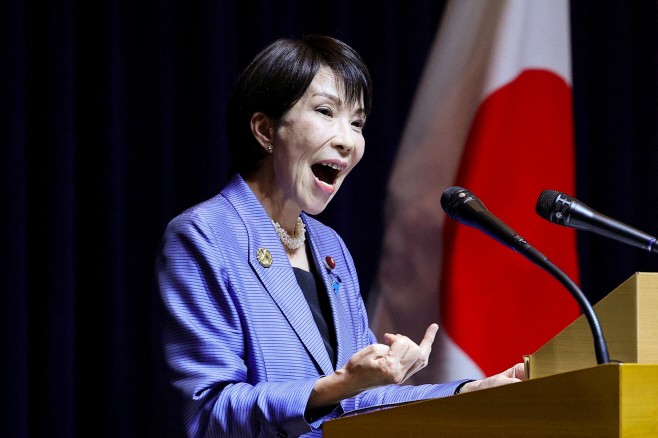 |
| Japanese Prime Minister Sanae Takaichi. / Photo via Yonhap News |
The Sanae Takaichi administration in Japan is initiating formal discussions to overhaul the country's three core security documents, which serve as the foundational blueprints for its foreign and defense policies. The primary flashpoints emerging in these talks include boosting the defense budget, reevaluating the Three Non-Nuclear Principles, responding to AI and drone warfare, strengthening the defense industry, assessing nuclear submarines, managing relations with the United States, shifting perceptions of China, and ensuring economic security.
On the 8th, the Asahi Shimbun analyzed the Takaichi administration's ongoing debates regarding the revisions and identified eight critical areas of focus. The "Three Security Documents" comprise the National Security Strategy (NSS), the National Defense Strategy, and the Defense Capability Buildup Program. These documents outline Japan's foreign and defense policies over approximately the next decade, while also dictating the defense budget and major military hardware procurement for a five-year period. The Japanese government first established the National Security Strategy in 2013 under the Shinzo Abe administration, and the Fumio Kishida administration subsequently enacted a comprehensive revision of all three documents in 2022.
The most contentious issue is defense spending. In the 2022 update, the Kishida administration committed to raising defense-related expenditures to 2% of the country's gross domestic product (GDP) by fiscal year 2027. The Takaichi administration achieved this target ahead of schedule in fiscal year 2025 and is currently pushing for further increases.
The Asahi reported that the Trump administration in the US is pressuring allies to boost defense spending to 3.5% of GDP, and up to 5% when including related expenses. Should Japan adopt the 3.5% benchmark, its annual defense budget could exceed 20 trillion yen.
The Three Non-Nuclear Principles are also on the table for discussion. Japan has long maintained the policy of "not possessing, not producing, and not permitting the introduction of" nuclear weapons. The current National Security Strategy explicitly states that Japan will adhere to these guidelines.
However, Prime Minister Takaichi has previously questioned the practicality of the "not permitting introduction" clause in her writings, citing Japan’s actual reliance on the US nuclear umbrella. Meanwhile, a public opinion poll conducted by the Asahi between March and April of this year revealed that 75% of respondents believed the Three Non-Nuclear Principles should be maintained, significantly outnumbering the 21% who favored a revision.
Adopting "new ways of warfare" utilizing AI and drones stands as another core pillar of the revision process. In light of the war in Ukraine and shifting geopolitics in the Middle East, countering low-cost unmanned aerial vehicles (UAVs), leveraging AI-driven data processing, defending against cyber threats, and managing cognitive warfare have emerged as urgent priorities. Consequently, the Japanese government is exploring ways to expand its drone fleet, secure domestic supply chains, and integrate AI technologies throughout the defense sector.
The strengthening of the defense industry is also expected to be included. The Takaichi administration views the defense industry as one of the 17 priority areas in its growth strategy. In April of this year, Japan revised the implementation guidelines of the Three Principles on Defense Equipment and Technology Transfer, widening the pathway for exporting weapons with lethal capabilities. Within the government and the ruling party, there are also discussions about nationalizing munitions factories, such as ammunition plants, and outsourcing their operations to private enterprises. Whether to introduce nuclear-powered submarines remains another flashpoint. China and Russia already possess nuclear submarines, and North Korea is reportedly pushing forward with their construction. South Korea has also previously announced plans to deploy nuclear submarines by the late 2030s. Within Japan, the necessity for next-generation submarines capable of long-endurance submergence and long-range maneuvers is being raised, but challenges include development costs, operational personnel, and consistency with the Atomic Energy Basic Act. Relations with the United States and perceptions of China are also critical factors that will dictate the phrasing in the revised documents. The Trump administration is demanding that allies increase their share of defense spending. Should the priorities of US global engagement shift, Japan will have to adjust its existing security framework, which has been predicated on its reliance on the United States. Regarding China, the 2022 documents labeled it as "the unprecedented and greatest strategic challenge." However, attention is now focused on what terminology will be used following the expansion of Chinese aircraft carrier activities, airspace violations, and ongoing debates surrounding a potential Taiwan contingency. Economic security is also set to be treated as a distinct pillar. The situation in the Middle East, risks in the Strait of Hormuz, dependence on energy and food imports, and the potential for supply chain disruptions are broadening the scope of Japan's security discourse. The Japanese government is advocating for the securing of "collective autonomy" to maintain supply chains in coordination with allies and like-minded nations. The Takaichi administration’s overhaul of the three core security documents is underway with the goal of completion by the end of the year. The Asahi Shimbun noted that this revision will not stop at mere adjustments to defense policy but could also impact Japan’s national trajectory and the financial burden on its citizens. Depending on the outcome of these discussions, the direction of Japan’s defense spending, nuclear policy, defense industry, and strategies toward the US and China are expected to be collectively realigned. Choe Yeong-jae |
Most Read
-
1
Celltrion’s Omlyclo gains ground in major European..

-
2
Trump demands rates fall below 1% as Fed hikes for..

-
3
Trump makes $1 trillion bet ahead of midterm elect..

-
4
Iran resumes ballistic missile production, assembl..

-
5
Samsung Electronics, Mistral AI to jointly develop..

-
6
Trump warns countries not helping U.S. must pay re..

-
7
Apple launches first foldable, 1 million won prici..

PEOPLE






HEADLINE NEWS
- Trump to roll out ‘unprecedented welcome’ for Xi with B-2 bombers, F-22 fighters
- S. Korea, U.S., and Japan form united front on Taiwan and economic coercion..
- Trump administration moves to impose sweeping sanctions on International Cr..
- Xi to make state visit to U.S. Sept. 23-25, dispelling rumors over his heal..

-
Address : In-Young Bldg., 34, Uisadang-daero 1-gil, Yeongdeungpo-gu, Seoul
Copyright by ASIATODAY CO., LTD. All rights resereved