



Lee to overhaul housing policy in the second half of this year
Jun 08, 2026, 05:05 pm


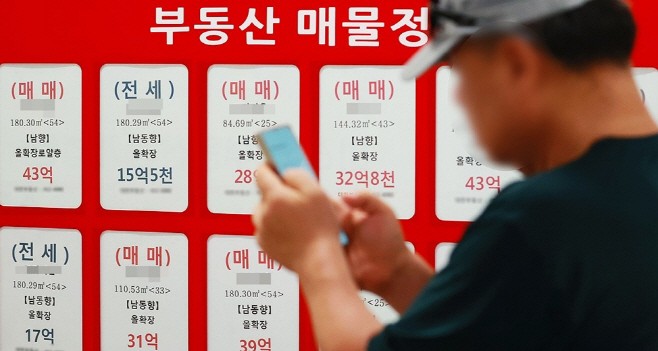 |
| An announcement regarding apartment listings is posted at a real estate agency in Seoul. / Yonhap News |
President Lee marked his first anniversary in office by reaffirming his commitment to real estate tax reform, outlining the framework for housing policy in the second half of the year. The key measures include tightening holding taxes, addressing structural shifts in the jeonse (lump-sum deposit) lease market, and expanding rental housing for the middle class.
During a press conference held at the Blue House guesthouse on the 8th, President Lee stated, "We plan to streamline taxation, financing, regulations, and supply altogether in the near future," adding, "The tax restructuring will likely take shape around July."
The most notable aspect is the overhaul of property holding taxes. "Korea’s holding taxes are generally low, meaning there is little financial burden even if people accumulate multiple properties," President Lee remarked. "If speculative properties are brought to the market, it will unlock massive supply potential."
While international comparisons of holding taxes vary by calculation method, data released by the Land Liberty Institute in March showed that South Korea's effective holding tax rate stands at 0.15%, ranking 20th among 30 OECD member nations. The National Assembly Budget Office notes that simple comparisons are limited due to differing property valuation methods across countries. However, following years of tax easement trends, President Lee’s explicit mention of next month's tax policies has drawn sharp focus toward a potential tax hike. Analysts consider adjustments to the fair market value ratio for the Comprehensive Real Estate Tax and stronger differential tax rates for multi-homeowners as highly likely options under review.
President Lee also addressed the jeonse market. "The jeonse system is a unique form of private financing found only in South Korea, and it is currently on the decline," he explained, noting that "a normalization process is necessary." By defining the decrease in jeonse listings as a natural byproduct of market restructuring, the president downplayed concerns over a lease market crisis. Currently, jeonse listings for apartments in Seoul hover between 10,000 and 20,000 cases. This drop is interpreted as a result of multi-homeowners putting their properties up for sale after President Lee announced that the temporary exemption on heavy capital gains taxes would end in May. The government assesses that as leased properties transitioned into sales, end-users purchased and moved into them, consequently lowering jeonse demand as well.
However, market anxieties persist over a worsening lease shortage due to shrinking rental supply. In fact, monthly rent (wolse) has recently surpassed 50% of all apartment lease transactions in Seoul for the first time, signaling a structural decline of the traditional jeonse system.
In response, President Lee teased an upcoming housing supply package. "We aim to provide high-quality, affordable rental housing in prime locations where average middle-class families can comfortably reside," he said. "We will finalize and announce the details soon."
Market experts emphasize that the crucial factor will be how quickly the government can deliver tangible supply signals to actual homebuyers. They point out that even if demand-suppression measures take effect, it will be difficult to calm market anxieties without visible progress on the supply front.
"Since construction and real estate are directly tied to the domestic economy, balancing demand suppression and supply expansion will be the ultimate test for policies in the second half of the year," a real estate expert noted. "The key lies in whether the supply expansion plans can offer enough specificity to restore market confidence."
Kim Da-bin
Most Read
-
1
Celltrion’s Omlyclo gains ground in major European..

-
2
Trump demands rates fall below 1% as Fed hikes for..

-
3
Trump makes $1 trillion bet ahead of midterm elect..

-
4
Iran resumes ballistic missile production, assembl..

-
5
Samsung Electronics, Mistral AI to jointly develop..

-
6
Trump warns countries not helping U.S. must pay re..

-
7
Apple launches first foldable, 1 million won prici..

PEOPLE





HEADLINE NEWS
- Trump to roll out ‘unprecedented welcome’ for Xi with B-2 bombers, F-22 fighters
- S. Korea, U.S., and Japan form united front on Taiwan and economic coercion..
- Trump administration moves to impose sweeping sanctions on International Cr..
- Xi to make state visit to U.S. Sept. 23-25, dispelling rumors over his heal..

-
Address : In-Young Bldg., 34, Uisadang-daero 1-gil, Yeongdeungpo-gu, Seoul
Copyright by ASIATODAY CO., LTD. All rights resereved