



Through China-NK summit, Xi pushes for multipolar order while guarding China's own interests
Jun 08, 2026, 02:54 pm


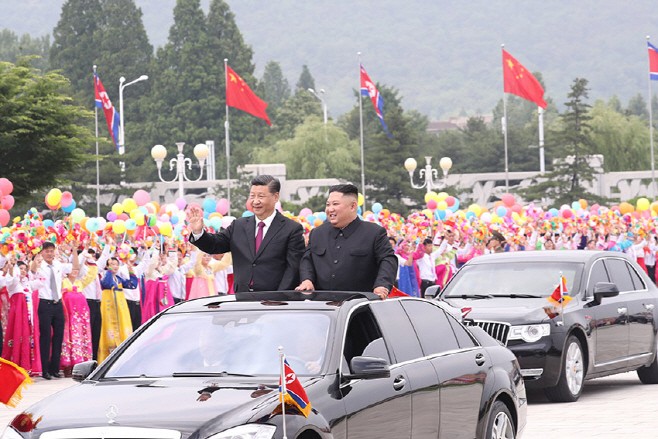 |
| Chinese General Secretary and President Xi Jinping, who arrived in North Korea on the 8th for a two-day visit, alongside North Korean leader Kim Jong Un. This image captures President Xi’s previous visit to North Korea on June 20, 2019. / Photo via Xinhua News Agency |
During an eight-day visit to Pyongyang, Xi Jinping, General Secretary of the Communist Party of China and President of China, made his first trip to North Korea in seven years. Together with Kim Jong Un, Chairman of the State Affairs Commission of North Korea, he held a summit at the Kumsusan State Guest House, where the two leaders, as expected, exchanged views on jointly promoting a multipolar world order and inclusive economic globalization. They also reaffirmed the traditional blood-alliance relationship between their two countries and agreed to strengthen strategic cooperation. It is reported that the joint statement issued after the summit included these points, which Xi had also emphasized the previous day in his contribution to Rodong Sinmun, the newspaper of the Workers’ Party of Korea.
According to diplomatic sources in Beijing familiar with bilateral relations, however, the two leaders reportedly did not actively discuss North Korea’s denuclearization issue, contrary to the expectations of South Korea, the United States, Japan, and the broader Western world. There is even speculation that Xi, taking into account North Korea’s repeated insistence on its principle of “never abandoning nuclear weapons,” effectively settled on a position of tacit acceptance to some degree.
In fact, from China’s perspective—which has only maintained in principle that it does not accept a nuclear-armed North Korea—such a stance would not be surprising. There is no need to risk upsetting Pyongyang and thereby create cracks in the anti-Western alignment among North Korea, China, and Russia that Beijing seeks to cultivate as a counterweight to closer cooperation among South Korea, China, and Japan. Moreover, as a Korean Peninsula expert in Beijing surnamed Zou remarked, “The possibility that North Korea’s nuclear weapons would be directed at China is low. Unlike South Korea, the United States, or Japan, China has little reason to perceive North Korea’s nuclear arsenal as a direct threat.” In that sense, North Korea’s possession of nuclear weapons does not pose a major immediate danger to China. One could therefore argue that Pyongyang’s nuclear capability is largely unrelated to China’s national interests.
Viewed from this perspective, there is nothing surprising about Xi’s reportedly more assertive position during the summit regarding China’s access to the East Sea (Sea of Japan) through North Korea’s Tumen River region. He may have judged that securing China’s long-standing objective of access to the East Sea would contribute far more to national interests than pursuing North Korean denuclearization, which is unlikely to be achieved through persuasion. The fact that the Japanese government and media have expressed significant concern over the matter requires little further explanation.
Xi’s apparent efforts to check the excessive closeness between North Korea and Russia should be understood in the same context. The rapid deepening of ties between Pyongyang and Moscow, which at times appears akin to a blood alliance, may be viewed by Beijing as not necessarily beneficial to either an ideal trilateral alignment among North Korea, China, and Russia or to China’s own interests. Indeed, from China’s perspective, if North Korea were eventually to pursue economic cooperation with Russia more actively than with China, Beijing’s standing as the leading socialist power could suffer a considerable blow.
It is also worth noting that Xi indirectly suggested a willingness to act as a mediator for renewed U.S.–North Korea dialogue and improved inter-Korean relations. Had he not judged such a role to be substantially beneficial to China’s national interests, there would have been little reason to assume that responsibility. This is particularly true with respect to improving inter-Korean relations, which could greatly facilitate expanded economic exchanges with South Korea. Some Chinese businesspeople have recently begun openly referring to the phrase “Jing Han Zheng Chao” (經韓政朝), meaning “economically prioritize South Korea while politically prioritizing North Korea,” and this may well explain why.
On the final day of his visit to North Korea, June 9, Xi is expected to continue the same course of action during meetings, including a luncheon with Kim. Kim, for his part, has little reason not to respond positively. This is all the more understandable when one recalls that, for North Korea, China remains every bit as indispensable to its survival as Russia.
Hong Soon-do
Most Read
-
1
Celltrion’s Omlyclo gains ground in major European..

-
2
Trump demands rates fall below 1% as Fed hikes for..

-
3
Trump makes $1 trillion bet ahead of midterm elect..

-
4
Iran resumes ballistic missile production, assembl..

-
5
Samsung Electronics, Mistral AI to jointly develop..

-
6
Trump warns countries not helping U.S. must pay re..

-
7
Apple launches first foldable, 1 million won prici..

PEOPLE






HEADLINE NEWS
- Trump to roll out ‘unprecedented welcome’ for Xi with B-2 bombers, F-22 fighters
- S. Korea, U.S., and Japan form united front on Taiwan and economic coercion..
- Trump administration moves to impose sweeping sanctions on International Cr..
- Xi to make state visit to U.S. Sept. 23-25, dispelling rumors over his heal..

-
Address : In-Young Bldg., 34, Uisadang-daero 1-gil, Yeongdeungpo-gu, Seoul
Copyright by ASIATODAY CO., LTD. All rights resereved