



Share of record-high apartment sales in Seoul metro area hits yearly low at 9.7%
Jun 08, 2026, 10:27 am


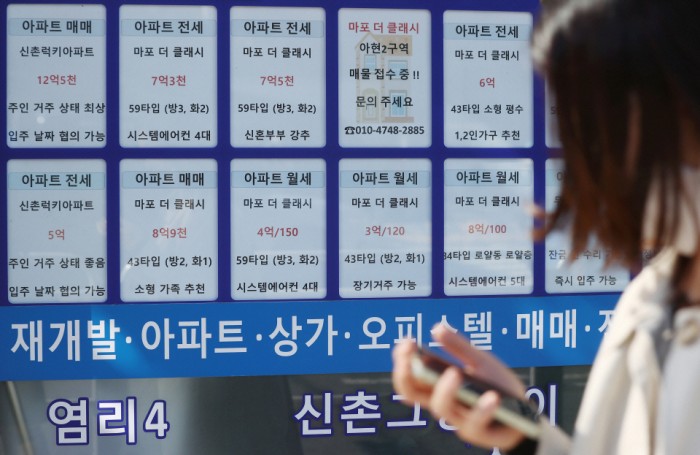 |
| Property listings are posted at a real estate agency in Mapo-gu, Seoul. / Photo via Yonhap News |
In the metropolitan area apartment market last month, ahead of the implementation of the capital gains tax heavy imposition, some urgent properties were transacted, causing the share of record-high sales to drop to its lowest level this year.
On the 8th, according to an analysis of the Ministry of Land, Infrastructure and Transport’s actual transaction data by real estate platform Zigbang, the share of record-high transactions among apartments in the metropolitan area contracted last month was logged at 9.7%. This is the lowest figure recorded so far this year.
By region, the share of record-high transactions in Seoul stood at 19.3%, down 2.0 percentage points (p) from the previous month (21.3%). Gyeonggi Province also recorded 7.0%, a decrease of 0.7%p compared to April (7.7%).
In Seoul, the contraction in the share of record-high transactions was particularly prominent in the Gangnam area. In Gangnam-gu, the share of record-high transactions, which reached 50.4% in May last year, shrank by 31.1%p to 19.3% in May this year. During the same period, Seocho-gu fell from 48.1% to 33.8%, and Yongsan-gu dropped from 35.4% to 26.4%. Gwangjin-gu (25.8% → 22.1%) and Yangcheon-gu (31.8% → 30.8%) also showed a declining trend.
The industry analyzes that this is due to an increase in cases where transactions were made at prices lower than previous transaction prices, centering on high-priced apartment complexes that face a relatively heavier burden from the capital gains tax heavy imposition.
Conversely, there were quite a few non-Gangnam areas where record-high transactions increased. The share of record-high transactions in Dongdaemun-gu expanded from 7.6% in May last year to 31.8% in May this year, and Yeongdeungpo-gu (19.3% → 41.2%), Dongjak-gu (16.5% → 35.3%), and Gangseo-gu (9.2% → 27.9%) also saw large gains.
However, since sales contracts signed last month can be reported until the end of this month, analysis suggests it is still premature to gauge market price changes since the implementation of the capital gains tax heavy imposition on the 10th of last month.
In Gyeonggi Province, the share of record-high transactions increased significantly among non-regulated areas, particularly those experiencing an influx of semiconductor industry demand or holding high expectations for transport infrastructure improvements.
In Guri, the share of record-high transactions, which was a mere 2.2% in May last year, rose 18.9 percentage points to 21.1% in May this year. This is interpreted as the result of transaction volume and prices rising together, reflecting recent pushes for the Subway Line 6 extension and reconstruction expectations.
In addition, Suji-gu in Yongin (3.3% → 19.4%), Hanam (8.5% → 21.4%), Jungwon-gu in Seongnam (12.8% → 24.6%), Dongtan-gu in Hwaseong (1.0% → 12.0%), and Sujeong-gu in Seongnam (4.0% → 14.2%) were also found to have significantly expanded their shares of record-high transactions compared to the same period last year.
Jeon Won-jun
Most Read
-
1
Celltrion’s Omlyclo gains ground in major European..

-
2
Trump demands rates fall below 1% as Fed hikes for..

-
3
Trump makes $1 trillion bet ahead of midterm elect..

-
4
Iran resumes ballistic missile production, assembl..

-
5
Samsung Electronics, Mistral AI to jointly develop..

-
6
Trump warns countries not helping U.S. must pay re..

-
7
Apple launches first foldable, 1 million won prici..

PEOPLE





HEADLINE NEWS
- Trump to roll out ‘unprecedented welcome’ for Xi with B-2 bombers, F-22 fighters
- S. Korea, U.S., and Japan form united front on Taiwan and economic coercion..
- Trump administration moves to impose sweeping sanctions on International Cr..
- Xi to make state visit to U.S. Sept. 23-25, dispelling rumors over his heal..

-
Address : In-Young Bldg., 34, Uisadang-daero 1-gil, Yeongdeungpo-gu, Seoul
Copyright by ASIATODAY CO., LTD. All rights resereved