



Cai Qi emerges as China's potential top transitional leader
Jun 08, 2026, 10:13 am


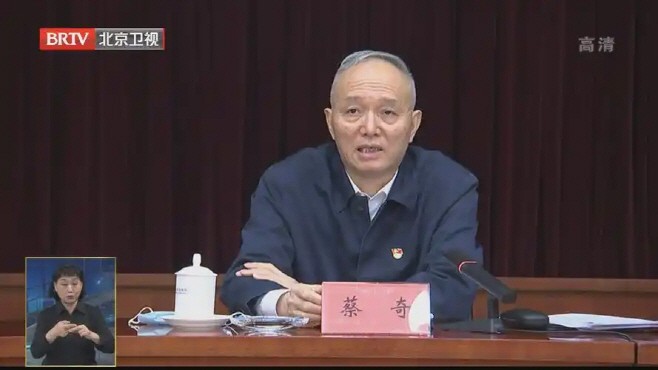 |
| The new Central Party School President Cai Qi during his tenure as Beijing Party Secretary. / Photo via Beijing Satellite TV |
Cai Qi, a member of the Standing Committee of the Political Bureau of the Communist Party of China (CPC) and Director of the General Office of the CPC Central Committee (who also serves as Secretary of the Secretariat), long considered the closest confidant of Chinese President and General Secretary Xi Jinping, has concurrently assumed the presidency of the Central Party School, the nation's premier training institution for top cadres. This development could imply that, in the virtual absence of a definitive number two in the party-state power hierarchy, he has taken on that role in name and in fact. Furthermore, it could also be seen as a rapid emergence as a transitional leader capable of preventing potential chaos during a high-level power succession, however unlikely that scenario may be.
According to China’s state-run Xinhua News Agency and China Central Television (CCTV), Standing Committee Member and Director Cai attended the graduation ceremony for the second class of the spring 2026 semester at the Central Party School on the 5th in his capacity as president, presenting graduation certificates to the completed trainees. This marks the first time he has been introduced as the president of the Central Party School by Chinese state media.
In this regard, Beijing sources well-versed in China's power structure analyzed, "This indicates that former Head of the Central Organization Department Chen Xi, who had been serving as the president of the Central Party School, recently stepped down, and Standing Committee Member and Director Cai Qi has concurrently assumed the post." Hong Kong media, including Sing Tao Daily, also interpreted, "The structure has returned to a system where a leader at the Politburo Standing Committee level takes charge of the Central Party School presidency."
The Central Party School is widely known as the top educational institution for senior cadres operated by the Party Central Committee. It trains high-ranking leaders and mid-level cadres on party ideology, policies, and governing philosophy. In short, it is the institution that grooms the core talent of the party. Consequently, without graduating from this school, it is virtually impossible to be appointed as a top-level official.
Standing Committee Member and Director Cai, born in 1955 and two years younger than his predecessor Chen, had early on been recognized as a formidable powerhouse while serving as the head of the General Office of the Central Committee, a position equivalent to Chief of Staff to President Xi. His track record of long service in Fujian and Zhejiang provinces—President Xi's political strongholds—is by no means coincidental. It can be said that he understands President Xi’s intentions better than anyone else. After entering the central political arena from Zhejiang Province, he served as the Mayor and Party Secretary of Beijing before ascending to the top leadership at the 20th National Congress of the CPC (the party congress held every five years) in October 2022.
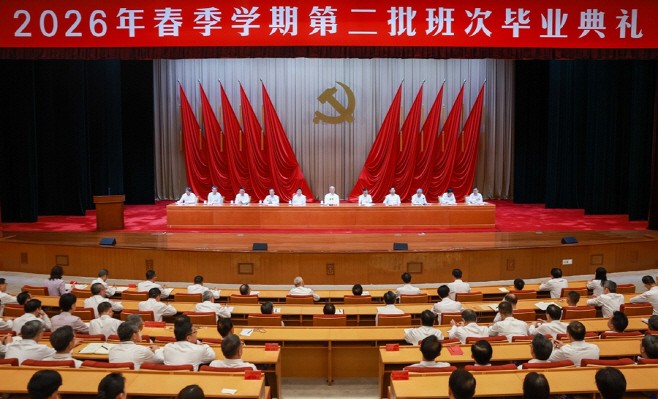 |
| The graduation ceremony for the second class of the spring 2026 semester at the Central Party School held on the 5th. The new President Cai is seated at the center of the podium. / Photo via Xinhua News Agency |
According to sources, it can be observed that Cai's standing within the Party has been further strengthened through this latest appointment. As he takes charge of both the General Office of the Central Committee and the Central Party School—the institution responsible for cadre education and ideological training—his influence within the Party is bound to expand even further. This explains why predictions are emerging from Beijing’s diplomatic circles that, in the event of President Xi’s early retirement due to health issues or other factors, Cai would briefly step in as a crisis-management leader for a transitional period just until power is smoothly handed over to a next-generation contender.
Naturally, if President Xi’s retirement comes sooner than expected, the possibility of Cai's tenure lasting longer cannot be entirely ruled out. Even in this scenario, however, it appears unlikely that he would become a dominant top leader possessing absolute authority like President Xi. This suggests that even if political upheavals were to arise, his role would inevitably remain that of a transitional leader.
Hong Soon-do
Most Read
-
1
Celltrion’s Omlyclo gains ground in major European..

-
2
Trump demands rates fall below 1% as Fed hikes for..

-
3
Trump makes $1 trillion bet ahead of midterm elect..

-
4
Iran resumes ballistic missile production, assembl..

-
5
Samsung Electronics, Mistral AI to jointly develop..

-
6
Trump warns countries not helping U.S. must pay re..

-
7
Apple launches first foldable, 1 million won prici..

PEOPLE





HEADLINE NEWS
- Trump to roll out ‘unprecedented welcome’ for Xi with B-2 bombers, F-22 fighters
- S. Korea, U.S., and Japan form united front on Taiwan and economic coercion..
- Trump administration moves to impose sweeping sanctions on International Cr..
- Xi to make state visit to U.S. Sept. 23-25, dispelling rumors over his heal..

-
Address : In-Young Bldg., 34, Uisadang-daero 1-gil, Yeongdeungpo-gu, Seoul
Copyright by ASIATODAY CO., LTD. All rights resereved