



MOTIE to launch ‘Manufacturing Data Vault'
Jun 05, 2026, 05:34 pm


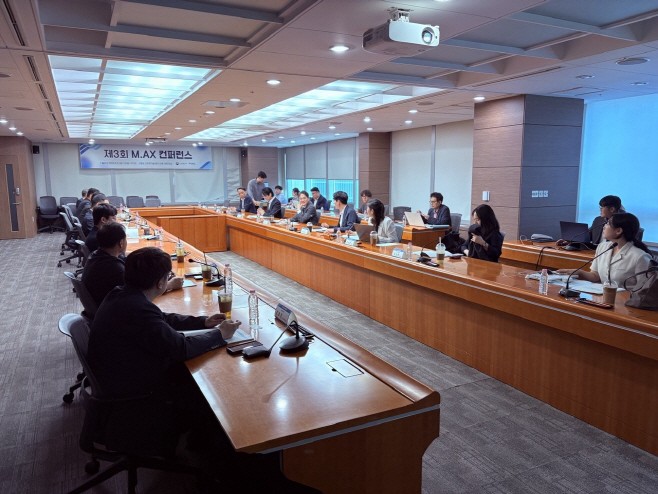 |
On June 5, the Ministry of Trade, Industry and Energy held the 3rd M.AX Conference at the Korea Technology Center in Seoul, bringing together experts from industry, academia, and research — including IBM, Samsung SDS, LG AI Research Institute, Megazone Cloud, and POSTECH — to discuss strategies for utilizing manufacturing data and building infrastructure. / Ministry of Trade, Industry and Energy
Artificial intelligence (AI) competition is expanding from semiconductors and data centers into manufacturing sites, and the government is moving to establish a so‑called “manufacturing data vault” that will allow companies to safely store and utilize core manufacturing data. The plan is to treat data held by Korea’s manufacturing industries — semiconductors, shipbuilding, automobiles, robotics — as national assets of competitiveness and to build an AI ecosystem for manufacturing based on them.
On June 5, the Ministry of Trade, Industry and Energy held the 3rd M.AX (Manufacturing AI Transformation) Conference at the Korea Technology Center in Seoul to discuss strategies for utilizing manufacturing data and building infrastructure. The event brought together experts from industry, academia, and research, including IBM, Samsung SDS, LG AI Research Institute, Megazone Cloud, and POSTECH, to explore ways to spread manufacturing AI.
In his opening remarks, Kim Seong‑yeol, Director General for Industrial Growth at the ministry, said, “In the AI era, the core of our industrial competitiveness lies in manufacturing data and sector‑specific AI models based on it. We will build a trusted and safe environment so that companies can confidently provide data, and we will devote all efforts to creating key infrastructure such as a manufacturing data library and data centers.”
At the conference, IBM Korea CEO Kim Hyun‑jung presented on “Data: The Core of Manufacturing AX,” POSTECH’s Ko Young‑myung spoke on “Linking Manufacturing Process Data and AI Models,” and Samsung SDS Executive Director Lee Joo‑pyeong discussed “The Role of AI Data Centers in Spreading Manufacturing AX.”
The ministry’s main emphasis was on manufacturing data. In the era of generative AI, the ability to secure high‑quality data is seen as the decisive factor for industrial competitiveness. Production process information, quality data, design know‑how, and the experiential knowledge of skilled workers accumulated on manufacturing floors are considered high‑value assets that general‑purpose AI cannot easily obtain.
The challenge is that much of the data companies hold constitutes core intellectual property and trade secrets. From the corporate perspective, providing data externally raises concerns about technology leaks.
To address this, the ministry is pushing to build a “manufacturing data library” to safely store and manage company‑provided data. The library will aggregate data collected from manufacturing sites but operate in a “clean room” environment separated from external networks, allowing usage but completely blocking external extraction. Data access will also be restricted through separate review procedures.
Industry observers expect that once the library is established, the pace of developing manufacturing‑specific AI will accelerate. While general AI is trained mainly on internet‑based data, demand for specialized AI models using real production data is rapidly growing in manufacturing.
The ministry has already begun securing manufacturing data through the M.AX Alliance. The AI Factory division is collecting process data to develop sector‑specific AI models, and efforts are underway to digitize the experience and know‑how of skilled workers into “manufacturing tacit knowledge AI models.”
In the humanoid robotics field, demonstration projects are being conducted to accumulate robot behavior data. In autonomous shipping, an AI data platform is being built to secure real‑world operational data from about 6,000 voyages. In future mobility, systems are being established to collect autonomous driving data.
Until the library is built, the ministry is using the Manufacturing AI Solutions Support Center operated by the Korea Electronics Technology Institute (KETI) as a temporary hub for storing data. Based on the data secured, it plans to develop a prototype manufacturing AI foundation model by the end of 2026 and begin field application and performance verification.
Infrastructure development to support data utilization is also underway. The ministry is expanding manufacturing‑tailored data centers and, using this year’s supplementary budget, plans to establish an edge AI data center within an industrial complex. The goal is to provide specialized infrastructure to handle real‑time data processing and AI inference demands.
Industry experts believe that competition in manufacturing AI will ultimately come down to competition in securing data. With world‑class manufacturing capabilities in semiconductors, shipbuilding, automobiles, and robotics, Korea is expected to gain a competitive edge in the global manufacturing AI market if it strategically leverages its manufacturing data.
Han Dae‑ui
|
Most Read
-
1
Kia Sportage outperforms Mazda CX-5 in German auto..

-
2
Houthis launch successive attacks on Saudi airport..

-
3
Saudi Arabia, Iran hold first diplomatic talks to..

-
4
U.S. deploys carrier, 10,000 more troops to Middle..

-
5
Saudi airport in Riyadh struck again, leaving at l..

-
6
Putin's ally visits China on the 8th ahead of APEC..

-
7
Chinese military support and training center opens..

PEOPLE






HEADLINE NEWS

-
Address : In-Young Bldg., 34, Uisadang-daero 1-gil, Yeongdeungpo-gu, Seoul
Copyright by ASIATODAY CO., LTD. All rights resereved