



Currency spike drives bank bond rates up
Jun 05, 2026, 05:09 pm


 |
This image was generated by AI
The won–dollar exchange rate has surged to its highest level since the global financial crisis, driving up bank bond yields. Concerns are mounting that borrowers’ interest repayment burdens will snowball as inflationary pressures raise the likelihood of a Bank of Korea rate hike. With household debt approaching 1,900 trillion won and booming stock markets fueling demand for “debt‑driven investment,” experts warn of growing risks to financial market stability.
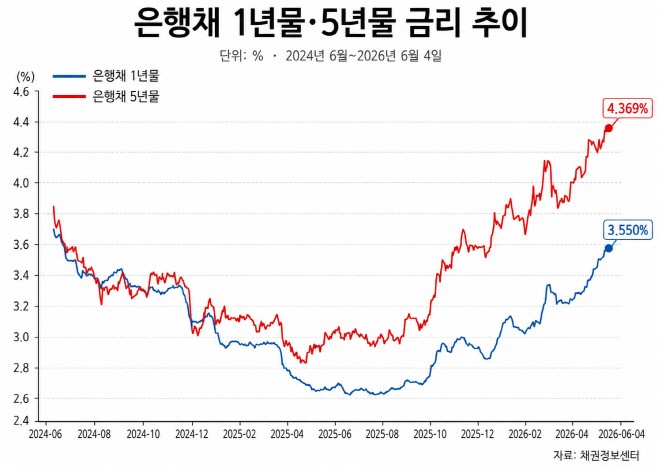
According to the Bond Information Center on June 5, the yield on five‑year AAA‑rated bank bonds — used as a benchmark for fixed‑rate mortgage loans — stood at 4.369% as of June 4. This marked a sharp rise of 0.105 percentage points from the previous trading day (4.264%), the highest level since August 25, 2023, when it reached 4.389%.
The yield on one‑year bank bonds, which serve as a benchmark for unsecured loans, also rose 0.066 percentage points over the same period to 3.550%. It was the first time in two years that the one‑year yield exceeded 3.5%, since June 27, 2024 (3.511%).
The surge in bank bond yields is attributed to rising government bond yields. Bank bond yields are typically calculated by adding a spread to government bond yields, so they tend to move in the same direction. As of June 4, the yield on three‑year government bonds hit 3.860%, the highest in two and a half years, and this increase was reflected in bank bond yields.
The sharp rise in government bond yields is linked to the soaring won–dollar exchange rate. On June 4, the exchange rate briefly broke through the 1,540‑won level during overnight trading, the highest since March 10, 2009 (1,561.0 won) during the global financial crisis. A rising won–dollar exchange rate typically pushes up import prices, which in turn fuels domestic consumer price inflation. According to the National Data Office, consumer prices in May rose 3.1% year‑on‑year. It was the first time in 26 months, since March 2024, that inflation exceeded 3%.
When inflationary pressures grow, market interest rates generally rise, as the central bank may raise its policy rate in response. In fact, the Bank of Korea left open the possibility of a rate hike in the second half during last month’s Monetary Policy Committee meeting, prompting markets to price in a tighter path. Lim Jae‑gyun, a researcher at KB Securities, said, “There are some concerns in the market about consecutive hikes in July and August or even a big step in July.”
Rising market rates directly translate into heavier interest burdens for borrowers. As of June 5, the five major commercial banks — KB Kookmin, Shinhan, Hana, Woori, and NH Nonghyup — were offering mortgage rates (five‑year reset type) ranging from 4.67% to 7.33%, up from 4.55% to 6.65% at the end of March. Unsecured loan rates have also climbed to around 6% at the upper end.
Since banks reflect movements in bank bond yields over the previous three trading days or the prior week in their lending benchmarks, the recent surge in yields is expected to be passed on to loan rates starting next week. A 0.25 percentage point rise in loan rates would increase borrowers’ total interest burden by 3.2 trillion won, with each borrower paying an additional 163,000 won on average.
According to the Bank of Korea, household debt stood at 1,865.8 trillion won in the first quarter of this year. With debt nearing 1,900 trillion won, rising interest burdens could destabilize financial markets. The growing scale of “debt‑driven investment” is another concern. Margin loan balances recently surpassed 38 trillion won, an all‑time high. Analysts warn that if rate hikes and a stock market correction occur simultaneously, the combined impact of heavier borrower burdens and weakened investor sentiment could be severe.
A financial industry official said, “The prolonged Middle East crisis and increased net selling by foreign investors are also factors preventing the exchange rate from falling. If inflation does not ease in June, expectations of larger rate hikes will strengthen.”
Han Sang‑wook |
Most Read
-
1
Celltrion’s Omlyclo gains ground in major European..

-
2
Trump demands rates fall below 1% as Fed hikes for..

-
3
Trump makes $1 trillion bet ahead of midterm elect..

-
4
Iran resumes ballistic missile production, assembl..

-
5
Samsung Electronics, Mistral AI to jointly develop..

-
6
Trump warns countries not helping U.S. must pay re..

-
7
Apple launches first foldable, 1 million won prici..

PEOPLE






HEADLINE NEWS
- Trump to roll out ‘unprecedented welcome’ for Xi with B-2 bombers, F-22 fighters
- S. Korea, U.S., and Japan form united front on Taiwan and economic coercion..
- Trump administration moves to impose sweeping sanctions on International Cr..
- Xi to make state visit to U.S. Sept. 23-25, dispelling rumors over his heal..

-
Address : In-Young Bldg., 34, Uisadang-daero 1-gil, Yeongdeungpo-gu, Seoul
Copyright by ASIATODAY CO., LTD. All rights resereved