



[After-report] Why a “dignified death” is so difficult
Jun 05, 2026, 09:11 am


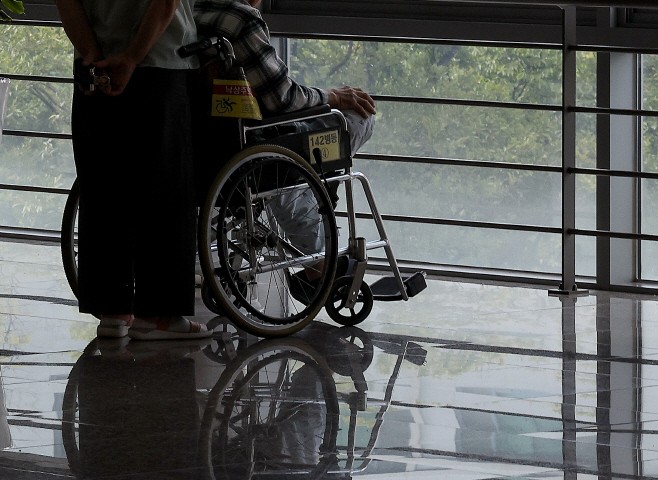 |
| A patient at a university hospital takes a rest while looking out the window. / Yonhap |
“I want to decide the end of my life myself.”
Since the system was introduced in 2018, more than 3.2 million people have written advance directives for life-sustaining treatment. Looking only at the numbers, it seemed that the system had taken root. A social consensus appeared to have formed around the idea of deciding one’s own final moments, and the system seemed to be operating stably.
Yet again, however, there was a gap between the system and the reality on the ground. The first thing that stood out was the difference between citizens who do not want life-sustaining treatment and what actually happens in practice. According to a Bank of Korea report, 84.1% of seniors aged 65 and older said they would not want life-sustaining treatment if recovery was impossible, but in reality only 16.7% had life-sustaining treatment withheld or withdrawn.
The reasons turned out to be unexpected. Writing an advance directive does not mean life-sustaining treatment can be stopped anytime, anywhere. The biggest barrier is physical infrastructure. To carry out the procedure of stopping life-sustaining treatment, a hospital ethics committee is required, but only 10.5% of long-term care hospitals have one. Considering that seven out of ten deaths in Korea occur in general hospitals or long-term care hospitals, millions of documents are effectively left as “pie in the sky.”
Legal hurdles also remain. Under current law, life-sustaining treatment can only be stopped at the “end-of-life stage” when death is imminent. The problem is that the boundary between terminal illness and end-of-life is ambiguous, yet medical staff interpret it very strictly to avoid legal liability. As a result, even terminal patients are blocked by the law from preparing to die peacefully without pain.
The neglect of those without family ties is the darkest aspect. Because they cannot express their wishes and cannot designate a proxy, they face a structural defect that leaves them to die “outside the system.” Without hospice infrastructure or even minimal dignity, these patients wander through emergency rooms, becoming “end-of-life refugees.”
Another issue is hospice care. While discussions about stopping life-sustaining treatment are expanding, the care system afterward remains insufficient. Many people wish to use hospice services, but actual usage rates are still low and regional disparities exist. Ultimately, the key question is not only whether life-sustaining treatment can be stopped, but where and how the remaining time can be spent.
The government is pursuing measures such as online registration of advance directives, expanding the timing of life-sustaining treatment decisions, and strengthening hospice infrastructure. These are clearly necessary changes. Yet for “well-dying” to take root in our society, more time will be needed. Only when medical infrastructure and care systems are in place to respect patients’ wishes in practice will a dignified end of life be possible.
This must ultimately be a mature response from society to the question of how the state will lay the foundation for care.
Lee Se-mi
Most Read
-
1
Celltrion’s Omlyclo gains ground in major European..

-
2
Trump demands rates fall below 1% as Fed hikes for..

-
3
Hyundai Motor Group breaks ground on integrated st..

-
4
U.S. strikes 3 Iranian oil tankers, Iran vows reta..

-
5
Trump makes $1 trillion bet ahead of midterm elect..

-
6
Iran resumes ballistic missile production, assembl..

-
7
Samsung Electronics, Mistral AI to jointly develop..

PEOPLE







-
Address : In-Young Bldg., 34, Uisadang-daero 1-gil, Yeongdeungpo-gu, Seoul
Copyright by ASIATODAY CO., LTD. All rights resereved