



Government discusses expanding window for ending life-sustaining care
Jun 02, 2026, 05:51 pm


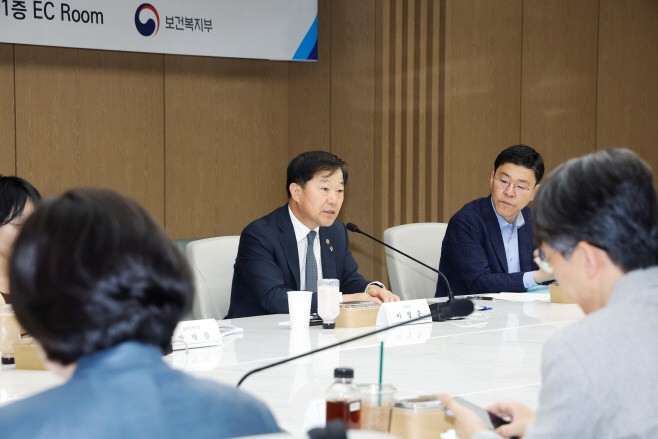 |
| Second Vice Minister of Health and Welfare Lee Hyoung-hoon presides over the National Council for Hospice and Life-Sustaining Care on the 2nd. / Photo via Ministry of Health and Welfare |
The government will initiate discussions on extending the timing for withholding or withdrawing life-sustaining treatment from the current end-of-life stage to the terminal stage.
On the 2nd, the Ministry of Health and Welfare announced that it convened the National Council for Hospice and Life-Sustaining Care to deliberate and finalize this year's implementation plan for the '2nd Comprehensive Plan for Hospice and Life-Sustaining Care.'
The council is a deliberative body formed under Article 8 of the Act on Decisions on Life-Sustaining Treatment, which reviews major policies regarding hospice services and the life-sustaining treatment decision system.
According to this year's implementation plan for the life-sustaining treatment decision system finalized on this day, the government will prepare procedures and amend regulations to enable individuals to register their Advance Directives on Life-Sustaining Treatment online, a process that was previously limited to in-person visits. Concurrently, it plans to continuously expand in-person registration centers, focusing on local public health medical institutions and medical institutions equipped with ethics committees, thereby allowing people to reflect on a dignified end of life by drafting advance directives.
Discussions will commence through organizations such as the National Bioethics Committee on expanding the window for withholding or withdrawing life-sustaining treatment—which is currently restricted to the end-of-life stage—to the terminal stage. Through these discussions, the government intends to step-by-step promote institutional revisions to broaden the scope of application, mapping out major points of contention and establishing specific standards based on social consensus.
To reinforce the foundation for stable institutional operations, the government will establish a document management system to convert and store legal forms, including Advance Directives on Life-Sustaining Treatment, as electronic documents, while continuously expanding education for personnel working at medical institutions and advance directive registration centers.
Through this year's hospice implementation plan, the government decided to improve the medical fee system for home-type hospices to ensure stable service provision, and to devise infrastructure expansion plans by analyzing factors that hinder hospice expansion. In particular, it plans to develop a hospice service model specialized for nursing hospitals and push forward with its field application.
By sharing information on waitlisted hospice patients, the government will support patient linkage between specialized hospice institutions, and it will upgrade the comprehensive hospice information system by the second half of this year to calculate and analyze detailed statistics, such as waitlist termination results. The Ministry of Health and Welfare explained that it will push forward with evidence-based policies, such as hospice project improvements, based on this system.
Furthermore, as part of strengthening the expertise of service providers, practical training courses will be expanded and operated, and the hospice satisfaction survey for bereaved families will be improved to be reflected in future systems.
Second Vice Minister of Health and Welfare Lee Hyoung-hoon, who presided over the council on this day, stated, "The issue of the end of life is a story that concerns all of us, something that can happen to me and my family at any time," adding, "We will continue to develop the system by reflecting voices from the field so that citizens can prepare for a dignified conclusion to their lives."
Seo Byung-joo
Most Read
-
1
Celltrion’s Omlyclo gains ground in major European..

-
2
Trump demands rates fall below 1% as Fed hikes for..

-
3
Hyundai Motor Group breaks ground on integrated st..

-
4
U.S. strikes 3 Iranian oil tankers, Iran vows reta..

-
5
Trump makes $1 trillion bet ahead of midterm elect..

-
6
Iran resumes ballistic missile production, assembl..

-
7
Samsung Electronics, Mistral AI to jointly develop..

PEOPLE







-
Address : In-Young Bldg., 34, Uisadang-daero 1-gil, Yeongdeungpo-gu, Seoul
Copyright by ASIATODAY CO., LTD. All rights resereved