



[Exclusive] Hyundai E&C sets up New Zealand branch to expand Oceania presence
Jun 02, 2026, 05:16 pm


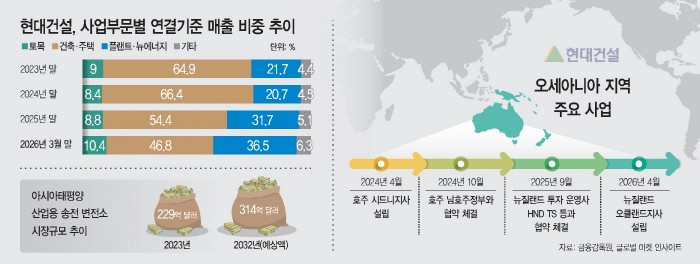 |
Hyundai Engineering & Construction has embarked on expanding its Oceania energy and housing businesses by establishing a branch in New Zealand, following its entry into Australia. The strategy aims to lay the groundwork for entering the local market by utilizing energy and housing projects as its two main pillars, while securing synergies with infrastructure projects over the medium to long term.
According to the industry on the 2nd, Hyundai E&C established its Auckland branch in New Zealand on April 28th. This comes about a month after the board of directors approved the establishment of the Auckland branch on March 26th. While this marks a faster pace compared to its recent establishment of a Japanese subsidiary, simple comparisons are limited given the differing registration procedures between branches and subsidiaries; however, it remains clear that Hyundai E&C is accelerating its efforts to secure business hubs in Oceania.
The Auckland branch is Hyundai E&C's second office in Oceania, following the establishment of the Sydney branch in Australia in 2024. The Sydney branch is expected to support energy and infrastructure projects within Australia, while the Auckland branch will support housing development and local network building in New Zealand, with each office managing business development and operations in their respective countries.
Hyundai E&C's consecutive establishment of branches in Oceania closely aligns with its region-specific business strategies. In the Americas and Europe, the company is focusing on energy projects, while in the Middle East, it is diversifying its portfolio through eco-friendly energy sectors such as blue hydrogen. In Asia, it is exploring business opportunities centered around the transport infrastructure market.
In Oceania, the company plans to step-by-step strengthen its construction execution capabilities through participation in housing investment development and construction management (CM), while securing synergies with energy and infrastructure projects. In Australia, it is attempting to settle into the large-scale power transmission and distribution public-private partnership (PPP) and renewable energy markets, and based on this, it envisions broadening its business scope to neighboring countries like New Zealand.
Power transmission and distribution is an area where Hyundai E&C has consistently secured competitiveness in the global market. As Australia concurrently pursues large-scale infrastructure investment and the expansion of renewable energy, it could serve as an opportunistic factor for Hyundai E&C, which aims to expand its global transmission and distribution business. According to the International Contractors Association of Korea, Australia intends to raise the share of renewable energy in its total energy sources from 39% in 2023 to 82% by 2030. Consequently, observations suggest that the company can sustain its revenue growth trend in the plant and new energy sectors, which encompass transmission and distribution projects.
In New Zealand, the company will simultaneously carry out housing projects. Hyundai E&C is reviewing plans to incorporate electric vehicle (EV) charging stations and solar panels into the local residential environment, leaving room for future business expansion. There is also potential for collaboration with Hyundai Motor Group affiliates such as Hyundai Engineering, which is currently pursuing EV charging station businesses.
Although the median housing price in New Zealand has declined by 16% from its peak in 2021, Hyundai E&C maintains that its target market differs from the general housing market. "As we are building high-end housing in affluent neighborhoods in New Zealand, it moves differently from the general housing market," an official from Hyundai E&C stated, adding, "While targeting foreign investors investing locally, we will also solidify our foundation to settle into global housing markets such as the United States."
Lee Soo-il
Most Read
-
1
Celltrion’s Omlyclo gains ground in major European..

-
2
Trump demands rates fall below 1% as Fed hikes for..

-
3
Trump makes $1 trillion bet ahead of midterm elect..

-
4
Iran resumes ballistic missile production, assembl..

-
5
Samsung Electronics, Mistral AI to jointly develop..

-
6
Trump warns countries not helping U.S. must pay re..

-
7
Apple launches first foldable, 1 million won prici..

PEOPLE






HEADLINE NEWS
- Trump to roll out ‘unprecedented welcome’ for Xi with B-2 bombers, F-22 fighters
- S. Korea, U.S., and Japan form united front on Taiwan and economic coercion..
- Trump administration moves to impose sweeping sanctions on International Cr..
- Xi to make state visit to U.S. Sept. 23-25, dispelling rumors over his heal..

-
Address : In-Young Bldg., 34, Uisadang-daero 1-gil, Yeongdeungpo-gu, Seoul
Copyright by ASIATODAY CO., LTD. All rights resereved