



Shadows of high prices and labor strikes cloud Lee’s first year stock gains
Jun 02, 2026, 02:33 pm


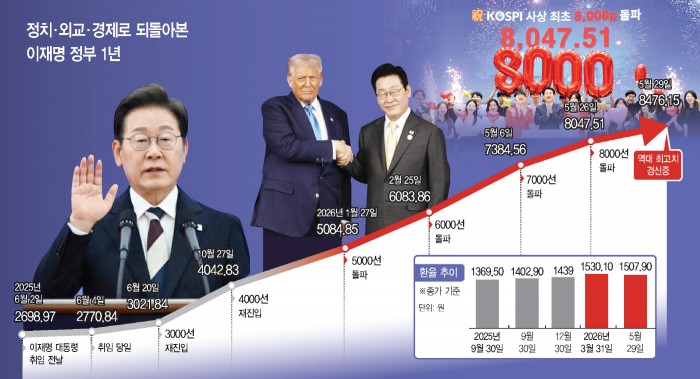 |
One year into the Lee Jae-myung administration, the South Korean capital market is navigating an unprecedented era. The KOSPI market, which had long stagnated around the 2,000 level, has surged past the 5,000 mark promised by President Lee and is now charging into the mid-8,000s. Market experts are putting forward rosy projections that a '10,000 KOSPI era' will open.
However, the shadows clouding the South Korean economy have also become distinct. The KRW/USD exchange rate hovering in the 1,500-won range has become the new normal, and surging inflation is adding to the burden on the livelihoods of ordinary citizens. The boom brought about by the semiconductor cycle has seemingly failed to flow across the broader South Korean economy.
Although the Lee Jae-myung government has set out to rein in real estate prices through high-intensity measures such as tightening loan regulations and ending the suspension of heavy capital gains taxation, the stubborn real estate market is expected to remain a headache throughout President Lee's term.
According to the Korea Exchange on the 31st, the KOSPI closed at 2,698.97 on June 2, 2025, the day before President Lee Jae-myung's inauguration, but rose to 2,770.84 on the day of the inauguration. The KOSPI market displayed a sharp upward trend throughout the past year, kicking off the KOSPI 5,000 era—a campaign promise of President Lee—on January 27 of this year, and recorded 8,476.15 on the 29th of this month. The KOSDAQ also surpassed the 1,000-point mark for the first time in four years, opening the 'Cheon-SDAQ' era.
Behind the high growth performance of the South Korean capital market lies the active promotion of capital market revitalization policies, such as the consecutive introductions of Commercial Act amendments that strengthened shareholder rights under the current administration, alongside the implementation of separate taxation on dividend income. Furthermore, the semiconductor supercycle allowing companies like Samsung Electronics and SK Hynix to enjoy an absolute boom also lifted the capital market. However, except for semiconductor and AI-related stocks, share prices of companies in other industries showed a trend detached from the KOSPI 8,000 era. Out of 947 listed companies on the KOSPI market, only 54 outperformed the KOSPI growth rate, while more than 500 companies remained flat or declined.
Yet, the past year has not been entirely filled with positive news. The exchange rate, which hovered in the mid-1,300-won range at the beginning of President Lee's term, surged due to factors like the US-Iran war, surpassing 1,530 won at the end of March and currently moving sideways in the 1,500-won tier. Although the Bank of Korea and the National Pension Service stepped in to defend the currency, the high exchange rate burden persisted. Concerns are rising that this could act as a significant constraint on the nation's economic growth.
The unyielding real estate prices also stand as a major headache and the biggest task for the current administration. The Lee Jae-myung government focused on suppressing demand and increasing properties put on sale by multi-homeowners through tightening loan regulations, taxes, and land transaction permit systems. While home prices in some areas of Seoul appeared to be contained during the early stages of the policy, they are showing an upward trend once again. In particular, as side effects such as instability in the monthly and jeonse rental markets and a lock-up of property listings emerged, the government is expected to take steps to stabilize housing prices through tax revisions and supply expansion policies following the June 3 local elections.
Cho Eun-guk
Most Read
-
1
Celltrion’s Omlyclo gains ground in major European..

-
2
Trump demands rates fall below 1% as Fed hikes for..

-
3
Trump makes $1 trillion bet ahead of midterm elect..

-
4
Iran resumes ballistic missile production, assembl..

-
5
Samsung Electronics, Mistral AI to jointly develop..

-
6
Trump warns countries not helping U.S. must pay re..

-
7
Apple launches first foldable, 1 million won prici..

PEOPLE





HEADLINE NEWS
- Trump to roll out ‘unprecedented welcome’ for Xi with B-2 bombers, F-22 fighters
- S. Korea, U.S., and Japan form united front on Taiwan and economic coercion..
- Trump administration moves to impose sweeping sanctions on International Cr..
- Xi to make state visit to U.S. Sept. 23-25, dispelling rumors over his heal..

-
Address : In-Young Bldg., 34, Uisadang-daero 1-gil, Yeongdeungpo-gu, Seoul
Copyright by ASIATODAY CO., LTD. All rights resereved