



Korea's exports surge on chip rally as nation eyes $1 trillion mark
Jun 02, 2026, 01:58 pm


 |
As the semiconductor supercycle continues, projections suggest that South Korea's annual exports could surpass $1 trillion for the first time in history.
Analysts say that if the AI-driven demand expansion persists into the second half of the year, the country could achieve its largest-ever export performance, far exceeding the government's initial target of $740 billion.
If this scenario becomes reality, South Korea will overtake Japan and Italy to leapfrog into the world's fifth-largest exporting nation, following China, the United States, Germany, and the Netherlands.
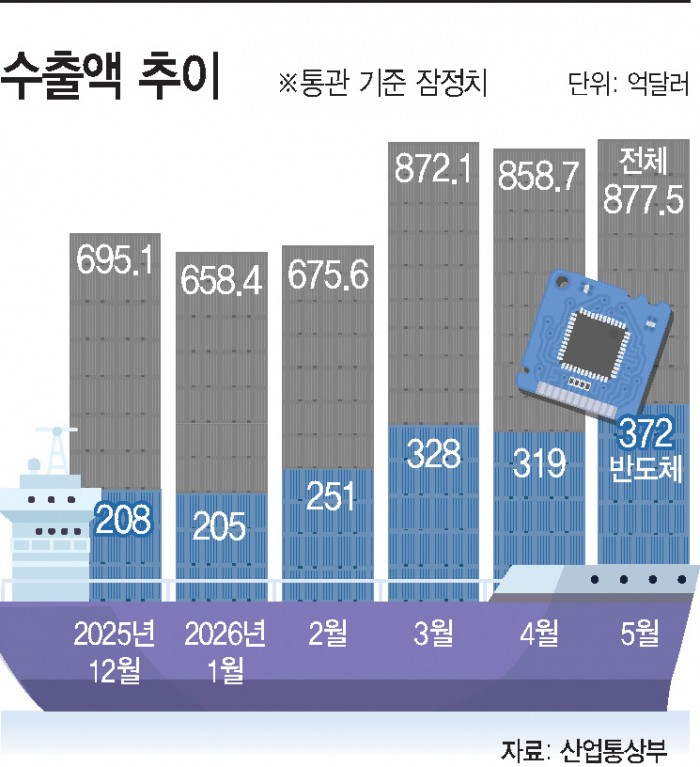
Regarding the possibility of hitting $1 trillion in annual exports, Kang Gam-chan, head of the Trade and Investment Bureau at the Ministry of Trade, Industry and Energy, said during a briefing on 'May Import and Export Trends' held on the 1st, "Given the current trend, we expect to approach the $920 billion projected by the Korea Institute for Industrial Economics and Trade (KIET) and the $950 billion suggested by the Bank of Korea," adding, "Depending on the circumstances, it could go even higher." According to the Ministry, May exports jumped 53.2 percent year-on-year to reach $87.75 billion. This marks the third consecutive month exports exceeded $80 billion, following March ($86.1 billion) and April ($85.9 billion).
Cumulative exports for the first five months of the year were tallied at $393.5 billion. This is a 43 percent increase compared to the same period last year ($274.9 billion). Consequently, outlooks suggest that even if the country merely maintains a monthly export flow of around $80 billion for the remainder of the year, it can easily achieve mid-$900 billion in annual exports and, depending on global conditions, fully possess the potential to break through the $1 trillion mark.
The core driver behind this export surge is semiconductors. As global big tech companies continue massive investments to build generative AI data centers, demand is skyrocketing for high-value-added products where domestic firms hold a competitive edge, such as High Bandwidth Memory (HBM), next-generation server DDR5, and high-capacity Solid State Drives (SSDs).
With the semiconductor export boom persisting, the government and major research institutions are raising their economic outlooks one after another. The Ministry originally set this year's export target at $740 billion at the beginning of the year, but assessments show it is highly likely to far exceed that figure considering the recent growth trend. Minister of Trade, Industry and Energy Kim Jung-gwan also noted during a recent press conference, "Though I am cautious, I believe this year's exports can surpass $900 billion."
The KIET drastically revised its export forecast for this year upward to $924.4 billion from the $697.1 billion it suggested last November. Accordingly, it also raised South Korea's economic growth rate forecast for this year from 1.9 percent to 2.5 percent.
The Bank of Korea similarly raised its growth forecast to 2.6 percent recently, citing the semiconductor economic recovery and export expansion as the main reasons.
Market attention is now shifting toward whether the annual export volume will reach $1 trillion. If materialized, it is expected to set a new milestone in South Korea's trade history. South Korea, which ranked seventh in global exports last year, would surpass Japan ($738.1 billion) and Italy ($714.1 billion)—nations with previously similar export volumes—to rise into the world's top five export powerhouses following China, the United States, Germany, and the Netherlands.
Industry insiders analyze that unlike Japan, whose dollar-denominated export value has stagnated due to the prolonged weak yen, South Korea is expanding its competitiveness by putting high-value-added industries forward, such as advanced semiconductors and future vehicles. However, experts point out that managing second-half external variables is crucial to reaching $1 trillion annually.
Minister Kim Jung-gwan also emphasized through social media recently, "We must secure industrial stamina capable of withstanding future downcycles through next-generation semiconductor development, foundry competitiveness reinforcement, and talent cultivation."
Kim Jung-gyu
Most Read
-
1
Celltrion’s Omlyclo gains ground in major European..

-
2
Trump demands rates fall below 1% as Fed hikes for..

-
3
Trump makes $1 trillion bet ahead of midterm elect..

-
4
Iran resumes ballistic missile production, assembl..

-
5
Samsung Electronics, Mistral AI to jointly develop..

-
6
Trump warns countries not helping U.S. must pay re..

-
7
Apple launches first foldable, 1 million won prici..

PEOPLE






HEADLINE NEWS
- Trump to roll out ‘unprecedented welcome’ for Xi with B-2 bombers, F-22 fighters
- S. Korea, U.S., and Japan form united front on Taiwan and economic coercion..
- Trump administration moves to impose sweeping sanctions on International Cr..
- Xi to make state visit to U.S. Sept. 23-25, dispelling rumors over his heal..

-
Address : In-Young Bldg., 34, Uisadang-daero 1-gil, Yeongdeungpo-gu, Seoul
Copyright by ASIATODAY CO., LTD. All rights resereved