



Opinions diverge over how to use surplus tax revenue
Jun 02, 2026, 01:51 pm


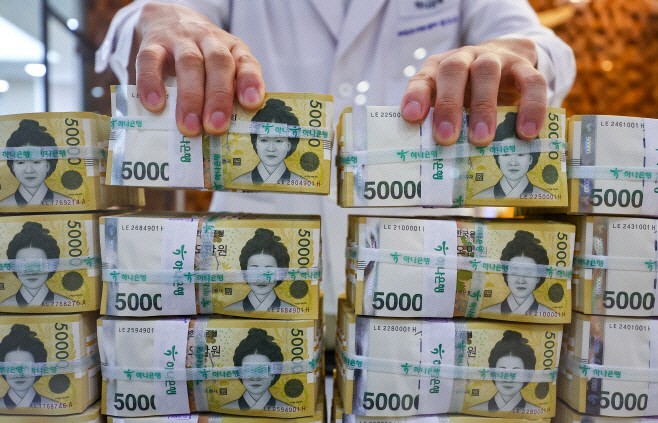 |
| An employee sorts 5,0000-won banknotes at the Anti-Counterfeiting Center inside Hana Bank's headquarters in Euljiro, Jung-gu, Seoul. / Photo via Yonhap News |
With the semiconductor industry boom pushing national tax revenue tracks ahead of expectations, various utilization plans regarding the surplus tax revenue are being proposed. The government has put forward a policy to use the surplus tax revenue as a resource for economic growth, such as investing in future industries, but some argue that it should be allocated to national debt repayment first.
According to relevant ministries including the Ministry of Finance and Economy on the 1st, cumulative tax revenue as of April increased by 21.09 trillion won year-on-year, surpassing half of the 41.5 trillion won annual increase previously projected by the government. In particular, earned income tax and corporate tax rose significantly driven by increased performance bonuses and earnings improvements at domestic semiconductor companies like Samsung Electronics and SK Hynix. Cumulative income tax as of April rose by 5.9 trillion won to 44.7 trillion won, while corporate tax increased by 3.2 trillion won to 39 trillion won.
Furthermore, tax revenue growth is observed to continue as these companies' earnings improvements are projected to persist throughout this year. According to financial information provider FnGuide, Samsung Electronics is projected to earn 349.7114 trillion won in operating profit this year, a 702 percent increase year-on-year, while SK Hynix is expected to generate 254.9580 trillion won, up 440 percent.
Practically determining that a tax surplus will occur this year, the government is presenting a position to utilize it as a resource for high-tech industry infrastructure investment. Deputy Prime Minister and Minister of Finance and Economy Koo Yun-cheol said on the YouTube channel 3ProTV on the 30th of last month, "If we develop and boldly invest in items equivalent to second and third memory semiconductors and create a virtuous cycle structure, more surplus tax revenue will come in." Specifically, the plan is to inject a significant portion of the surplus tax revenue into a sovereign wealth fund scheduled to launch during the second half of this year, seeking long-term growth through investments in national strategic industries.
Some raise voices that the surplus tax revenue must be preferentially injected as a resource for national debt repayment. Previously, the government repaid 1 trillion won worth of government bonds while passing an undated supplementary budget bill in March. This marked the first time in five years since 2021 that government bonds were repaid through a supplementary budget.
Jung Kyu-chul, head of the Department of Macroeconomic and Financial Policy at the Korea Development Institute (KDI), also advised during an economic outlook briefing for the first half of 2026 last month, "The need for fiscal policy aimed at economic stimulus is not significant during an economic expansion phase."
Academia suggests a flexible utilization approach that reflects budget expenditure status. Kim Sang-bong, an economics professor at Hansung University, explained, "While debt repayment through the surplus tax revenue is important, we can seek ways to simultaneously pursue other utilization directions," adding, "For instance, there is a method of dividing the surplus tax revenue to repay debt in a scale proportional to additionally spent budgets, while investing the remaining tax revenue into growth policies."
Seo Byung-joo
Most Read
-
1
Celltrion’s Omlyclo gains ground in major European..

-
2
Trump demands rates fall below 1% as Fed hikes for..

-
3
Trump makes $1 trillion bet ahead of midterm elect..

-
4
Iran resumes ballistic missile production, assembl..

-
5
Samsung Electronics, Mistral AI to jointly develop..

-
6
Trump warns countries not helping U.S. must pay re..

-
7
Apple launches first foldable, 1 million won prici..

PEOPLE






HEADLINE NEWS
- Trump to roll out ‘unprecedented welcome’ for Xi with B-2 bombers, F-22 fighters
- S. Korea, U.S., and Japan form united front on Taiwan and economic coercion..
- Trump administration moves to impose sweeping sanctions on International Cr..
- Xi to make state visit to U.S. Sept. 23-25, dispelling rumors over his heal..

-
Address : In-Young Bldg., 34, Uisadang-daero 1-gil, Yeongdeungpo-gu, Seoul
Copyright by ASIATODAY CO., LTD. All rights resereved