



K-biotech innovation bears fruit in new drugs and treatments
Jun 02, 2026, 11:32 am


 |
Just one year into the Lee Jae-myung administration, South Korea's K-biotech industry has achieved historic milestones by successfully hitting two targets at once: regulatory innovation and expanding its global export footprint. Industry observers assess that by boldly overhauling long-standing regulations to reflect voices from the field, the sector has built a solid launchpad to lead the global market, with pharmaceutical and biotech exports surpassing $10 billion for the first time in history.
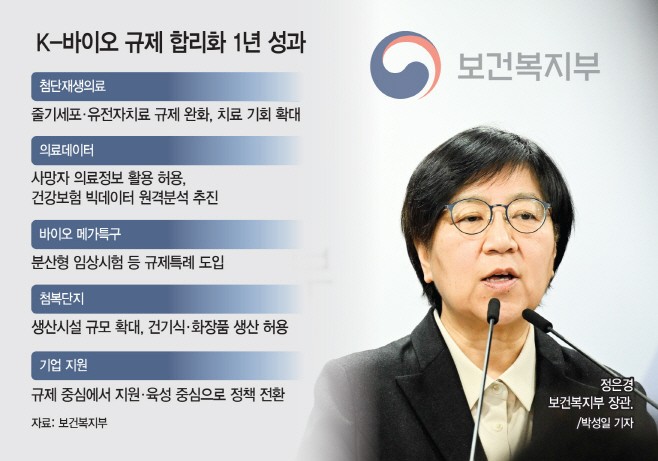
According to the 'Key Regulatory Rationalization Outcomes and Industry Promotion Report' for the K-biotech sector released by the Ministry of Health and Welfare on the 1st, the most notable achievements lie in the regulatory rationalization of advanced regenerative medicine and medical data, both considered future growth engines. The government has undertaken sweeping institutional overhauls to ensure that domestic clinical research can proceed smoothly, creating an environment where patients no longer need to travel abroad to receive medical treatments.
Previously, advanced regenerative medicine faced clear limitations. Despite having the technology for stem cell therapies, the scope of treatment was restricted only to serious, rare, and incurable diseases, and the vague definitions made the application process for practitioners complicated. In particular, even for low-to-medium-risk clinical research, excessive non-clinical data akin to high-risk levels were demanded, delaying research. In response, the government provided exemplary guidelines for 82 diseases so that research fields can flexibly judge whether a condition is an incurable disease, throwing its full support behind bolstering research and treatment.
Consequently, the path has opened to launch clinical research and apply practical treatments domestically using autologous stem cells for conditions like chronic pain or musculoskeletal disorders, which previously triggered frequent medical tours abroad. Even if domestic research data is insufficient, treatments are now permitted by leveraging already verified overseas clinical trials and clinical research results. Indeed, this past April, an autologous immune cell therapy designed to prevent recurrence in patients with rare lymphoma at high risk of relapse became the fruit of these efforts, gaining approval as the 'First Advanced Regenerative Medicine Treatment'.
The utilization of medical data from deceased individuals, which had been bound by regulations, has also opened up. The Ministry of Health and Welfare, alongside the Personal Information Protection Commission, clarified guidelines to facilitate the use of information from the deceased and developed a 'low-risk pseudonymized dataset' with enhanced personal identification prevention measures, resolving confusion in the field.
The promotion of the bio-industry linked to balanced regional development has also taken concrete shape. A representative example is the 'Bio Mega-Cluster Promotion Plan' announced this past April by the government, linked with the national balanced growth strategy connecting the Capital region, Southeast region, Daegu-Gyeongbuk region, Central region, and Honam region, alongside Jeju, Gangwon, and Jeonbuk—collectively known as the '5 Hubs and 3 Special Zones'. The core of the Bio Mega-Cluster is the 'menu-style regulatory exemptions' designed to help tenant companies deliver outcomes in a free environment. By providing various deregulation items like simplified procedures and eased licensing standards in a pre-packaged format, companies and regions can easily and quickly select the specific exemptions they need.
Regarding manufacturing facility regulations within advanced medical complexes, the restriction on the installation size of pharmaceutical and medical device production facilities—previously tightly bound to under 5,000 square meters—was significantly relaxed threefold to under 15,000 square meters. Furthermore, the entry of health functional food and functional cosmetics manufacturing facilities, which acted as a stumbling block to corporate investment as they were in principle barred from entering the complexes, is now permitted.
This omnidirectional regulatory innovation translated immediately into tangible economic performance. Last year, total exports across the entire biohealth sector, encompassing pharmaceuticals, biotech, medical devices, and cosmetics, rose 10.3 percent year-on-year to hit a record high of $27.9 billion (approximately 42 trillion won). Notably, exports of pharmaceuticals and biotech as a single category recorded $10.4 billion, crossing the $10 billion milestone for the first time in history.
"We will stimulate preemptive investments from corporations by boldly introducing menu-style regulatory exemptions centered around the Bio Mega-Clusters," stated Minister of Health and Welfare Jung Eun-kyeong. "We will fully back the sector by marshaling pan-governmental capabilities so that South Korea can leap forward as a central nation leading the global biohealth market."
Lee Sae-mi
Most Read
-
1
Celltrion’s Omlyclo gains ground in major European..

-
2
Trump demands rates fall below 1% as Fed hikes for..

-
3
Hyundai Motor Group breaks ground on integrated st..

-
4
U.S. strikes 3 Iranian oil tankers, Iran vows reta..

-
5
Trump makes $1 trillion bet ahead of midterm elect..

-
6
Iran resumes ballistic missile production, assembl..

-
7
Samsung Electronics, Mistral AI to jointly develop..

PEOPLE







-
Address : In-Young Bldg., 34, Uisadang-daero 1-gil, Yeongdeungpo-gu, Seoul
Copyright by ASIATODAY CO., LTD. All rights resereved