



Mideast supply crunch hits SMEs with soaring costs and empty inventories
Jun 02, 2026, 09:58 am


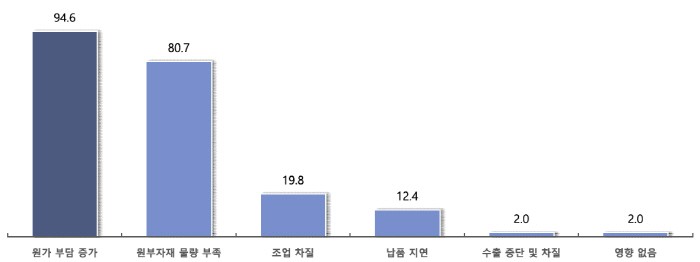 |
| Changes in production activities due to the Middle East situation. |
As the situation in the Middle East grows unstable, domestic small and medium-sized enterprises (SMEs) have been pushed to the brink due to difficulties in procuring raw and ancillary materials. While suffering from a double whammy of decreasing production and soaring costs, they are in a reality where they lack the sheer capacity to prepare for a prolonged crisis.
According to a survey conducted by the Korea Federation of Small and Medium Business (KBIZ) targeting 410 companies procuring raw and ancillary materials, 94.6 percent of the responding enterprises complained of an increased cost burden, while 80.7 percent reported shortages in volume. KBIZ conducted the 'Survey on Raw and Ancillary Material Procurement Difficulties of SMEs Related to the Middle East' from May 15 to 31, targeting 410 SMEs currently procuring raw and ancillary materials, and released the results on June 2.
The companies replying that the purchase unit price of raw and ancillary materials jumped by more than 20 percent compared to late February reached 71.9 percent. In particular, businesses utilizing packaging materials and films took the hardest hit, with responses indicating that costs skyrocketed by over 80 percent far exceeding the overall average. While the situation remains grim, inventory conditions are equally disastrous. Enterprises holding less than 70 percent of their appropriate inventory levels reached 65.9 percent, and 36.1 percent of the firms found it difficult to hold out for even a single month.
When asked how they would respond if the Middle East crisis persists for more than three months, not many companies possessed clear countermeasures. Excluding those planning to scale back operations, nearly half of the total, at 49.7 percent, have been unable to establish any specific response plan at all.
On the ground, unilateral price hikes and supply restrictions by large corporate suppliers are cited as the greatest sources of pain. Amid situations where prices are notified without clear calculation criteria, a torrent of grievances pours out from cash-strapped SMEs, stating they have been pushed out of the competition to secure raw materials and are facing the risk of production halts.
"Disruptions in procuring basic raw and ancillary materials can ultimately lead to production shutdowns across downstream industries as a whole, including food and daily necessities," noted Kim Hee-jung, head of the Economic Policy Division at KBIZ. He pointed out, "The government must closely monitor the price-setting and supply processes of raw material suppliers and act swiftly to stabilize the supply for SMEs."
Enterprises are strongly demanding that the government preferentially push forward measures such as strengthening the monitoring of raw and ancillary material supply conditions, supporting the utilization of the delivery unit price indexing system, and providing emergency management stabilization funds.
Oh Se-eun
Most Read
-
1
Celltrion’s Omlyclo gains ground in major European..

-
2
Trump demands rates fall below 1% as Fed hikes for..

-
3
Trump makes $1 trillion bet ahead of midterm elect..

-
4
Iran resumes ballistic missile production, assembl..

-
5
Samsung Electronics, Mistral AI to jointly develop..

-
6
Trump warns countries not helping U.S. must pay re..

-
7
Apple launches first foldable, 1 million won prici..

PEOPLE






HEADLINE NEWS
- Trump to roll out ‘unprecedented welcome’ for Xi with B-2 bombers, F-22 fighters
- S. Korea, U.S., and Japan form united front on Taiwan and economic coercion..
- Trump administration moves to impose sweeping sanctions on International Cr..
- Xi to make state visit to U.S. Sept. 23-25, dispelling rumors over his heal..

-
Address : In-Young Bldg., 34, Uisadang-daero 1-gil, Yeongdeungpo-gu, Seoul
Copyright by ASIATODAY CO., LTD. All rights resereved