



Swarms of unwelcome ‘lovebugs’ to hit country this month amid early heat
Jun 01, 2026, 05:45 pm


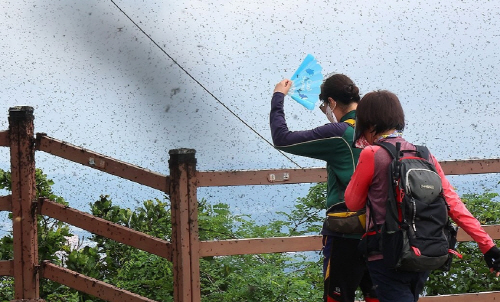 |
| The summit of Gyeyang Mountain in Gyeyang-gu, Incheon, is blanketed by swarms of lovebugs last year. / Photo via Yonhap News |
Swarms of plecia longiforceps (commonly known as lovebugs), the notorious summer nuisance, are expected to plague the Korean Peninsula starting mid-month. There is a high probability they will arrive earlier and in greater numbers than in previous years—a direct consequence of the early heat wave that struck in May, as climate change increasingly shifts South Korea's weather patterns toward a subtropical climate. Forest authorities and local governments have initiated pest control operations to minimize public discomfort.
An analysis by the National Institute of Forest Science under the Korea Forest Service using its proprietary prediction model indicates that the peak window for the lovebug outbreak this year will span from June 15 to 29. This timeline is approximately two days earlier than last year. While the peak activity date is projected to hit on June 24—identical to last year—the total duration of the outbreak has contracted by two days, meaning a massive volume of the insects will likely converge simultaneously within a shorter period.
The lovebug is a species of saprophagous fly indigenous to subtropical regions, including southern China and Taiwan, as well as East Asian nations like South Korea and Japan. It earned its moniker from the distinct habit of males and females remaining coupled while flying. The insects are non-toxic and do not cause direct harm to animals or agricultural crops. In fact, they are classified as beneficial insects because they prey on pests such as mites and decompose fallen leaves to enrich the soil with nutrients. Nevertheless, their high-density clusters during specific periods disrupt pedestrian traffic and induce public aversion.
The date of the year's first lovebug sighting advanced significantly from June 16 in 2023 to June 4 in 2024, and this year, individual sightings were recorded as early as May. This pattern is intrinsically linked to climate change on the Korean Peninsula. Lovebugs typically remain in the pupal stage until May and mature into adults starting in June. However, the recent frequency of summer-like heat in May has accelerated their development. The average May temperature in Seoul has been on a steady upward trajectory, climbing from 16.3 degrees Celsius in 2024 to 17.8 degrees in 2025, and hitting 19.6 degrees in 2026. This year proved exceptionally severe, with temperatures soaring past 30 degrees starting on May 14—shattering records by over 3 degrees compared to 2024, which was previously considered one of the hottest years on record. This explains why lovebugs, once confined to southern China, have consistently expanded their activity levels since they were first detected in South Korea in 2015.
Local municipalities have taken preemptive measures since last month, deploying insect traps along urban rivers, parks, and mountainous fringes. Concurrently, the Korea Forest Service is conducting field experiments to develop novel pest control agents. "While field environments may exhibit variations from indoor laboratory settings due to shifting weather and ecological variables, we will utilize these experimental findings to establish the optimal timing and application methods for eradication," stated Park Yong-hwan, a researcher at the National Institute of Forest Science.
Kim Hong-chan
Most Read
-
1
Celltrion’s Omlyclo gains ground in major European..

-
2
Trump demands rates fall below 1% as Fed hikes for..

-
3
Hyundai Motor Group breaks ground on integrated st..

-
4
U.S. strikes 3 Iranian oil tankers, Iran vows reta..

-
5
Trump makes $1 trillion bet ahead of midterm elect..

-
6
Iran resumes ballistic missile production, assembl..

-
7
Samsung Electronics, Mistral AI to jointly develop..

PEOPLE







-
Address : In-Young Bldg., 34, Uisadang-daero 1-gil, Yeongdeungpo-gu, Seoul
Copyright by ASIATODAY CO., LTD. All rights resereved