



S. Korea’s exports top $80B for 3rd month, hitting record $87.7B in May
Jun 01, 2026, 01:23 pm


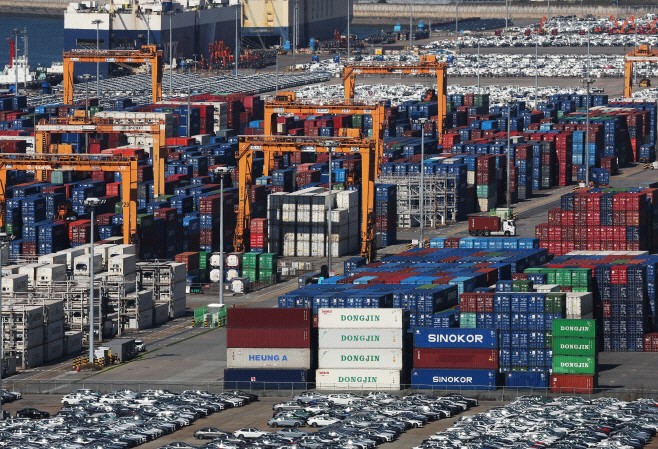 |
South Korea’s monthly exports surged to an all-time high last month, breaking through the $80 billion threshold for the third consecutive month. Driven by robust semiconductor shipments fueled by expanding global investments in artificial intelligence (AI), the trade balance also posted a historic record-high surplus.
According to the May 2026 Import and Export Trends report released by the Ministry of Trade, Industry and Energy on June 1, outbound shipments last month jumped 53.2 percent year-on-year to reach $87.75 billion. This marks the highest monthly export volume on record.
Imports grew by 20.8 percent to $60.8 billion, resulting in a staggering trade surplus of $26.95 billion.
Notably, monthly exports surpassed the $80 billion mark for the third straight month, following $87.2 billion in March and $85.9 billion in April. Average daily exports, adjusted for working days, reached $4.28 billion, clearing the $4 billion milestone for the first time in history.
Semiconductors spearheaded this stellar export performance. Chip shipments skyrocketed 169.4 percent year-on-year to register an all-time high of $37.16 billion last month.
As memory prices continued their upward trajectory backed by aggressive AI infrastructure investments from Big Tech firms in the United States, exports of DRAM leaped 369.8 percent, while NAND flash shipments rose 206.8 percent.
Computer exports also swelled 290.7 percent to $4.18 billion, powered by a spike in demand for solid-state drives (SSDs) destined for AI servers. Displays grew by 9.4 percent and wireless communication devices ticked up 12.6 percent, pushing all tech sectors into positive growth territory.
Conversely, automotive exports slipped 5.9 percent to $5.83 billion. Analysts attribute this decline to a confluence of factors, including fewer working days, intermittent component supply disruptions, logistical burdens stemming from conflicts in the Middle East, and expanded local production in the U.S. triggered by tariff policies. Meanwhile, shipbuilding exports climbed 16.7 percent to $2.61 billion, buoyed by increased deliveries of liquefied natural gas (LNG) carriers.
In the energy and chemical sectors, petroleum product exports jumped 46.6 percent to $5.25 billion under the influence of high global oil prices, while petrochemical shipments increased 11.1 percent. Non-ferrous metal exports also grew 41.5 percent, driven by rising demand for copper and aluminum required for the expansion of AI data centers.
By destination, shipments to China surged 80.9 percent to $189 billion, maintaining an upward trend for seven consecutive months. Exports to the U.S. increased 59.1 percent to $15.97 billion, while outbound shipments to ASEAN nations set a new record high at $15.85 billion.
The cumulative trade surplus for the first five months of this year reached $101.91 billion, already eclipsing the previous full-year record high of $95.2 billion set in 2017.
"Trade uncertainties persist, including whether the war in the Middle East will draw to a close, alongside U.S. tariffs and the European Union's steel tariff-rate quotas (TRQ)," Trade Minister Kim Jung-kwan stated. "The government will work closely with major counterparts to mitigate trade risks for our enterprises and foster a stable export environment. We will actively support corporate production and export activities by ensuring the stable procurement of key imported raw materials, such as crude oil and naphtha, and comprehensively reviewing our supply chains."
Kim Jeong-gyu
Most Read
-
1
Celltrion’s Omlyclo gains ground in major European..

-
2
Trump demands rates fall below 1% as Fed hikes for..

-
3
Trump makes $1 trillion bet ahead of midterm elect..

-
4
Iran resumes ballistic missile production, assembl..

-
5
Samsung Electronics, Mistral AI to jointly develop..

-
6
Trump warns countries not helping U.S. must pay re..

-
7
Apple launches first foldable, 1 million won prici..

PEOPLE






HEADLINE NEWS
- Trump to roll out ‘unprecedented welcome’ for Xi with B-2 bombers, F-22 fighters
- S. Korea, U.S., and Japan form united front on Taiwan and economic coercion..
- Trump administration moves to impose sweeping sanctions on International Cr..
- Xi to make state visit to U.S. Sept. 23-25, dispelling rumors over his heal..

-
Address : In-Young Bldg., 34, Uisadang-daero 1-gil, Yeongdeungpo-gu, Seoul
Copyright by ASIATODAY CO., LTD. All rights resereved