



Gov't to promote investment on funds for K-medical devices
May 29, 2026, 10:30 am


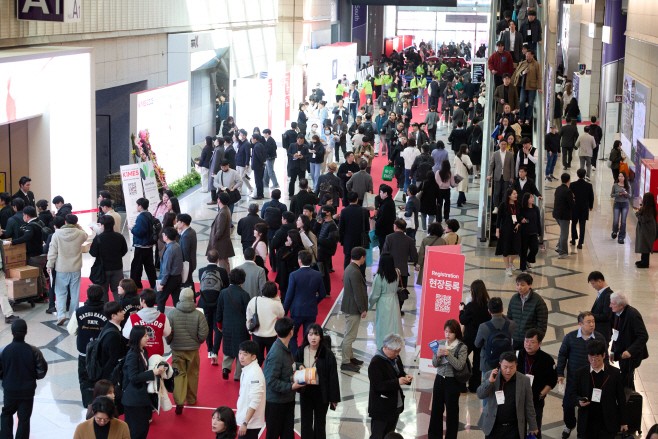 |
The exhibition floor of the International Medical and Hospital Equipment Show (KIMES 2026) held at COEX in Seoul this past March. / Photo courtesy of KIMES
The South Korean government, which has designated "K-medical devices" as a next-generation national growth engine, is engineering a dedicated investment fund to stimulate private sector capital injection. Although the medical device sector is experiencing rapid expansion, complex and prolonged clinical trials and regulatory bottlenecks frequently deter private backers. To offset these operational barriers, the government is introducing a specialized fund structured to alleviate funding constraints for early-stage startups and ensure sustainable industry growth.
According to industry sources on May 28, the Korea Health Industry Development Institute (KHIDI) is accepting bids for a research project titled "Planning Study on the Structuring of a Dedicated Investment Fund for the Medical Device Industry" through June 9. The initiative builds upon previous state-led efforts, including a comprehensive, interagency advanced medical device R&D program that funneled 940.0 billion won into the sector over a seven-year cycle.
The domestic medical device ecosystem has experienced a strong post-pandemic rebound. Last year, South Korea's medical device market expanded 12.6% year-on-year to reach 11.8769 trillion won, maintaining a compound annual growth rate (CAGR) of 6.8% over the past five years. During the same fiscal timeframe, domestic manufacturing output and export volumes ticked up 8.1% and 2.2% to hit 12.3558 trillion won and 7.6395 trillion won, respectively, logging consecutive annual gains.
Concurrently, venture capital interest has trended upward. Data from the domestic startup investment database The VC indicates that venture backing for medical technologies grew from 329.3 billion won in 2023 to 444.9 billion won the following year, before climbing to 499.4 billion won last year.
Despite this upward trajectory, KHIDI analyzes that institutional private investments remain restricted by the unique structural constraints of the medical technology industry, which is defined by protracted development pipelines, intensive clinical trials, and high regulatory compliance standards. Specifically, many enterprises struggle to bridge the capital intensive "Valley of Death"—the phase between initial technological breakthrough and full-scale commercialization. This has highlighted the urgent need for a continuous, end-to-end investment framework that links early R&D funding with downstream clinical deployment and market entry.
The upcoming research project, scheduled to conclude by late October, will survey active institutional investors and medical tech enterprises to gauge their participation interest in a public-private hybrid fund. The study will also project optimal annual funding capacities and recommend optimal organizational legal structures and management strategies for the vehicle.
Moving forward, the state-backed study aims to establish a robust policy justification for the dedicated vehicle, using state-sponsored seed capital to de-risk projects and crowd in private asset managers. Furthermore, researchers will conduct market feasibility and cost-benefit analyses to validate the long-term viability of the fund while measuring its broader socioeconomic spillover effects.
"Given that the vast majority of domestic medical technology players are early-stage startups, securing external capital is a critical factor governing their scaling potential and commercial survival," a KHIDI official noted. "By analyzing both domestic and international venture capital trends, we plan to implement institutional frameworks and policy measures optimized for efficient fund deployment and management."
Seo Byung-ju |
Most Read
-
1
Celltrion’s Omlyclo gains ground in major European..

-
2
Trump demands rates fall below 1% as Fed hikes for..

-
3
Hyundai Motor Group breaks ground on integrated st..

-
4
U.S. strikes 3 Iranian oil tankers, Iran vows reta..

-
5
Trump makes $1 trillion bet ahead of midterm elect..

-
6
Iran resumes ballistic missile production, assembl..

-
7
Samsung Electronics, Mistral AI to jointly develop..

PEOPLE







-
Address : In-Young Bldg., 34, Uisadang-daero 1-gil, Yeongdeungpo-gu, Seoul
Copyright by ASIATODAY CO., LTD. All rights resereved