



Korea speeds up 'Blue Carbon' expansion utilizing tidal flats and seaweed
May 28, 2026, 10:18 am


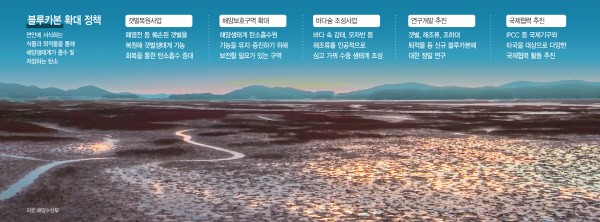 |
The center of gravity for carbon neutrality is shifting from land to sea. Moving beyond "green carbon," which centers primarily on forests and trees, "blue carbon"—the carbon absorbed by marine ecosystems such as tidal flats, seagrass, and seaweed—has recently emerged as a pivotal mechanism for climate response. Consequently, the Ministry of Oceans and Fisheries is accelerating its strategy to expand blue carbon reserves by leveraging tidal flats and seaweed. The initiative aims to nurture blue carbon not merely as a tool for marine conservation, but as a core policy instrument for greenhouse gas reduction and carbon neutrality implementation.
According to the Ministry of Oceans and Fisheries on May 27, blue carbon is recognized by the international community as an official climate response mechanism driven by marine carbon sinks like halophytes, seagrass, and mangroves. In alignment with this, the Ministry introduced its "Blue Carbon Drive Strategy" in 2023, establishing milestones to fulfill the 2030 Nationally Determined Contributions (NDC) and the 2050 Carbon Neutrality Roadmap. The policy framework centers on tidal flat restoration, the expansion of marine protected areas, and the cultivation of marine forests.
First, the tidal flat restoration initiative focuses on reclaiming degraded tidal flats, such as abandoned salt pans, to restore their baseline carbon absorption capacities. Tidal flats are regarded as primary carbon sinks due to their capacity to trap and store organic matter within sedimentary layers over long periods. In connection with this, the Ministry finalized the "Second Basic Plan for the Management and Restoration of Tidal Flats," outlining a mid-to-long-term roadmap for systematic restoration and efficient management.
The expansion of marine protected areas serves as another critical pillar of the blue carbon blueprint. By designating regions rich in marine biodiversity or essential for carbon sink preservation as protected zones, the policy aims to mitigate ecosystem degradation while maintaining and boosting carbon storage capacities.
Concurrently, the government is ramping up its marine forest cultivation project, which involves artificially transplanting and managing seaweeds such as Ecklonia cava and Sargassum to rehabilitate underwater ecosystems. Seaweeds function as prominent marine carbon sinks by absorbing atmospheric carbon dioxide through photosynthesis. With coastal barrenness and rising sea temperatures shrinking natural seaweed habitats, the creation of marine forests has garnered attention as a dual-purpose policy capable of achieving both carbon sequestration and fishery replenishment.
Alongside these policy initiatives, the Ministry is channeling significant resources into securing a scientific foundation for blue carbon. Since 2017, the Ministry has driven dedicated research and development (R&D) to build statistical databases and calculate absorption coefficients for existing blue carbon sources. Crucially, the government is conducting rigorous studies on potential new blue carbon vectors—including tidal flats, seaweed, and subtidal sediments—to chart carbon absorption mechanisms and derive precise absorption coefficients. This research represents an essential prerequisite for securing official recognition from the international community.
The Ministry's extensive investment in blue carbon R&D is underpinned by its long-term objective of integrating these resources into international carbon markets and national greenhouse gas reduction inventories. Currently, official blue carbon sources recognized under international frameworks remain limited to mangrove forests, salt marshes, and seagrass meadows. Conversely, tidal flats and expansive seaweed colonies—which constitute core components of South Korea's coastal ecology—have yet to be fully validated as official carbon sinks under global criteria.
To bridge this gap, the Ministry is intensifying international cooperation with bodies such as the Intergovernmental Panel on Climate Change (IPCC) and the United Nations Framework Convention on Climate Change (UNFCCC). Capitalizing on its domestic R&D findings, South Korea has actively participated in IPCC expert panels, hosted side events at UNFCCC assemblies, and convened international forums to persistently advocate for the inclusion of new blue carbon categories. As a result of these efforts, tidal flats, seaweed, and subtidal sediments were formally acknowledged as candidate blue carbon sources during the 63rd IPCC session held this past October.
Furthermore, in January of this year, two South Korean researchers were selected as authors for the upcoming IPCC Methodology Report, directly participating in its drafting process. Scheduled for official publication in 2027, this volume will serve as the global standard guideline for carbon accounting.
Once the report is issued, the probability of tidal flats and seaweed securing status as official carbon sinks within the UNFCCC architecture escalates significantly. This transition would allow South Korea—leveraging its status as a nation with some of the world's highest-ranked tidal flat areas alongside its advanced marine forest cultivation and seaweed aquaculture technologies—to aggressively scale up its carbon reduction metrics. Concurrently, it is expected to unlock new economic avenues tied to the international carbon market.
"Moving forward, we intend to continuously discover novel blue carbon resources, including marine plankton," a ministry official stated. "We will actively engage with international organizations and host global forums to ensure these new blue carbon sources receive official recognition as global carbon sinks."
Lee Ji-hoon
Most Read
-
1
Celltrion’s Omlyclo gains ground in major European..

-
2
Trump demands rates fall below 1% as Fed hikes for..

-
3
Trump makes $1 trillion bet ahead of midterm elect..

-
4
Iran resumes ballistic missile production, assembl..

-
5
Samsung Electronics, Mistral AI to jointly develop..

-
6
Trump warns countries not helping U.S. must pay re..

-
7
Apple launches first foldable, 1 million won prici..

PEOPLE






HEADLINE NEWS
- Trump to roll out ‘unprecedented welcome’ for Xi with B-2 bombers, F-22 fighters
- S. Korea, U.S., and Japan form united front on Taiwan and economic coercion..
- Trump administration moves to impose sweeping sanctions on International Cr..
- Xi to make state visit to U.S. Sept. 23-25, dispelling rumors over his heal..

-
Address : In-Young Bldg., 34, Uisadang-daero 1-gil, Yeongdeungpo-gu, Seoul
Copyright by ASIATODAY CO., LTD. All rights resereved