



NASA to build permanent Moon base
May 28, 2026, 09:32 am


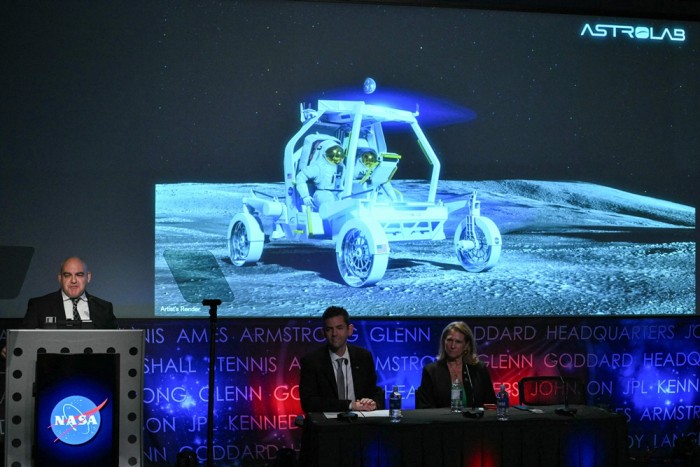 |
| Carlos Garcia Galan, NASA's Moon Base Project Manager (left), outlines the current status of initiatives to establish a sustained human presence on the Moon during a press conference held at NASA Headquarters in Washington, D.C., on May 26 (local time), as an image of Astrolab's lunar exploration rover is displayed on the screen. Seated alongside him are NASA Administrator Jared Isaacman (center) and Lori Glaze, Acting Director of the Exploration Development Directorate. / Photo via AFP-Yonhap News |
The National Aeronautics and Space Administration (NASA) unveiled its uncrewed exploration mission slate for this year on May 26 (local time), taking a major stride toward its long-term objective of constructing a permanent base on the lunar surface.
Coming less than two months after the triumphant lunar orbital flight of Artemis II, NASA convened a press conference at its headquarters in Washington, D.C., to disclose the inaugural phase of its lunar outpost initiative. The space agency announced it has secured contracts worth hundreds of millions of dollars with four American aerospace firms.
Blue Origin, founded by Amazon billionaire Jeff Bezos, will supply two lunar landers tasked with transporting exploration vehicles to designated drop zones near the Moon's south pole.
The vehicles, designated as Lunar Terrain Vehicles (LTVs), will be engineered by space startups Astrolab and Lunar Outpost.
Firefly Aerospace, which pulled off a successful lunar landing last year, is slated to transport the first-ever drone to the lunar surface.
If operations proceed according to schedule, this hardware must be deployed to the Moon prior to 2028, ahead of the arrival of Artemis astronauts.
During the Artemis II mission in early last month, a crew of four astronauts charted a path around the lunar orbit, venturing deeper into deep space than any Apollo lunar expedition of the late 1960s and early 1970s.
The Artemis III mission, slated for next year, will see another crew of astronauts execute orbital docking tests between NASA's Orion capsule and lunar landers being developed independently by Blue Origin and SpaceX.
The second phase of the lunar base infrastructure project will commence in 2029 and run through the early 2030s, during which construction on permanent facilities—including a localized power grid—will initiate.
The final rollout of specialized, permanent habitation modules capable of supporting extended astronaut stays will materialize during the third phase in the 2030s.
"At that juncture, we will be in a position to state that we are establishing a permanent presence, and we are there to stay," noted Carlos Garcia Galan, NASA's Moon Base Project Manager, while detailing the roadmap.
NASA Administrator Jared Isaacman underscored that the primary objective of the lunar outpost is to conduct pivotal scientific research and lay the structural groundwork for future human Mars exploration, while simultaneously jumpstarting a self-sustaining lunar economy.
"For those who have waited with patience, the great return is close at hand," Isaacman remarked. "We are not downshifting our momentum, and this is merely the beginning."
Kim Hyun-min
Most Read
-
1
Celltrion’s Omlyclo gains ground in major European..

-
2
Trump demands rates fall below 1% as Fed hikes for..

-
3
Trump makes $1 trillion bet ahead of midterm elect..

-
4
Iran resumes ballistic missile production, assembl..

-
5
Samsung Electronics, Mistral AI to jointly develop..

-
6
Trump warns countries not helping U.S. must pay re..

-
7
Apple launches first foldable, 1 million won prici..

PEOPLE






HEADLINE NEWS
- Trump to roll out ‘unprecedented welcome’ for Xi with B-2 bombers, F-22 fighters
- S. Korea, U.S., and Japan form united front on Taiwan and economic coercion..
- Trump administration moves to impose sweeping sanctions on International Cr..
- Xi to make state visit to U.S. Sept. 23-25, dispelling rumors over his heal..

-
Address : In-Young Bldg., 34, Uisadang-daero 1-gil, Yeongdeungpo-gu, Seoul
Copyright by ASIATODAY CO., LTD. All rights resereved