



Backlash grows over Coupang Eats’ expanded free delivery
May 28, 2026, 08:17 am


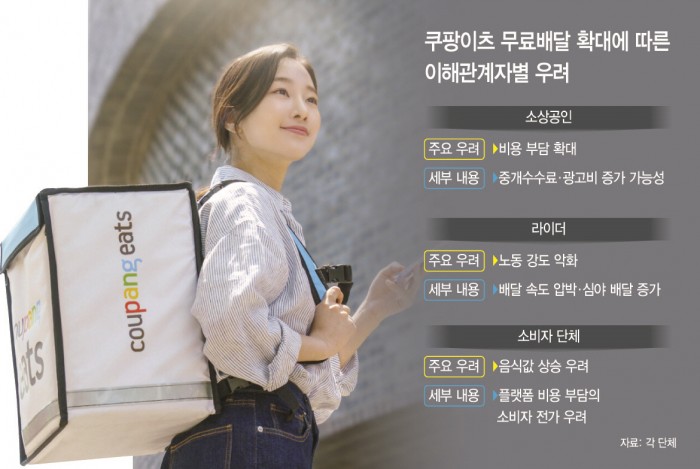 |
Opposition is growing among consumers, restaurant owners and delivery riders following Coupang Eats’ decision to expand its free-delivery service to general members. Critics argue that while the policy appears to benefit consumers on the surface, the costs could ultimately be shifted onto market participants through higher commissions, advertising fees and lower delivery pay rates.
According to industry officials on Tuesday, restaurant owners warned that prolonged competition among delivery platforms over free delivery could increase pressure from brokerage commissions and advertising costs. Riders also raised concerns about worsening working conditions driven by intensifying competition over delivery speed, while consumer groups cautioned that food prices could eventually rise.
Industry observers say the economics of food delivery apps make it difficult for free-delivery services to remain truly cost-free. Based on the current fee structure of Baemin, a 20,000 won order can incur brokerage commissions of up to 7.8 percent, amounting to more than 1,500 won in platform fees alone. Additional payment-processing and packaging costs further increase the burden even before ingredient expenses are considered.
Five organizations — including the Korea Federation of Micro Enterprises, the National Merchants Association of Korea, the Korea Foodservice Industry Association, the Korea Franchise Association and the National Cafe Owners Cooperative — issued a joint statement on May 22 criticizing the policy as “a declaration of war squeezing small business owners dry.”
Delivery riders also expressed concerns that the expansion of free delivery could accelerate excessive competition among riders and drive down delivery rates. The Korean Confederation of Trade Unions’ Delivery Platform Workers Union said increased order volumes could force riders to work “faster, longer and under more dangerous conditions.”
Consumer advocacy groups echoed similar concerns. Twelve organizations under the Korea National Council of Consumer Organizations said in a joint statement on May 20 that the policy could eventually lead to higher food-delivery prices. They warned that as dependence on platforms grows, pricing power may become increasingly concentrated in the hands of platform operators, with consumers ultimately bearing the cost.
Experts also warned that a prolonged free-delivery war could lead to higher food prices and declining service quality. Lee Hee-chan, a professor at Sejong University, said platform operators would eventually need to offset rising marketing costs through higher platform fees. He added that restaurant owners may respond by lowering food quality, leading consumers to receive lower-quality meals at the same price.
Coupang Eats, however, rejected claims that the policy would pass costs onto merchants. The company said it would absorb the expenses internally and described the initiative as a measure aimed at easing consumer burdens amid high inflation and stimulating consumption. It also denied that the expanded free-delivery policy would lead to higher food prices.
#Coupang Eats #free delivery #delivery app #food delivery #delivery fees
Copyright by Asiatoday
Most Read
-
1
Kia Sportage outperforms Mazda CX-5 in German auto..

-
2
Houthis launch successive attacks on Saudi airport..

-
3
Saudi Arabia, Iran hold first diplomatic talks to..

-
4
U.S. deploys carrier, 10,000 more troops to Middle..

-
5
Saudi airport in Riyadh struck again, leaving at l..

-
6
Putin's ally visits China on the 8th ahead of APEC..

-
7
Chinese military support and training center opens..

PEOPLE






HEADLINE NEWS

-
Address : In-Young Bldg., 34, Uisadang-daero 1-gil, Yeongdeungpo-gu, Seoul
Copyright by ASIATODAY CO., LTD. All rights resereved