



Korea business sentiment hits highest level in nearly four years
May 27, 2026, 09:37 am


 |
| /Song Eui-joo |
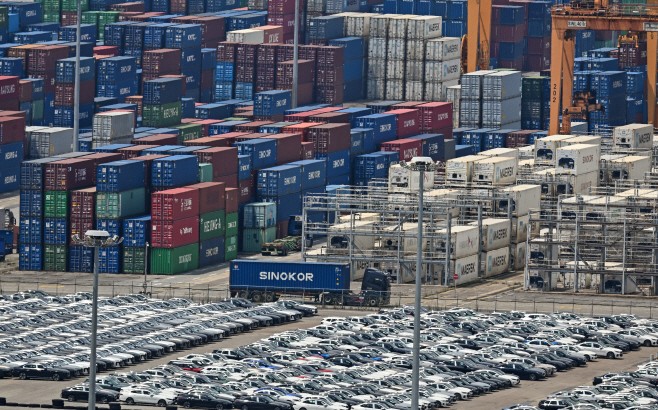
South Korea’s business sentiment improved sharply in May despite the prolonged conflict in the Middle East, reaching its highest level in nearly three years and seven months on the back of strong semiconductor exports and seasonal consumption during holiday periods.
According to the “May Business Survey Index and Economic Sentiment Index” released Tuesday by the Bank of Korea, the composite business sentiment index (CBSI) for all industries rose 4.0 points from the previous month to 98.9.
The figure marked the highest reading since October 2022, when the index stood at 99.0. The monthly increase was also the largest since May 2023, when the index climbed 4.4 points.
The outlook index for next month also improved, rising 3.7 points month-on-month to 97.6.
The CBSI is calculated using key components of the Business Survey Index (BSI) and reflects overall corporate sentiment. A reading above 100 indicates optimism, while a figure below 100 signals pessimism.
Manufacturing sentiment rebounded particularly strongly. The manufacturing CBSI rose 1.7 points from the previous month to 100.8, marking the first time the index exceeded 100 since August 2022.
Improved business conditions and financing conditions helped drive the increase. The manufacturing outlook index for June also rose 2.3 points to 100.3.
By sector, gains were especially noticeable in electrical equipment, electronics and communications equipment, and machinery and equipment industries.
The electrical equipment sector benefited from increased exports by automotive battery manufacturers, while semiconductor and component makers boosted the electronics and communications sector. Demand growth from downstream industries including semiconductors, shipbuilding and defense also supported machinery-related sectors.
Sentiment among non-manufacturing businesses also improved significantly.
The non-manufacturing CBSI rose 5.4 points to 97.5 in May, marking the largest monthly increase since May 2023.
Profitability and business condition improvements were cited as the main drivers.
Transportation and warehousing, wholesale and retail, and arts, sports and leisure sectors all showed gains.
The transportation and warehousing sector benefited from rising cargo volumes and freight rates among overseas shipping operators, as well as increased domestic passenger transport demand during the holiday period.
Wholesale and retail businesses handling chemicals, steel products and pharmaceuticals also reported improved business conditions, supported by stronger consumer spending during holidays.
Meanwhile, the arts, sports and leisure sector benefited from increased outdoor activities linked to warmer weather and family-oriented events during Korea’s “Family Month” in May.
The Economic Sentiment Index (ESI), which reflects both corporate and consumer sentiment, also rebounded.
The May ESI rose 5.8 points month-on-month to 97.5, supported by improved export outlooks, factory utilization expectations and financing conditions.
However, companies continued to cite rising raw material costs as their biggest management challenge.
Among manufacturers, 32.8% identified higher raw material prices as their primary concern, followed by economic uncertainty at 17.7% and weak domestic demand at 15.5%.
In the non-manufacturing sector, rising raw material costs were also the top concern at 18.0%, followed by economic uncertainty and sluggish domestic demand.
#Bank of Korea #CBSI #ESI #business sentiment #semiconductor exports
Copyright by Asiatoday
Most Read
-
1
Celltrion’s Omlyclo gains ground in major European..

-
2
Trump demands rates fall below 1% as Fed hikes for..

-
3
Trump makes $1 trillion bet ahead of midterm elect..

-
4
Iran resumes ballistic missile production, assembl..

-
5
Trump warns countries not helping U.S. must pay re..

-
6
Apple launches first foldable, 1 million won prici..

-
7
Turkish Airlines named main club partner of Liverp..

PEOPLE






-
Address : In-Young Bldg., 34, Uisadang-daero 1-gil, Yeongdeungpo-gu, Seoul
Copyright by ASIATODAY CO., LTD. All rights resereved