



"Missing" suspect tracked down via prosecutor's double-check
May 26, 2026, 10:44 am


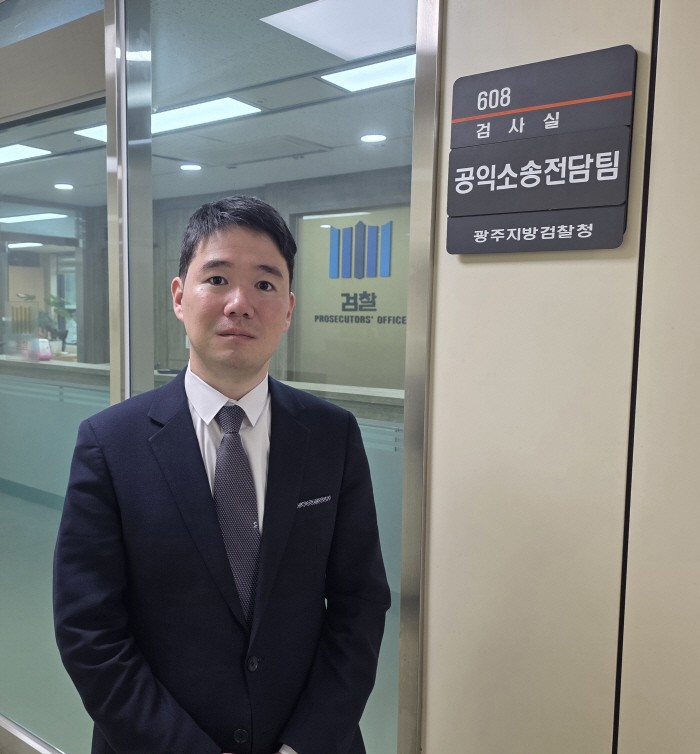 |
| Ryu Jae-hyun, a prosecutor at the Human Rights Protection Division of the Gwangju District Prosecutors' Office. / Photo via Reporter Jeong Min-hun |
"Missing."
The police made a decision to suspend the investigation on December 25 last year regarding A, a man in his 60s who had repeatedly committed construction cost fraud against small business owners. This was because the police could not locate A despite searching his registered address and questioning people in his neighborhood. In August of the same year, A was suspected of approaching five interior designers and commissioning work by promising to pay the construction costs, subsequently forcing them to complete the work without having either the intention or financial capacity to pay. The total damages amounted to approximately 23 million won, and A was a repeat offender with multiple prior convictions for identical counts of fraud.
The trajectory of the case shifted entirely when the prosecution took another look at the case files. Ryu Jae-hyun (39, 4th class of the bar exam), a prosecutor at the Human Rights Protection Division of the Gwangju District Prosecutors' Office, reviewed the case in accordance with directives requiring the examination of police investigation suspensions within 30 days. He additionally tracked and cross-referenced the trial statuses of other cases involving A. During this process, anomalous circumstances were detected. While the police had deemed A's whereabouts "untraceable," A had actually been appearing normally at a different police station to undergo investigation for a separate case. It was further confirmed that he had even explicitly stated his current actual residence during that questioning.
Concluding that it was necessary to re-evaluate whether the police's search for the suspect had been sufficient, Prosecutor Ryu issued a formal request for corrective action. Following this request, the police conducted a supplementary investigation and apprehended A on charges of fraud on the 5th of last month. They applied for an arrest warrant, successfully securing physical custody of the suspect two days after the initial arrest. Had the review remained a perfunctory examination of paperwork, the case could have been permanently buried. However, Prosecutor Ryu's assessment not only enabled the recovery of damages for the victims but also preempted further harm.
Prosecutor Ryu evaluated this case as an illustrative example demonstrating the necessity of a mutual cross-checking system between investigative agencies. "In the case of a police decision to suspend an investigation, unlike a decision not to forward a case to the prosecution, the case is not automatically forwarded to the prosecution even if the accuser or complainant files an objection," Ryu explained. "I review these cases with the mindset that if the police make an erroneous decision to suspend an investigation, a prosecutor's request for corrective action is virtually the sole remaining avenue for legal remedy." The Human Rights Protection Division of the Gwangju District Prosecutors' Office, where Ryu serves, was assigned 603 suspended investigation cases between January and April of this year, issuing requests for corrective action in 18 of them (3.0%).
According to Ryu, what matters in criminal justice procedures is not the absolute perfection of any single agency, but rather a system that continuously checks mutual determinations to minimize the margin of error. Regarding the system of requesting corrective actions for suspended investigations, Ryu stated, "Its significance lies in its 'double-check' function, which allows a case to be reviewed one more time."
"In the process of the prosecution re-examining the details verified once by the police, we can compensate for points that might have been overlooked," he said. "It is the difference between one person looking at the same case once, versus multiple agencies checking it multiple times." He added, "The more times a case is reviewed, the higher the probability that deficiencies will be corrected, which ultimately benefits the parties involved in the case."
Prosecutor Ryu expressed concern that if legal mechanisms such as requests for corrective action were to disappear, it could lead to deficiencies in protecting victims' rights. In particular, he warned that if the prosecution's authority to directly conduct supplementary investigations were abolished, the mutual oversight functions between investigative agencies would weaken, making it difficult to rectify unjust grievances in a timely manner.
"Currently, if the police fail to comply with a request for corrective action without justifiable grounds, the prosecution can demand the case be forwarded and directly conduct a supplementary investigation," he noted. "However, if direct supplementary investigations become impossible in the future, there are concerns that problems may arise in protecting victims' rights. Therefore, it is necessary to establish sophisticated alternative institutional mechanisms." He continued, "On a more fundamental level, given that all investigative agencies face challenging circumstances, it is my hope that the nation's overall capacity to counter crime does not deteriorate."
Ryu also emphasized, "One of the most critical principles in criminal proceedings is due process of law, and to uphold this, one must accurately understand legal statutes. The legal expert responsible for that role is the prosecutor." He further explained, "Because the vast majority of police officers do not come from a legal background, there are instances where they may misunderstand legal provisions. Thus, it is a globally common structure for prosecutors to exercise judicial control across various domains, such as warrant applications and cases not forwarded to the prosecution." He added, "In the United States as well, while the police can directly apply for warrants in certain jurisdictions, they consult with prosecutors in advance in most actual cases. Failing to utilize the review of a legal expert to reduce mistakes could be a form of societal waste."
Jeong Min-hun
Most Read
-
1
Celltrion’s Omlyclo gains ground in major European..

-
2
Trump demands rates fall below 1% as Fed hikes for..

-
3
Hyundai Motor Group breaks ground on integrated st..

-
4
U.S. strikes 3 Iranian oil tankers, Iran vows reta..

-
5
Trump makes $1 trillion bet ahead of midterm elect..

-
6
Iran resumes ballistic missile production, assembl..

-
7
Samsung Electronics, Mistral AI to jointly develop..

PEOPLE







-
Address : In-Young Bldg., 34, Uisadang-daero 1-gil, Yeongdeungpo-gu, Seoul
Copyright by ASIATODAY CO., LTD. All rights resereved