



Hyundai speeds up Atlas robot mass production
May 26, 2026, 08:15 am


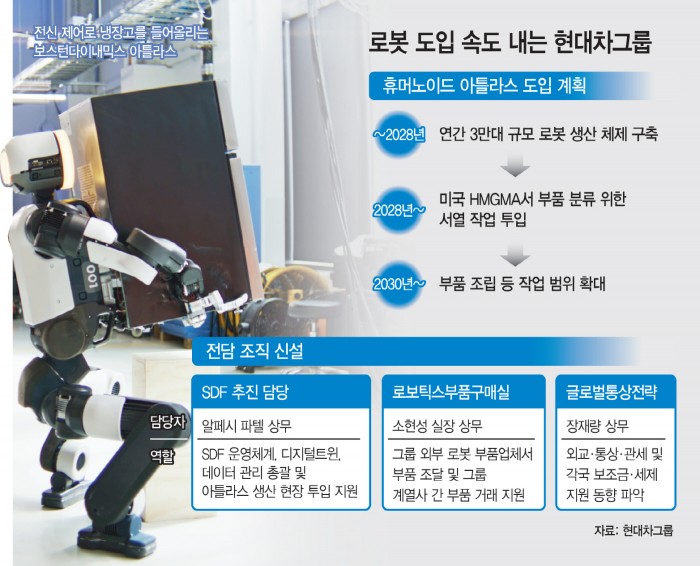 |
Hyundai Motor Group is accelerating its push toward humanoid robot mass production and AI-powered manufacturing by creating new software-defined factory (SDF) and robotics procurement divisions ahead of the deployment of its humanoid robot Atlas in production facilities.
The group is widely expected to choose the U.S. state of Georgia, home to Hyundai Motor Group Metaplant America (HMGMA), as the main production base for Atlas. Industry observers say the move reflects Hyundai’s broader strategy to simultaneously build an AI-based manufacturing system and a robotics supply chain.
According to industry sources on May 25, Hyundai Motor Group recently established a new SDF division and appointed Executive Vice President Alpesh Patel to lead the initiative.
SDF refers to a next-generation manufacturing system in which artificial intelligence integrates and controls factory operations — including production, quality control and logistics — through a unified software platform. The goal goes beyond simple automation by enabling real-time analysis of manufacturing data and optimization of logistics and quality management.
Patel, formerly with global consulting firm McKinsey & Company, joined Hyundai Motor Group in 2023 and previously served as chief innovation officer at Hyundai Motor Group Innovation Center Singapore (HMGICS), where he led the development of digital manufacturing systems.
Industry officials believe Hyundai’s decision to bring Patel into the group headquarters signals plans to expand the smart manufacturing model tested at HMGICS to global production facilities.
Patel is expected to oversee digital twin systems, production data management and AI-based factory operations while also serving as a control tower for Atlas deployment at manufacturing sites. Analysts say humanoid robots can only operate efficiently in factories when production equipment, logistics flows and worker movement are integrated into a unified software environment.
Hyundai is also strengthening its robotics parts supply chain. The automaker recently launched a dedicated Robotics Parts Procurement Division and appointed Executive Vice President So Hyun-sung to lead it.
The new unit will oversee sourcing and cost competitiveness for key components such as actuators, robotic grippers and head modules in preparation for mass production at Boston Dynamics.
Boston Dynamics has reportedly requested that Hyundai Mobis manufacture key Atlas components. Hyundai plans to build a large-scale production system centered on Hyundai Mobis while linking it to its global procurement network to improve supply stability and price competitiveness.
Industry sources also say Hyundai may build an actuator production facility in the United States capable of manufacturing about 350,000 units annually.
The group has additionally reorganized teams to respond to rapidly changing global trade conditions. Hyundai recently established a Global Trade Strategy Division under its Global Policy Office (GPO), appointing Executive Vice President Jang Jae-ryang to oversee diplomacy, trade and tariff-related issues.
Analysts view the move as part of Hyundai’s broader effort to manage risks tied to global production and supply chains.
Among potential production sites for Atlas, Georgia is considered the frontrunner over Massachusetts, where Boston Dynamics is headquartered. Industry officials said Georgia gained an advantage because robots produced there could immediately be deployed and tested at HMGMA facilities.
HMGMA already operates as a smart factory where roughly 1,700 workers and more than 1,000 robots work together. Analysts say the site provides an ideal environment for continuously testing, training and refining Atlas robots in real manufacturing settings.
The location is also viewed as favorable for vertical integration, from parts procurement to finished robot deployment, improving logistics efficiency and supply chain management.
Hyundai Motor Group plans to establish an annual production capacity of 30,000 Atlas robots by 2028 and gradually deploy more than 25,000 of them across Hyundai and Kia production facilities.
Initially, Atlas robots are expected to handle parts sequencing tasks at HMGMA in Georgia before eventually expanding into assembly operations. Hyundai also plans to broaden SDF deployment to facilities including its Pune plant in India and its dedicated electric vehicle factory in Ulsan, South Korea.
“Hyundai Motor Group is not simply building automated factories,” an industry official said. “It is creating a future manufacturing system where AI and humanoid robots work together. The establishment of the SDF organization, supply chain preparation and selection of mass production bases are all groundwork for the era of large-scale robot manufacturing.”
#Hyundai Motor Group #Atlas #Boston Dynamics #humanoid robot #smart factory
Copyright by Asiatoday
Most Read
-
1
Kia Sportage outperforms Mazda CX-5 in German auto..

-
2
Houthis launch successive attacks on Saudi airport..

-
3
Saudi Arabia, Iran hold first diplomatic talks to..

-
4
U.S. deploys carrier, 10,000 more troops to Middle..

-
5
Saudi airport in Riyadh struck again, leaving at l..

-
6
Putin's ally visits China on the 8th ahead of APEC..

-
7
Chinese military support and training center opens..

PEOPLE






HEADLINE NEWS

-
Address : In-Young Bldg., 34, Uisadang-daero 1-gil, Yeongdeungpo-gu, Seoul
Copyright by ASIATODAY CO., LTD. All rights resereved