



Samsung unions face internal rift over bonus dispute
May 04, 2026, 08:57 am


 |
Labor tensions are escalating within Samsung Electronics as internal conflicts among union members intensify over performance bonus demands, particularly between semiconductor and non-semiconductor divisions.
The company’s labor union has been pushing for expanded bonuses centered on the semiconductor (DS) division, which recently posted record earnings. However, this has triggered backlash from employees in other divisions, leading to a surge in union withdrawals and weakening support for a planned general strike later this month.
According to industry sources on May 3, the number of union members applying for withdrawal has surged sharply. Applications exceeded 500 on April 25 and surpassed 1,000 by April 29, compared with fewer than 100 previously. Some employees have publicly shared proof of their withdrawal on internal forums and workplace communities, amplifying internal unrest.
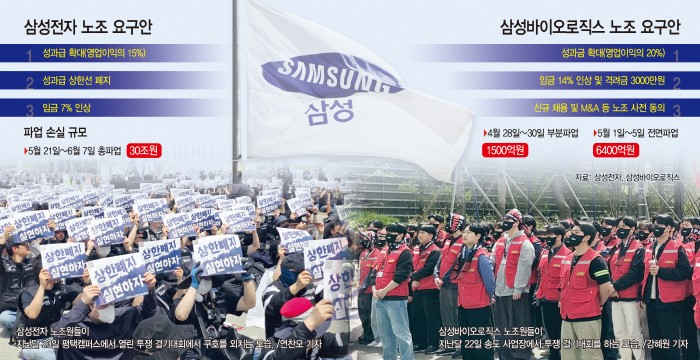
At the core of the dispute is the union’s demand that the DS division receive performance bonuses equivalent to 15% of operating profit, along with the removal of the existing cap of 50% of annual salary. Based on projected operating profit, this could translate into a bonus pool of up to 45 trillion won, or as much as 600 million won per employee in the division.
While the union has called for a general strike on May 21 based on these demands, it has not proposed equivalent measures for the Device eXperience (DX) division, which includes consumer electronics and mobile businesses. The DS division recorded over 50 trillion won in operating profit in the first quarter, while the DX division posted around 3 trillion won, with some forecasts suggesting a potential annual loss.
This disparity has fueled criticism from DX employees, who argue that the union is focusing disproportionately on semiconductor workers. Samsung management has also cited concerns over internal inequality and morale as reasons for rejecting the union’s demands.
The situation is further complicated by ongoing restructuring in the DX division. Samsung is reportedly implementing voluntary retirement programs, considering the closure of low-profit appliance production lines, and reviewing outsourcing options. A management audit of its domestic appliance and mobile distribution unit is also underway.
Industry analysts warn that growing intra-union conflict could undermine the justification for a general strike, particularly as concerns rise over the broader economic impact of labor actions.
Meanwhile, a separate strike at Samsung Biologics is adding to the pressure. The company estimates potential losses of up to 640 billion won due to production disruptions, along with concerns over long-term client trust.
If labor risks escalate at Samsung Electronics, analysts estimate potential losses of up to 30 trillion won from disruptions such as semiconductor production halts. Citigroup has already lowered its target price for Samsung Electronics stock, citing risks from strike-related provisions and earnings uncertainty.
Experts say the union must reassess its approach. Professor Hong Ki-yong of Incheon National University noted that the union’s collective action is losing legitimacy not only socially but also internally, urging reflection on whether a large-scale strike that could harm the national economy is justified.
#Samsung Electronics #labor union #bonus dispute #DS division #DX division
Copyright by Asiatoday
Most Read
-
1
Kia Sportage outperforms Mazda CX-5 in German auto..

-
2
Houthis launch successive attacks on Saudi airport..

-
3
Saudi Arabia, Iran hold first diplomatic talks to..

-
4
U.S. deploys carrier, 10,000 more troops to Middle..

-
5
Saudi airport in Riyadh struck again, leaving at l..

-
6
Putin's ally visits China on the 8th ahead of APEC..

-
7
Chinese military support and training center opens..

PEOPLE






HEADLINE NEWS

-
Address : In-Young Bldg., 34, Uisadang-daero 1-gil, Yeongdeungpo-gu, Seoul
Copyright by ASIATODAY CO., LTD. All rights resereved