



Samsung heirs finish $12B tax, set example of noblesse oblige
May 04, 2026, 08:56 am


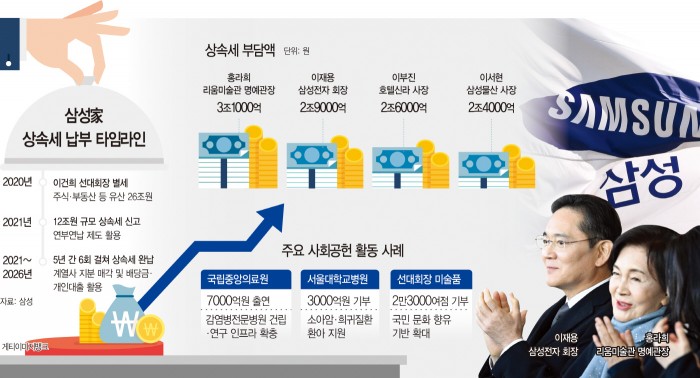 |
The family of Lee Jae-yong, Executive Chairman of Samsung Electronics, has completed payment of approximately 12 trillion won in inheritance taxes over five years, marking the largest such payment in South Korean history.
The tax stems from the estimated 26 trillion won estate left by the late Lee Kun-hee. Despite the immense financial burden, the family fulfilled the obligation in six installments, setting a precedent in the business community for both tax compliance and social responsibility.
The total amount exceeds the country’s annual inheritance tax revenue of 8.2 trillion won in 2024 by nearly 50%, underscoring the unprecedented scale of the payment.
Inheritance proceedings began following Lee Kun-hee’s death in October 2020. In April 2021, family members—including Lee Jae-yong, Hong Ra-hee, Lee Boo-jin, and Lee Seo-hyun—filed their tax returns with authorities, stating that “paying taxes is a fundamental duty of citizens” and pledging full compliance.
Individually, Hong Ra-hee paid 3.1 trillion won, Lee Jae-yong 2.9 trillion won, Lee Boo-jin 2.6 trillion won, and Lee Seo-hyun 2.4 trillion won. To finance the payments, family members sold shares in key affiliates such as Samsung Life Insurance, Samsung Electronics, and Samsung C&T, while Lee Jae-yong relied on dividends and personal loans.
Samsung said the funds flowing into state finances would support welfare, healthcare, and social infrastructure, noting that “the greatest beneficiaries of Chairman Lee Kun-hee’s achievements are the people.”
Beyond tax payments, the family has continued philanthropic efforts in line with Lee Kun-hee’s vision of contributing to humanity. In 2021, they donated 700 billion won to the National Medical Center to support infectious disease response, including building Korea’s first dedicated infectious disease hospital.
They also contributed 300 billion won to Seoul National University Hospital for pediatric cancer and rare disease treatment and research, benefiting tens of thousands of patients.
In the cultural sector, the family donated over 23,000 artworks—including national treasures—to the state. The “Lee Kun-hee Collection” exhibitions have drawn millions of visitors domestically and internationally, further enhancing Korea’s cultural standing.
Industry observers say the Samsung family has demonstrated a clear example of “noblesse oblige,” returning wealth accumulated through corporate growth to society while reinforcing the late chairman’s philosophy of public contribution.
#Samsung #Lee Jae-yong #inheritance tax #Lee Kun-hee #noblesse oblige
Copyright by Asiatoday
Most Read
-
1
Kia Sportage outperforms Mazda CX-5 in German auto..

-
2
Houthis launch successive attacks on Saudi airport..

-
3
Saudi Arabia, Iran hold first diplomatic talks to..

-
4
U.S. deploys carrier, 10,000 more troops to Middle..

-
5
Saudi airport in Riyadh struck again, leaving at l..

-
6
Putin's ally visits China on the 8th ahead of APEC..

-
7
Chinese military support and training center opens..

PEOPLE






HEADLINE NEWS

-
Address : In-Young Bldg., 34, Uisadang-daero 1-gil, Yeongdeungpo-gu, Seoul
Copyright by ASIATODAY CO., LTD. All rights resereved