



Korea sees triple rise despite war risks
Apr 30, 2026, 11:45 am


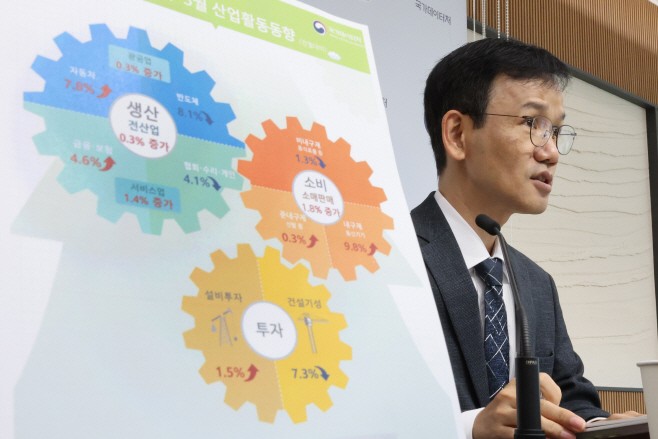 |
| Lee Doo-won, director of economic trend statistics at the Statistics Korea, briefs the March industrial activity report at the Government Complex in Sejong on April 30. /Yonhap |
South Korea’s production, consumption, and investment all increased in March, marking a “triple rise” for the first time in six months despite ongoing geopolitical tensions in the Middle East.
According to the Statistics Korea on April 30, the country’s all-industry production index rose 0.3% month-on-month to 118.3, extending gains for a second consecutive month.
Industrial output was supported by balanced growth in manufacturing and utilities, although semiconductor production declined 8.1% following a strong 28.2% surge in the previous month, reflecting a base effect. Petroleum refining output also fell 6.3% due to the impact of the Middle East conflict, seasonal factors, and government policies.
The service sector grew 1.4%, led by finance, insurance, transportation, and warehousing. In particular, finance and insurance rose 4.6% on the back of a strong stock market.
Retail sales, a key gauge of consumption, increased 1.8% from the previous month, driven by higher demand for durable goods such as communication devices and computers, as well as semi-durable goods like shoes and bags. On a yearly basis, overall retail sales rose 5%.
Officials attributed the increase to delayed launches of new communication devices and seasonal demand linked to the new school term, which boosted computer sales.
Investment also rose 1.5%, as gains in transport equipment offset declines in machinery. However, construction activity fell 7.3% due to reduced civil engineering and building work.
For the first quarter as a whole, industrial production rose 1.7% quarter-on-quarter, while retail sales increased 2.4% and facility investment jumped 12.6%.
The government said it plans to sustain the recovery through swift execution of supplementary budget programs, including energy cost support measures, as well as initiatives to promote eco-friendly consumption, tourism, and youth employment.
Despite the positive indicators, authorities warned that the impact of the Middle East conflict—now in its third month—could become more pronounced in April and May.
“The March data reflect a mix of early war impacts, seasonal maintenance schedules, and policy factors,” an official said. “From April or May, the war’s effects may act as a downward pressure on production, consumption, and overall economic activity, requiring close monitoring.”
#industrial output #consumption #investment #triple increase #Middle East war
Copyright by Asiatoday
Most Read
-
1
Celltrion’s Omlyclo gains ground in major European..

-
2
Trump demands rates fall below 1% as Fed hikes for..

-
3
Trump makes $1 trillion bet ahead of midterm elect..

-
4
Iran resumes ballistic missile production, assembl..

-
5
Trump warns countries not helping U.S. must pay re..

-
6
Apple launches first foldable, 1 million won prici..

-
7
Turkish Airlines named main club partner of Liverp..

PEOPLE







-
Address : In-Young Bldg., 34, Uisadang-daero 1-gil, Yeongdeungpo-gu, Seoul
Copyright by ASIATODAY CO., LTD. All rights resereved