



Hyundai expands hydrogen ecosystem, converts CNG stations
Apr 29, 2026, 09:26 am


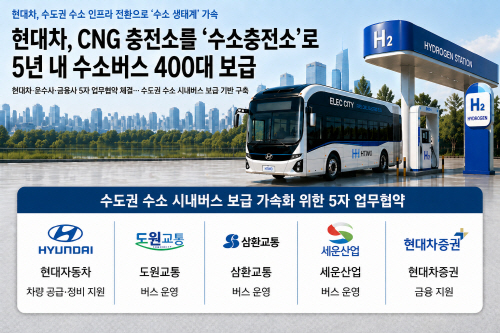 |
| This image was generated using AI. |
Hyundai Motor is accelerating efforts to strengthen its hydrogen business as part of a broader strategy to secure leadership in the future energy ecosystem.
Through its hydrogen brand and business platform HTWO, the company is building a full value chain encompassing hydrogen production, storage, and transportation, while addressing one of the key barriers to mass adoption—insufficient infrastructure.
Hyundai recently signed a memorandum of understanding with transportation operators and financial partners to expand hydrogen-powered city buses in the Seoul metropolitan area.
The core initiative involves converting compressed natural gas (CNG) fueling stations into hydrogen refueling stations, creating a foundation for wider adoption of hydrogen buses.
The company aims to deploy up to 400 hydrogen fuel cell buses on metropolitan routes within the next five years, supplying its Elec City hydrogen buses and providing specialized maintenance training to ensure smooth operations.
Despite advantages such as faster refueling and longer driving range compared to electric vehicles, hydrogen mobility has faced slow adoption due to limited refueling infrastructure.
According to data from the Korea Gas Safety Corporation, South Korea currently has around 250 commercial hydrogen refueling stations, including only nine in Seoul. In contrast, there are about 100 CNG stations across the metropolitan area, including 29 in Seoul.
Converting these existing facilities is expected to significantly improve accessibility and accelerate hydrogen vehicle deployment.
Hyundai Motor Group is positioning hydrogen as a core pillar of its future mobility vision, aiming to move beyond transportation into broader industrial applications.
Euisun Chung recently emphasized that “hydrogen can play a key role in the global transition to clean energy,” highlighting its strategic importance.
Earlier this year, the group also unveiled a 9 trillion won investment project in Saemangeum, which includes plans to build a 200MW water electrolysis plant to produce clean hydrogen. The hydrogen will be used across multiple mobility solutions, including trams, buses, and demand-responsive transport (DRT) services.
Industry experts say the expansion of hydrogen infrastructure could have a broad impact beyond buses.
By easing regulatory and safety constraints tied to station deployment, the initiative is expected to support wider adoption of hydrogen vehicles, including Hyundai’s passenger fuel cell model NEXO.
As Hyundai continues its decades-long push into hydrogen energy, the latest move marks a significant step toward realizing a scalable hydrogen economy.
#Hyundai Motor #hydrogen #HTWO #hydrogen bus #CNG station
Copyright by Asiatoday
Most Read
-
1
Kia Sportage outperforms Mazda CX-5 in German auto..

-
2
Houthis launch successive attacks on Saudi airport..

-
3
Saudi Arabia, Iran hold first diplomatic talks to..

-
4
U.S. deploys carrier, 10,000 more troops to Middle..

-
5
Saudi airport in Riyadh struck again, leaving at l..

-
6
Putin's ally visits China on the 8th ahead of APEC..

-
7
Chinese military support and training center opens..

PEOPLE






HEADLINE NEWS

-
Address : In-Young Bldg., 34, Uisadang-daero 1-gil, Yeongdeungpo-gu, Seoul
Copyright by ASIATODAY CO., LTD. All rights resereved