



Samsung Heavy wins FDC design approval at DCW
Apr 24, 2026, 09:12 am


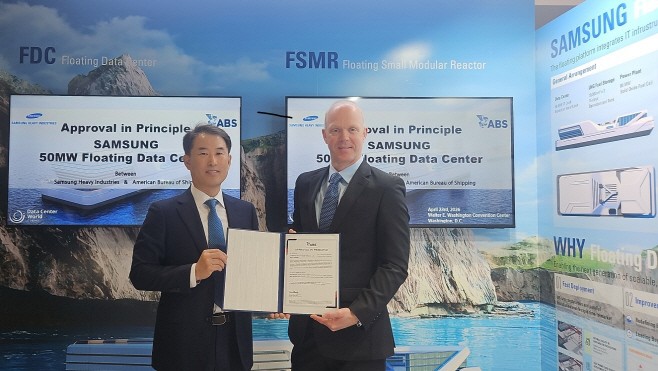 |
| Ahn Young-kyu (left), Executive Vice President and CTO of Samsung Heavy Industries, and Gareth Burton, Global Engineering Vice President at American Bureau of Shipping (ABS), pose for a photo after agreeing to cooperate on the development of power systems for floating data centers at Data Center World 2026, held in Washington, D.C., from April 20 to 23. / Samsung Heavy Industries |
Samsung Heavy Industries said Friday it has begun its full-scale entry into the U.S. floating data center (FDC) market, securing key design approvals and partnerships at a major industry event.
The company participated in Data Center World 2026, held in Washington, D.C. from April 20 to 23, where it obtained Approval in Principle (AiP) for a 50-megawatt-class floating data center from American Bureau of Shipping (ABS) and Lloyd’s Register (LR).
Floating data centers are emerging as an alternative to land-based facilities, addressing challenges such as land availability, power supply, and cooling efficiency by operating on water. Demand for such solutions is expected to surge alongside the commercialization of AI technologies.
Samsung Heavy’s FDC model leverages shipyard-based standardized construction processes that integrate design, manufacturing, and equipment installation simultaneously, enabling faster delivery compared to conventional land-based data centers. The model can also be equipped with its own power generation system, reducing reliance on onshore electricity.
During the event, the company signed a memorandum of understanding with ABB to collaborate on FDC power system development, and another agreement with U.S.-based data center developer Mustarian to advance floating data center projects in the United States.
Samsung Heavy plans to accelerate commercialization of FDCs by linking design certification with power system development and local partnerships for operations and regulatory approvals in the U.S.
Ahn Young-kyu, Executive Vice President and CTO of Samsung Heavy Industries, said, “FDC represents a new business model that expands shipbuilding technology into the digital infrastructure sector. By combining it with eco-friendly energy, we aim to set new standards in the global data market and secure future growth engines.”
Meanwhile, Choi Won-young, head of the company’s labor-management council, also attended the event, highlighting joint participation by labor and management. He said the council would actively support new business growth such as FDCs and expressed hope that the results would benefit employees.
#Samsung Heavy Industries #floating data center #FDC #Data Center World 2026
Copyright by Asiatoday
Most Read
-
1
Kia Sportage outperforms Mazda CX-5 in German auto..

-
2
Houthis launch successive attacks on Saudi airport..

-
3
Saudi Arabia, Iran hold first diplomatic talks to..

-
4
U.S. deploys carrier, 10,000 more troops to Middle..

-
5
Saudi airport in Riyadh struck again, leaving at l..

-
6
Putin's ally visits China on the 8th ahead of APEC..

-
7
Chinese military support and training center opens..

PEOPLE






HEADLINE NEWS

-
Address : In-Young Bldg., 34, Uisadang-daero 1-gil, Yeongdeungpo-gu, Seoul
Copyright by ASIATODAY CO., LTD. All rights resereved