



Parties confirm differences on budget despite rare meeting
Apr 08, 2026, 08:23 am


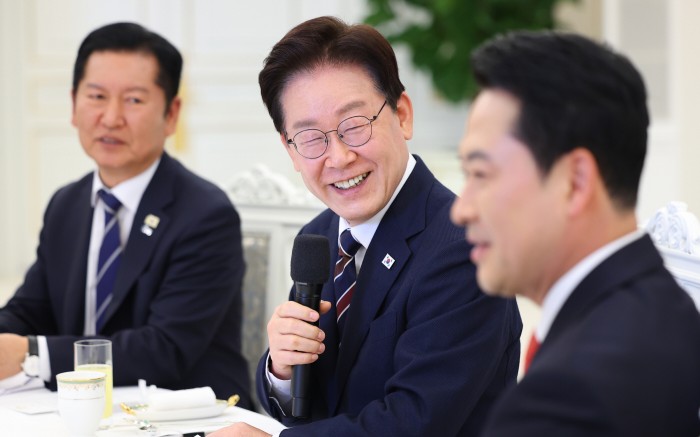 |
| Lee Jae-myung speaks at a trilateral meeting with ruling and opposition leaders on people’s livelihoods and the economy at the presidential office on April 7. From left: Jung Cheong-rae, Lee, and Jang Dong-hyeok. |
Ruling and opposition parties confirmed sharp differences over a supplementary budget bill during a rare trilateral meeting with the government, raising expectations of a contentious review process in the National Assembly.
Lee Jae-myung met with ruling and opposition leaders on April 7 to discuss the need for a supplementary budget to respond to the Middle East crisis, but disagreements quickly surfaced over specific budget items and support measures.
The meeting, held at the presidential guesthouse, was intended to seek cooperation on passing the budget. However, debates emerged almost immediately.
Jang Dong-hyeok, leader of the People Power Party, criticized certain programs—including support for Chinese tourists and cultural and tourism-related spending—arguing they do not align with the purpose of a “wartime supplementary budget.”
The issue of funding to attract Chinese-speaking tourists also sparked debate. Jang argued the program effectively targeted Chinese visitors, while Jung Cheong-rae of the Democratic Party of Korea countered that it was aimed at boosting consumption among all foreign tourists, not a specific country.
Lee responded, “It appears to be a budget for promoting tourism,” adding, “There is no way it is limited only to Chinese people.” He added that if it were indeed restricted, it should be cut.
The two sides also clashed over how to support citizens affected by high oil prices. Jang criticized the plan to provide support to the bottom 70% income group as “cash handouts.”
Lee rejected the characterization, saying, “‘Cash handouts’ is an excessive expression,” and reiterated the need to compensate citizens for rising fuel costs.
On funding, Lee said the supplementary budget would be financed through increased tax revenues rather than issuing government bonds or raising taxes. He added that unnecessary items could be adjusted during parliamentary review.
Political observers say the meeting largely served to confirm existing differences rather than bridge them. Analysts expect continued clashes during the legislative process, given the wide gap in views over budget allocation and support methods.
Meanwhile, Lee appeared in a red-and-blue tie at the meeting and jokingly encouraged the party leaders to shake hands beforehand, saying, “You’re not avoiding shaking hands because it’s awkward, right?”
#supplementary budget #South Korea politics #Lee Jae-myung #Jang Dong-hyeok #Jung Cheong-rae
Copyright by Asiatoday
Most Read
-
1
Trump shares map on social media labeling Strait o..

-
2
Kia Sportage outperforms Mazda CX-5 in German auto..

-
3
Houthis launch successive attacks on Saudi airport..

-
4
U.S. deploys carrier, 10,000 more troops to Middle..

-
5
Trump rejects Iran's offer to open Strait of Hormu..

-
6
N. Korea conducts first swarm attack drill with dr..

-
7
U.S.-China summit falls short on substance as Trum..

PEOPLE





HEADLINE NEWS
- Seoul dismisses Ukraine's claim of 'S. Korean support for Russia' as "inaccurate and inappropriate"
- S. Korea, Japan race to develop nuclear-powered submarines
- Henri Kagan, Kenso Soai win Nobel Prize in Chemistry for uncovering how mol..
- Vance says Alaska LNG cooperation will move forward with Seoul's current or..

-
Address : In-Young Bldg., 34, Uisadang-daero 1-gil, Yeongdeungpo-gu, Seoul
Copyright by ASIATODAY CO., LTD. All rights resereved