



Cho vague on US deployment request
Mar 18, 2026, 08:24 am


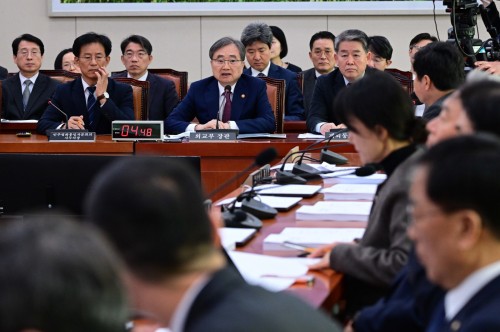 |
| Foreign Minister Cho Hyun responds to lawmakers’ questions during a National Assembly Foreign Affairs Committee meeting on March 17. |
Cho Hyun offered an अस्पiguous response when asked whether the United States had formally requested South Korea to deploy naval forces to the Strait of Hormuz, underscoring Seoul’s cautious stance amid rising Middle East tensions.
Speaking at a parliamentary session, Cho said, “It could be a request, or it might not be,” declining to confirm whether any official request had been made.
Pressed repeatedly by lawmakers during a Foreign Affairs Committee meeting, he added, “It is difficult to answer,” emphasizing that his reluctance should not be interpreted as confirmation of a formal request.
His remarks followed a phone call on March 16 with Marco Rubio, during which the two sides discussed developments in the Middle East and bilateral relations. According to the foreign ministry, Rubio explained the regional situation and sought continued interest and support for peace and stability, while stressing the importance of ensuring long-term security in the Strait of Hormuz.
A foreign ministry official later clarified that Cho’s comments reflected the evolving nature of Washington’s plans.
“The U.S. proposal is still in progress, and we intend to monitor how it develops before determining our response,” the official said.
Cho’s remarks appeared aimed at avoiding premature conclusions that the phone call constituted a formal request for South Korean naval deployment.
Cho also addressed concerns that dispatching naval forces could raise constitutional issues, stating that any decision would be made in accordance with laws and the Constitution, with full reporting to the National Assembly.
Separately, Defense Minister Ahn Gyu-back told lawmakers that no official request had been received from Washington, adding that a social media message from former President Donald Trump should not be regarded as a formal request.
He stressed that any deployment to the Strait of Hormuz would require parliamentary consent.
Cho noted that the government has prepared contingency plans to ensure the safety of 26 South Korean vessels and 183 crew members currently in the region. Authorities have established communication channels with nearby port states and are ready to provide supplies if necessary.
Meanwhile, Cho is scheduled to visit France from March 25 to 27 at the invitation of the host of the G7 foreign ministers’ expanded meeting. On the sidelines, he is expected to hold bilateral talks with major counterparts, including potential meetings with U.S. and Japanese officials to discuss regional issues such as Iran.
Analysts say Seoul is carefully balancing alliance coordination with domestic political and legal considerations, as uncertainty persists over Washington’s intentions in the region.
#Cho Hyun #South Korea foreign minister #Hormuz Strait #US military request
Copyright by Asiatoday
Most Read
-
1
Trump shares map on social media labeling Strait o..

-
2
Kia Sportage outperforms Mazda CX-5 in German auto..

-
3
Houthis launch successive attacks on Saudi airport..

-
4
U.S. deploys carrier, 10,000 more troops to Middle..

-
5
Trump rejects Iran's offer to open Strait of Hormu..

-
6
N. Korea conducts first swarm attack drill with dr..

-
7
U.S.-China summit falls short on substance as Trum..

PEOPLE






HEADLINE NEWS
- Seoul dismisses Ukraine's claim of 'S. Korean support for Russia' as "inaccurate and inappropriate"
- S. Korea, Japan race to develop nuclear-powered submarines
- Henri Kagan, Kenso Soai win Nobel Prize in Chemistry for uncovering how mol..
- Vance says Alaska LNG cooperation will move forward with Seoul's current or..

-
Address : In-Young Bldg., 34, Uisadang-daero 1-gil, Yeongdeungpo-gu, Seoul
Copyright by ASIATODAY CO., LTD. All rights resereved