



Coupang investors withdraw Section 301 petition
Mar 10, 2026, 08:55 am


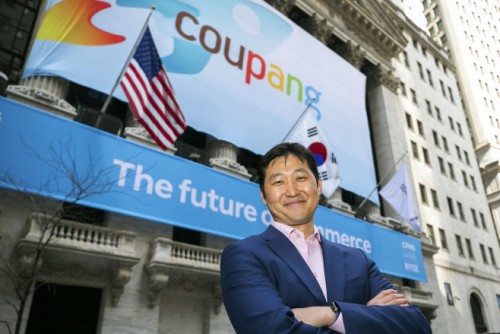 |
| Coupang Chairman Kim Bom-suk poses for a commemorative photo in front of the New York Stock Exchange on March 11, 2021, the day the company was listed in the United States. /AP–Yonhap News |
U.S. investment firms backing Coupang have withdrawn a trade complaint filed with the Office of the United States Trade Representative (USTR) under Section 301, saying they expect the U.S. government to pursue a broader investigation into South Korea’s trade practices.
Greenoaks and Altimeter, major American investors in the e-commerce company, said in a joint statement on March 9 that they were withdrawing their petition, which had asked the USTR to investigate what they described as discriminatory treatment of Coupang by the South Korean government.
The firms said recent discussions with the USTR confirmed that the issue has already reached the highest levels of both governments. They added that the decision reflects a strategic shift, as the Trump administration and USTR are considering launching a wider Section 301 investigation into trade practices affecting U.S. companies.
“The U.S. government’s response clearly demonstrates its commitment to holding Korea accountable for honoring its trade commitments,” the investors said. “Given the possibility of a comprehensive government-led approach, a petition focused on a single company could become redundant.”
They also cited public remarks by President Donald Trump and U.S. trade officials emphasizing that South Korea must ensure its digital service regulations comply with the Korea-U.S. Free Trade Agreement (KORUS FTA) and do not discriminate against American companies.
The dispute stems from a large-scale data breach at Coupang last November that exposed personal information belonging to about 33.7 million customers. Following the incident, the South Korean government launched extensive investigations and audits of the company.
Coupang’s investors argue that the government imposed discriminatory and punitive regulatory actions targeting the company. Their legal representatives said Korean authorities conducted sweeping investigations across several areas, including labor, finance and customs, which they claim were unrelated to the data breach and effectively restricted the company’s business operations.
They also cited comments by Prime Minister Kim Min-seok that the government must restore market order “with the determination used to eradicate the mafia” as an example of what they described as a hostile campaign against the company.
The South Korean government, however, maintains that the case is a matter of domestic law enforcement rather than a trade dispute and says it is handling the issue fairly under national law.
Despite withdrawing the Section 301 petition, the investors confirmed that they will continue pursuing investor–state dispute settlement (ISDS) proceedings under the Korea-U.S. Free Trade Agreement. The investors submitted a notice of intent to arbitrate against the Korean government on Jan. 22, triggering a 90-day cooling-off period before formal arbitration can begin.
Additional investment firms including Abrams Capital, Durable Capital Partners and Foxhaven Asset Management joined the case last month, bringing the combined stake held by the plaintiffs to about 6.26 percent of Coupang shares.
Observers say the dispute could become a new flashpoint in digital trade tensions between South Korea and the United States, particularly amid the Trump administration’s tougher trade policies. The issue has already drawn attention in Washington, with U.S. Vice President J.D. Vance raising the matter during a Jan. 23 meeting with Prime Minister Kim at the White House, and the U.S. House Judiciary Committee calling Coupang Korea’s interim chief executive Harold Rogers for a closed-door hearing last month.
Analysts say the withdrawal of the petition does not signal the end of the dispute, but rather suggests the conflict may shift from a corporate complaint to a broader government-level trade issue. The investors said in their statement that U.S. investors and companies must receive fair and non-discriminatory treatment under international agreements and expressed confidence that the principle will ultimately be upheld.
#Coupang #USTR Section 301 #Greenoaks #Altimeter #U.S.-Korea trade dispute
Copyright by Asiatoday
Most Read
-
1
Kia Sportage outperforms Mazda CX-5 in German auto..

-
2
Houthis launch successive attacks on Saudi airport..

-
3
Saudi Arabia, Iran hold first diplomatic talks to..

-
4
U.S. deploys carrier, 10,000 more troops to Middle..

-
5
Saudi airport in Riyadh struck again, leaving at l..

-
6
Putin's ally visits China on the 8th ahead of APEC..

-
7
Chinese military support and training center opens..

PEOPLE






HEADLINE NEWS

-
Address : In-Young Bldg., 34, Uisadang-daero 1-gil, Yeongdeungpo-gu, Seoul
Copyright by ASIATODAY CO., LTD. All rights resereved