



Bipartisan U.S. investment bill clears committee unanimously
Mar 10, 2026, 08:50 am


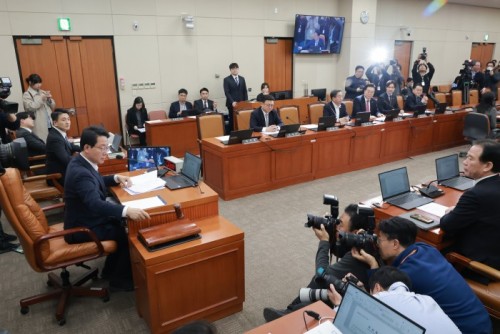 |
| Rep. Kim Sang-hoon of the People Power Party, who chairs the special committee on U.S.-bound investment legislation, presides over the fourth plenary session at the National Assembly on March 9, approving the Special Act on Strategic Investment Management between Korea and the United States. /Yonhap News |
A bipartisan bill aimed at managing strategic investments between South Korea and the United States cleared a special parliamentary committee Monday with unanimous support and is set for a final vote at the National Assembly on March 12.
The ruling Democratic Party of Korea and the opposition People Power Party approved a revised version of the “Special Act on Strategic Investment Management between Korea and the United States,” commonly known as the U.S. investment law, during a plenary meeting of the special committee on U.S.-bound investment.
The bill’s most contentious provision — a clause requiring corporate contributions to the Korea-U.S. strategic investment fund — was ultimately removed following opposition concerns.
Rep. Park Soo-young of the People Power Party, the opposition floor member on the committee, said businesses had raised strong objections to the requirement.
“There were many concerns that companies could not refuse if they were pressured to provide funds,” Park said. “We believed provisions that could place a burden on businesses should be removed.”
Under the revised plan, the investment fund will be financed through returns from foreign exchange reserve management and government-backed bonds, rather than corporate contributions.
Park added that the government may secure additional funding through presidential decree in unforeseen situations but must report the move to the National Assembly in advance.
“If corporate contributions were reinstated through enforcement rules, it would directly contradict the legislative intent,” he said.
The capitalization of the newly created Korea-U.S. Strategic Investment Corporation was also reduced from the government’s original proposal of 3 trillion won to 2 trillion won.
Deputy Prime Minister and Finance Minister Koo Yun-cheol said the government initially proposed the larger amount to support 20-year long-term loans and guarantees, but lawmakers agreed to start with 2 trillion won and adjust if necessary.
To address concerns about overlap with existing policy banks, Koo said the new corporation would take primary responsibility for investments while cooperating with institutions such as the Export-Import Bank of Korea.
The organization will be kept relatively small, with a maximum staff of 50 and three board directors.
Executive positions will require at least 10 years of experience in finance or strategic industries, a measure intended to prevent politically motivated appointments.
The law also mandates the creation of a risk management committee within the board, the submission of annual reports on fund management and investment performance to the National Assembly, and prior parliamentary approval for exceptions related to U.S.-bound investment rules.
Rep. Kim Sang-hoon of the People Power Party, who chairs the special committee, thanked lawmakers for reaching a bipartisan agreement before the legislative deadline.
“Despite several controversies, committee members worked together to finalize the bill within the required timeframe,” Kim said.
Industry Minister Kim Jung-kwan, who returned from a visit to Washington earlier in the day, said he had briefed U.S. Commerce Secretary Howard Lutnick on the National Assembly’s swift handling of the legislation.
“He responded positively,” Kim said. “If the bill passes, it appears there will be no official notice of tariff increases.”
The special act will be forwarded to the Legislation and Judiciary Committee before being submitted to a plenary vote scheduled for March 12.
#South Korea #U.S. investment law #Korea-U.S. strategic investment #National Assembly
Copyright by Asiatoday
Most Read
-
1
Trump shares map on social media labeling Strait o..

-
2
Kia Sportage outperforms Mazda CX-5 in German auto..

-
3
Houthis launch successive attacks on Saudi airport..

-
4
U.S. deploys carrier, 10,000 more troops to Middle..

-
5
Trump rejects Iran's offer to open Strait of Hormu..

-
6
N. Korea conducts first swarm attack drill with dr..

-
7
U.S.-China summit falls short on substance as Trum..

PEOPLE






HEADLINE NEWS
- Seoul dismisses Ukraine's claim of 'S. Korean support for Russia' as "inaccurate and inappropriate"
- S. Korea, Japan race to develop nuclear-powered submarines
- Henri Kagan, Kenso Soai win Nobel Prize in Chemistry for uncovering how mol..
- Vance says Alaska LNG cooperation will move forward with Seoul's current or..

-
Address : In-Young Bldg., 34, Uisadang-daero 1-gil, Yeongdeungpo-gu, Seoul
Copyright by ASIATODAY CO., LTD. All rights resereved