



Lee cautions ruling camp amid prosecution reform rift
Mar 09, 2026, 08:35 am


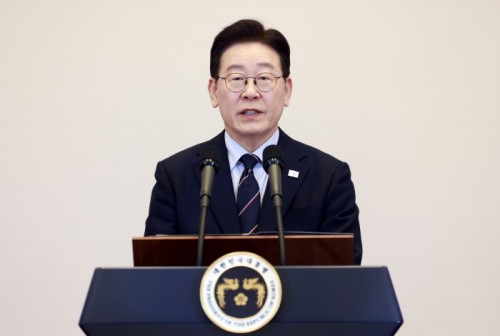 |
| President Lee Jae-myung speaks during a public event. / Yonhap |
President Lee Jae-myung stressed that political power must be exercised responsibly, saying that holding office does not mean the governing camp can do whatever it wants.
“While we must never abandon the ideals, values and promises we held before coming to power, becoming the president or the ruling force does not mean we can do everything at will — nor should we,” Lee said.
His remarks are widely interpreted as an indirect criticism of hardline members within the Democratic Party of Korea (DPK) who have expressed dissatisfaction with the government’s plan to establish a Major Crimes Investigation Office and a Public Prosecution Office as part of prosecution reform.
According to political sources on March 8, Lee posted the message on X the previous evening, writing that although a political leader may represent one side before taking office, “the moment one becomes president, one must represent the entire nation.”
Lee added that “having authority means bearing an equal amount of responsibility.” He said public officials must carefully determine the path that brings the greatest benefit to the largest number of citizens, maintaining the perspective of a fair third party and rational judgment.
“There is a difference between simply making claims and criticisms and being in a position where one must present alternatives and take full responsibility for the outcome,” he wrote.
Lee also emphasized that political advantages for individuals or groups should not outweigh the national interest.
“Political positioning or electoral gains for a specific individual or group must never take precedence over the country’s future or the welfare of its people,” he said.
The president did not specify which issue his message referred to, and officials at the Presidential Office declined to elaborate, saying the remarks reflected Lee’s general political philosophy.
However, some observers believe the comments were directed at critics within the ruling camp and civil society groups who have raised concerns about the government’s prosecution reform plan.
Choo Mi-ae, chair of the National Assembly’s Legislation and Judiciary Committee, recently argued that the proposed law merely changes the title of the existing prosecution system rather than fundamentally reforming it. Lawmaker Kim Yong-min also called for removing prosecutors’ quasi-judicial status, while civic groups such as People’s Solidarity for Participatory Democracy and Lawyers for a Democratic Society criticized the plan as insufficient.
Meanwhile, Lee is scheduled to chair an emergency economic inspection meeting at 11 a.m. on March 9 to review economic and price conditions related to the Middle East crisis.
The meeting will assess international oil prices, financial market conditions and domestic economic indicators including the stock market, exchange rates and inflation, as the government prepares measures to address rising uncertainty.
#Lee Jae-myung #prosecution reform #Democratic Party #Choo Mi-ae
Copyright by Asiatoday
Most Read
-
1
Trump shares map on social media labeling Strait o..

-
2
Kia Sportage outperforms Mazda CX-5 in German auto..

-
3
Houthis launch successive attacks on Saudi airport..

-
4
U.S. deploys carrier, 10,000 more troops to Middle..

-
5
Trump rejects Iran's offer to open Strait of Hormu..

-
6
N. Korea conducts first swarm attack drill with dr..

-
7
U.S.-China summit falls short on substance as Trum..

PEOPLE





HEADLINE NEWS
- Seoul dismisses Ukraine's claim of 'S. Korean support for Russia' as "inaccurate and inappropriate"
- S. Korea, Japan race to develop nuclear-powered submarines
- Henri Kagan, Kenso Soai win Nobel Prize in Chemistry for uncovering how mol..
- Vance says Alaska LNG cooperation will move forward with Seoul's current or..

-
Address : In-Young Bldg., 34, Uisadang-daero 1-gil, Yeongdeungpo-gu, Seoul
Copyright by ASIATODAY CO., LTD. All rights resereved