



Hormuz blockade raises uncertainty for global shipping industry
Mar 06, 2026, 09:13 am


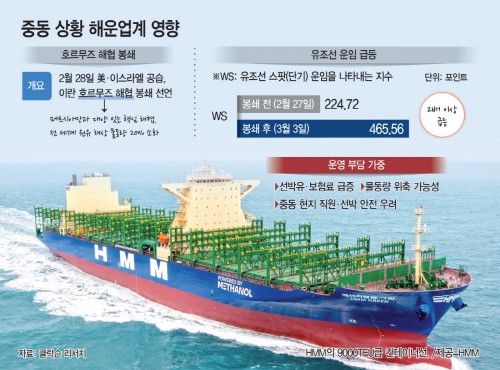 |
The global shipping industry is facing growing uncertainty as the blockade of the Strait of Hormuz drives tanker freight rates sharply higher while simultaneously threatening profitability through declining cargo volumes and rising operating costs.
According to global maritime analytics firm Clarksons Research, the tanker index (WS), which tracks daily freight rates for crude oil carriers, reached 465.56 points as of March 3, more than doubling from 224.72 on Feb. 27.
The Korea Ocean Business Corporation also reported that daily charter rates for very large crude carriers (VLCCs) surged to about $350,000, up roughly 75% from around $200,000 previously.
The spike follows Iran’s decision to block the Strait of Hormuz in response to U.S. and Israeli airstrikes late last month.
The narrow waterway linking the Persian Gulf to the open ocean handles roughly 20–30% of the world’s seaborne oil shipments, making it one of the most critical chokepoints in global energy logistics.
While rising freight rates are typically considered positive for shipping companies, industry participants say the current situation is far more complex.
Shipping firms are simultaneously dealing with shrinking cargo volumes, surging fuel prices and sharply rising insurance costs — factors that could erode profitability despite higher freight rates.
Cargo traffic through the Strait of Hormuz has reportedly fallen by more than 80% since the blockade began.
The Korea Ocean Business Corporation estimates that the disruption could affect as much as 650,000 TEU of weekly cargo moving between Asia, Europe and the Middle East. One TEU represents a standard 20-foot shipping container.
Companies are also concerned about rising operating costs as geopolitical tensions between the United States and Iran show signs of prolonging.
Fuel costs are particularly sensitive for shipping companies, accounting for roughly 10% to 25% of operating expenses.
According to the New York Mercantile Exchange, U.S. West Texas Intermediate (WTI) crude futures rose to $74.66 per barrel on March 4, extending gains for a second straight session. Prices briefly surged to $84.48 during intraday trading, approaching the highest levels in months.
Some analysts believe the surge in freight rates could remain largely limited to oil tankers.
Container ships may see less dramatic changes because cargo can be unloaded at nearby safe ports and transported overland to final destinations — an option that is not feasible for crude oil shipments.
Industry officials say the situation remains highly volatile.
“Freight rates are surging not only in the Middle East but also at alternative loading ports,” a shipping industry source said. “Even if revenues increase due to higher freight rates, that does not necessarily translate into higher profitability.”
The source added that for many shipping segments other than crude oil tankers, rising operating costs could outweigh the benefits of higher freight rates.
Executives at Korean shipping companies including HMM and Pan Ocean said they are currently reviewing multiple contingency scenarios to minimize potential impacts while prioritizing the safety of employees and vessels.
#Strait of Hormuz blockade #tanker freight rates #shipping industry risk #oil tanker market #global shipping routes
Copyright by Asiatoday
Most Read
-
1
Kia Sportage outperforms Mazda CX-5 in German auto..

-
2
Houthis launch successive attacks on Saudi airport..

-
3
Saudi Arabia, Iran hold first diplomatic talks to..

-
4
U.S. deploys carrier, 10,000 more troops to Middle..

-
5
Saudi airport in Riyadh struck again, leaving at l..

-
6
Putin's ally visits China on the 8th ahead of APEC..

-
7
Chinese military support and training center opens..

PEOPLE






HEADLINE NEWS

-
Address : In-Young Bldg., 34, Uisadang-daero 1-gil, Yeongdeungpo-gu, Seoul
Copyright by ASIATODAY CO., LTD. All rights resereved