



US approves TerraPower SMR, marking breakthrough for SK–Gates partnership
Mar 06, 2026, 09:08 am


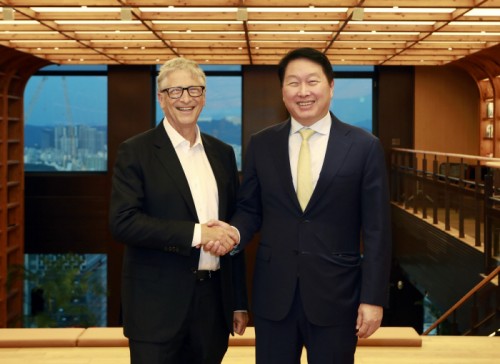 |
| SK Group Chairman Chey Tae-won (right) shakes hands with TerraPower founder and chairman Bill Gates during a meeting at SK Seorin Building in Jongno District, Seoul, in August last year. / SK Innovation |
A next-generation nuclear power project jointly advanced by SK Group Chairman Chey Tae-won and TerraPower founder Bill Gates has achieved a major milestone after receiving U.S. regulatory approval for construction.
TerraPower — backed by investments from SK Innovation and Korea Hydro & Nuclear Power (KHNP) — received approval on March 5 from the U.S. Nuclear Regulatory Commission (NRC) to build a small modular reactor (SMR) in Wyoming.
The project marks the first approval for a commercial nuclear power plant construction in the United States in about a decade and the first commercialization approval for a fourth-generation advanced reactor.
TerraPower plans to begin construction within the month and aims to operate the demonstration reactor by 2030.
According to SK Innovation, the NRC’s decision confirms the safety and technological maturity of TerraPower’s next-generation SMR technology.
The achievement is widely viewed as the result of Chey’s efforts to build a global energy alliance. SK and SK Innovation invested $250 million in TerraPower in August 2022, securing the position of the company’s second-largest shareholder. In 2023, Chey also helped bring KHNP into a trilateral partnership to strengthen technology demonstration capabilities.
Chey has emphasized a “first-mover” strategy in next-generation energy, linking SMR development to the rapidly expanding power demands of artificial intelligence.
During a meeting with Gates in Seoul last August, Chey discussed ways to strengthen cooperation on SMR projects. At the Trans-Pacific Dialogue 2026 in Washington last month, he announced plans to develop integrated solutions that combine AI data centers with power plants.
TerraPower’s sodium-cooled fast reactor (SFR) technology addresses structural limitations of conventional light-water reactors. Using liquid sodium as a coolant — which has a boiling point of about 880 degrees Celsius — allows the reactor to operate at atmospheric pressure, significantly reducing the risk of pressure-related accidents.
The technology also improves efficiency due to sodium’s high thermal conductivity and reduces spent nuclear fuel generation to about 10% of the level produced by traditional reactors, offering a potential solution to radioactive waste challenges.
Another key advantage is the reactor’s load-following capability when linked with energy storage systems (ESS). This allows electricity output to adjust flexibly to demand, improving integration with renewable energy sources that have fluctuating power generation.
The model is also seen as particularly suitable for powering AI data centers. By locating SMRs near data centers, operators can minimize transmission losses while supplying stable, carbon-free baseload power around the clock.
With global demand for electricity surging alongside AI development, SMRs are increasingly viewed as a strategic energy solution. The International Energy Agency (IEA) projects global SMR capacity could reach up to 370 gigawatts by 2050.
Korean companies including Doosan Enerbility and Samsung C&T are also expanding partnerships abroad to enter the growing SMR market, helping strengthen the emerging Korean SMR ecosystem.
SK Innovation said it plans to combine its energy materials capabilities with KHNP’s expertise in nuclear construction and operation to build a global SMR supply chain.
Kim Moo-hwan, head of the energy solutions business at SK Innovation, said, “Starting with the world’s first commercial SMR plant construction, we will focus on expanding our global market share.”
#Chey Tae-won #Bill Gates #TerraPower #SMR reactor #small modular reactor
Copyright by Asiatoday
Most Read
-
1
Kia Sportage outperforms Mazda CX-5 in German auto..

-
2
Houthis launch successive attacks on Saudi airport..

-
3
Saudi Arabia, Iran hold first diplomatic talks to..

-
4
U.S. deploys carrier, 10,000 more troops to Middle..

-
5
Saudi airport in Riyadh struck again, leaving at l..

-
6
Putin's ally visits China on the 8th ahead of APEC..

-
7
Chinese military support and training center opens..

PEOPLE





HEADLINE NEWS

-
Address : In-Young Bldg., 34, Uisadang-daero 1-gil, Yeongdeungpo-gu, Seoul
Copyright by ASIATODAY CO., LTD. All rights resereved