



Industrial production declines as spending and investment rise
Mar 04, 2026, 10:01 am


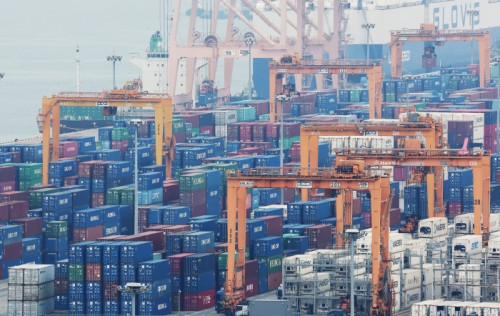 |
| Cargo ships are docked at Pyeongtaek Port in Pyeongtaek, South Korea. / Yonhap |
South Korea’s industrial production declined in January due largely to reduced semiconductor output, but consumer spending and facility investment rebounded while leading economic indicators improved, government data showed Tuesday.
According to the January industrial activity report released by the National Data Agency, overall industrial production fell 1.3 percent from the previous month.
The drop reversed two consecutive months of growth recorded in November and December.
Semiconductor output weighs on production
Production in mining and manufacturing declined 1.9 percent. While electronic components rose 6.5 percent, semiconductor output — including DRAM and system chips — fell 4.4 percent.
Production of other transport equipment, including oil tankers and container ships, also dropped sharply by 17.8 percent.
Service sector output remained flat as gains in information and communications (8.0 percent) and finance and insurance (1.1 percent) were offset by declines in wholesale and retail (-1.4 percent) and professional, scientific and technical services (-3.0 percent).
Consumer spending and investment recover
Retail sales rose 2.3 percent from the previous month as sales increased across all categories.
Sales of semi-durable goods such as clothing climbed 6.0 percent, while durable goods including communication devices and computers rose 2.3 percent. Non-durable goods such as cosmetics also increased 0.9 percent.
However, sales at supermarkets and miscellaneous stores dropped 13.8 percent and large discount stores fell 20.1 percent, while automobile and fuel retailers (7.6 percent) and online or non-store retail (6.1 percent) recorded growth.
Facility investment increased 6.8 percent, driven by a surge in spending on semiconductor manufacturing equipment (41.1 percent) and automobiles (16.0 percent).
Construction sector weakens sharply
Construction activity continued to slump, with construction completed — a measure of actual work done by builders — falling 11.3 percent from the previous month.
It marked the largest monthly drop since January 2012.
Construction orders, however, rose 35.8 percent year-on-year as both building projects such as housing (24.1 percent) and civil engineering projects including railways (70.5 percent) increased.
Leading indicators show improvement
The coincident composite index, which reflects the current economic situation, remained unchanged as gains in service output and imports offset declines in construction activity and retail sales.
The leading composite index, which signals future economic conditions, rose 0.7 points thanks to increases in the KOSPI index and the export-import price ratio despite a decline in economic sentiment.
#South Korea economy #industrial production #retail sales #facility investment
Copyright by Asiatoday
Most Read
-
1
Celltrion’s Omlyclo gains ground in major European..

-
2
Trump demands rates fall below 1% as Fed hikes for..

-
3
Trump makes $1 trillion bet ahead of midterm elect..

-
4
Iran resumes ballistic missile production, assembl..

-
5
Trump warns countries not helping U.S. must pay re..

-
6
Apple launches first foldable, 1 million won prici..

-
7
Turkish Airlines named main club partner of Liverp..

PEOPLE







-
Address : In-Young Bldg., 34, Uisadang-daero 1-gil, Yeongdeungpo-gu, Seoul
Copyright by ASIATODAY CO., LTD. All rights resereved